
Six years of decisions from the Supreme Court’s six-justice conservative supermajority have dramatically shifted public opinion on the need for Court reform. In July 2020, Gallup polling data showed that 58 percent of Americans approved of the Court’s job performance. By July 2026, that number had plummeted to 33 percent. Today, proposals like term limits, enforceable ethics rules, and court expansion all have majority support. Basically, most people think the Court sucks and want Congress to fix it.
This has proven distressing for people who largely like the Court just the way it is. In recent months, Justice Samuel Alito, Republican members of Congress, and prominent legal commentators have all issued a slew of public objections to Court reform. And these arguments have only intensified in the wake of Democrats’ victory in the 2026 midterm elections.
A common feature of these objections to Court reform is disapproval of Democrats’ motives for doing so. On Thursday, for example, SCOTUSblog published an op-ed written by staffers at a conservative Christian legal organization asserting that Court expansion is not intended to address “a legitimate, administrative problem with the court’s functioning.” Rather, the authors contend, the proposal is “a partisan reaction to the rulings themselves.”
Just one day earlier, The New York Times published an article by University of Chicago Law professor William Baude that similarly framed the upswell of advocacy as the result of sour grapes. “The calls for reform simply reflect the fact that the court has managed to offend people on the left and right,” Baude wrote. He further stated that “partisan judicial reform,” which he defined as reforms motivated by “frustration with specific judicial decisions” and “the hope that the reformed court will rule differently,” is a “dangerous game.”
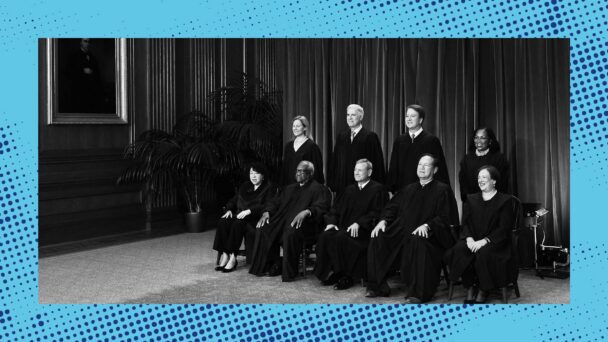
These articles came on the heels of Harvard Law professor Noah Feldman’s warning in Bloomberg that Democrats should not pursue Court expansion and other reforms he characterized as “aggressively partisan.” Before that, Manhattan Institute senior fellow James Piereson claimed in The Wall Street Journal that a Court expansion law enacted for “partisan” reasons would likely be “an unconstitutional assault on judicial independence and the separation of powers.”
These critics present proposals for Court reform as little more than an expression of petty party politics. As they tell it, Democrats want to change the Court’s composition just because they don’t like the Court’s decisions. They say precious little, however, about what the Court’s decisions actually are, much less why Democrats don’t like them.
This omission is critical. The Court has repeatedly struck down laws passed by Congress to allow people of color to participate equally in the political process. The Court has repeatedly empowered the president to ignore laws passed by Congress, including humanitarian laws that the administration violated for explicitly racist reasons. By facilitating race-based detention and deportation without trial, among many other horrors, the Court has repeatedly refused to enforce laws designed to protect fundamental rights and liberties.
Taken together, the Supreme Court’s decisions have adopted and entrenched a principle at odds with the Constitution: that some people are outside of the law’s protection while others are outside of the law’s constraints. Chiding proponents of Court reform for simply “disliking” or “disagreeing” with these decisions obscures the fact that with increasing frequency, the Court’s decisions are incompatible with a functioning democratic society. By abdicating its responsibility to apply the laws enacted by Congress, the Court is failing to act as a court at all.
By framing Supreme Court reform as a sore-loser solution to not getting one’s preferred outcome, critics imply that reform would undermine the Court’s integrity, and even democracy itself. In reality, the Court has undermined its own integrity, and the Court itself is putting democracy in danger. Reform is necessary to pull the country back from the brink.