Louisiana v. Callais, the Supreme Court’s recent party-line decision destroying what remained of the Voting Rights Act of 1965, is riddled with half-truths and whole lies.
Writing for the six-justice Republican majority, Justice Sam Alito announced that Section 2 of the VRA offers no protection to voters of color unless they show an “objective likelihood” of “intentional racial discrimination.” He insisted that the Court has “not overruled” its precedents, and failed to mention that, just three years ago, the Court reaffirmed that the VRA “turns on the presence of discriminatory effects, not discriminatory intent.”
Alito also claimed that the Court’s creation of an intent requirement is “the best reading of the statutory text,” and ensures that the VRA “does not intrude on States’ prerogative to draw districts based on nonracial factors.” He left out the fact that Congress explicitly amended the VRA in 1982 so that states couldn’t avoid liability for illegal racial gerrymanders by trotting out, in the words of the Senate Report that accompanied the amendments, a “non-racial rationalization.”
Perhaps the most significant lie comes in Alito’s rebuke of congressional maps that courts and legislatures create under the VRA as a remedy for racial gerrymanders. Although he acknowledged in the first sentence of Callais that Congress designed the Voting Rights Act “to enforce the Constitution,” he then claimed that creating new maps to restore the political power of targeted communities of color is “the very race-based discrimination that the Constitution forbids.”
The Constitution forbids no such thing. In simple, direct language, the Fifteenth Amendment establishes that citizens’ right to vote “shall not be denied or abridged” on account of “race, color, or previous condition of servitude.” And it says that Congress “shall have power” to enforce this prohibition “by appropriate legislation.” It is a concise yet capacious grant of authority to Congress to protect voters of color. By dramatically narrowing that power in Callais, the conservative justices did more than gut the Voting Rights Act. They posed an unmistakable threat to any future congressional effort to build a multiracial democracy, too.

As the Voting Rights Act was written by Congress, a policy violates Section 2 if it deprives people of color of an equal opportunity to “participate in the political process” and “elect representatives of their choice.” In order to determine whether a policy produces such discriminatory effects, Congress instructed courts to review “the totality of the circumstances.”
Callais scrapped both this effects test and the standard for assessing test results, with a three-part justification masquerading as constitutional analysis. First, without any basis in the text, Alito declared that the Fifteenth Amendment’s prohibition on racial discrimination “bars only state action motivated by a discriminatory purpose.” Second, Alito explained that legislation is “appropriate” to enforce that prohibition if there’s “a congruence and proportionality between the injury to be prevented or remedied and the means adopted to that end.”
Some form of means-ends analysis seems reasonable enough. But there is a large leap from there to step three, in which Alito concluded that a law that aims to enforce the Fifteenth Amendment by “prohibiting mere disparate impact” is “never appropriate,” because such a law goes beyond the “right that the Amendment secures,” and is instead “changing what the right is.”
Set aside, for now, the idea that the VRA’s ban on race-based voter discrimination—and Congress’s demand that courts conduct an exhaustive review of conditions demonstrating that the political process was not equally open to people of color—amounted to a prohibition of “mere disparate impact.” Callais says that Congress exceeds its authority under the Fifteenth Amendment—making any law protecting voters of color vulnerable to being struck down or completely rewritten—unless a law is precisely calibrated to solely address conduct that is so obviously racist that even Alito admits that it is intentional racial discrimination.
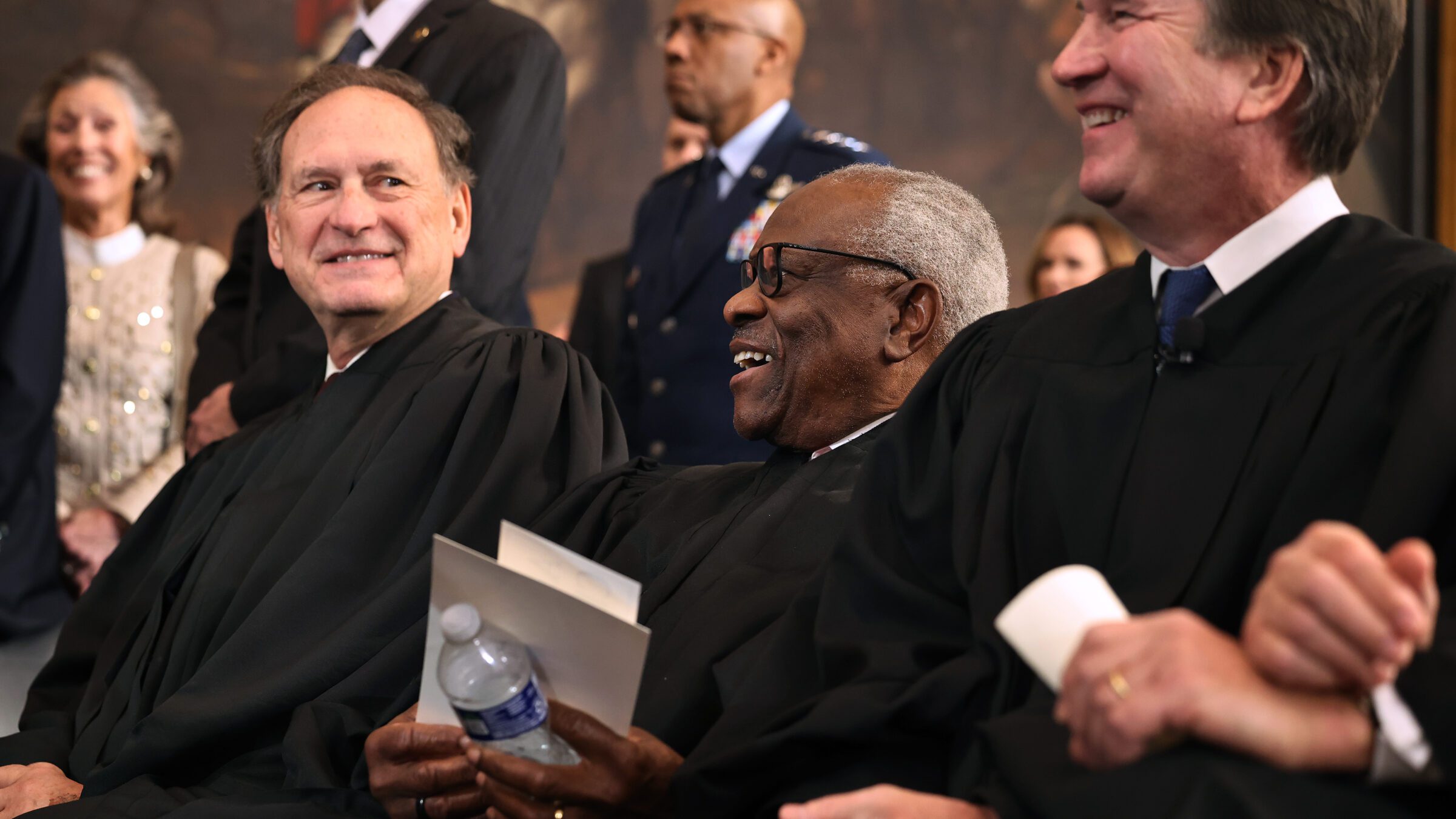
(Photo by Chip Somodevilla/Getty Images)
Present occupant of the White House excluded, most people have the good sense to not be racist on main. Furthermore, the Court is notoriously reluctant to identify even obvious bigotry as such. Politicians who intentionally discriminate can therefore easily evade a law that requires a showing of discriminatory intent. Consequently, if a legislature is trying to prevent intentional racial discrimination, or remedy the effects of such conduct where it has already occurred, it is reasonable for the legislature to pass a law broad enough to actually encompass the consequences of that conduct. Yet in Callais, the Court endorsed a cramped understanding of “appropriate” that forbids such legislative action.
Justice Elena Kagan described Callais’s restrictive standard as “unprecedented,” in a dissent joined by the other liberal justices. “The majority has conjured it out of thin air,” she said. Indeed, the Supreme Court recognized 60 years ago, in the earliest cases interpreting the VRA, that “appropriate legislation” under the Fifteenth Amendment gives Congress “the same broad powers expressed in the Necessary and Proper Clause.” So, Kagan wrote, “Congress has discretion to determine whether and what legislation is needed to secure the Amendment’s guarantees.”

Alito suggests that the VRA is not an appropriate way to enforce the Fifteenth Amendment because its prohibition on racial gerrymanders could block partisan gerrymanders, too, which he believes are constitutionally permissible. But it should not be hard to understand how a policy can still be congruent and proportional to an objective of preventing harm, even if it has the potential of occasionally preventing harmless conduct, too.
Examples of this principle abound in both law and daily life. A city, for instance, might set a speed limit at 40 miles per hour so drivers don’t get into deadly car accidents. Driving at 50 miles per hour would not necessarily cause death, but the city’s law is a rational way of regulating unsafe speed. My older sister doesn’t allow my 3-year-old niece to drink anything after 8 PM so she doesn’t wet the bed. My niece would not necessarily wet the bed if she had a glass of water at 8:01 PM, but my sister’s rule is still reasonably adapted to the desired goal. Callais’s redefinition of “appropriate” is thus a break with law and logic.
The Constitution confers broad power on Congress to prevent race-based denial or abridgement of the right to vote. Congress’s enactment of the Voting Rights Act was a plainly appropriate exercise of that constitutional authority. And the Republican justices’ rewriting of that Act was achievable only by rewriting the Constitution itself.
The danger of Callais, then, goes beyond the VRA, too. It was not enough for the Roberts Court to kill the crown jewel of the Civil Rights Movement. Callais hollows out the promise of the Fifteenth Amendment in order to ensure that no other civil rights law gets the chance to live.