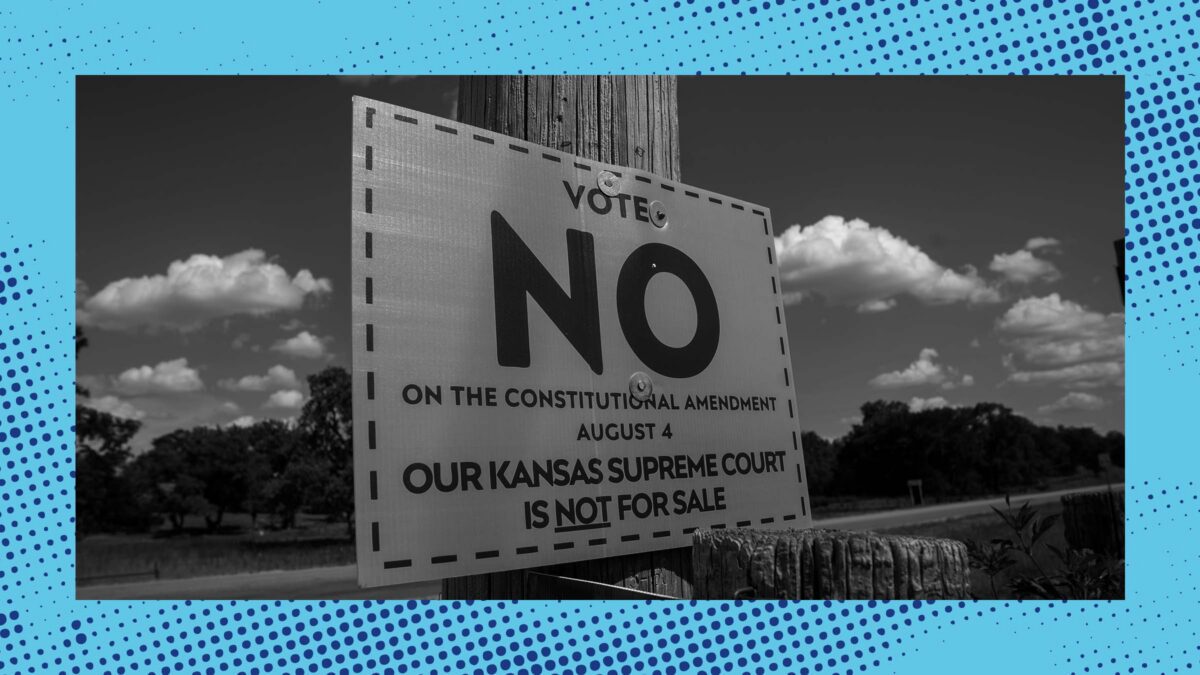
On Tuesday, voters in Kansas will decide whether to make a dramatic change to the process for filling vacancies on the Kansas Supreme Court. For the last 68 years, under state law, a nine-member bipartisan commission has assembled lists of three potential nominees for the governor to choose from. The commission consists of both lawyers and nonlawyers, and it is far more transparent than most systems in place for selecting high court judges: Its interviews of aspiring justices, for example, are livestreamed for the public.
This is a real problem for the state’s Republican culture warriors, who in recent years have become increasingly angry with the court’s decisions on, among other things, abortion access: Back in 2019, the Kansas Supreme Court issued a landmark opinion holding that the state constitution protects residents’ right to access abortion care. In response, the GOP-controlled legislature concocted the Kansas Elections for Supreme Court Justice Amendment, which is, as the name suggests, a constitutional amendment that would abolish the nominating commission and allow the legislature to institute partisan judicial elections instead.
Supporters of the amendment say it would return political power to the people: Voters, not “attorneys and political insiders,” they argue, should decide who sits on Kansas’s courts. What the amendment is really about is Republican politicians’ desire to restrict abortion rights, and their frustration with both the Kansas Supreme Court, for refusing to let them do so, and also with Kansas voters, who in 2022 ratified the Kansas Supreme Court’s decision by emphatically rejecting a GOP-backed anti-abortion constitutional amendment.
The legislature’s bet is that in a state that President Donald Trump won by 16 points in 2024, transforming state supreme court seats into explicitly partisan prizes—and infusing the judicial selection process with millions of dollars in dark-money spending—will yield a more conservative Kansas Supreme Court that will do what right-wing activists want.

Republican frustration with the Kansas Supreme Court’s insubordination reached its zenith seven years ago, when the court held in Hodes & Nauser v. Schmidt that abortion rights are protected by the Kansas Constitution’s guarantee of “inalienable natural rights.” In its opinion, the court emphasized its power to interpret the Kansas Constitution’s promises “independently of the manner in which federal courts interpret corresponding provisions of the United States Constitution.”
For reproductive rights advocates in the state, both the holding and its legal basis were huge. Only a year earlier, Justice Brett Kavanaugh’s confirmation to the U.S. Supreme Court had created a solid majority of five anti-abortion justices primed to overturn Roe v. Wade. The result in Hodes & Nauser v. Schmidt meant that even if Roe fell, Kansans’ abortion rights would remain safe from the conservative legal movement.
Almost immediately after the court decided Hodes & Nauser, Republican lawmakers began pushing to amend the Kansas constitution to explicitly state that it does not protect abortion rights. Eventually, they got a proposal on the ballot in the form of a referendum known as the “Value Them Both” Amendment, which went before voters in August 2022.
Their timing could not have been worse. In June, just two months before Kansans headed to the polls, the U.S. Supreme Court indeed overturned Roe in Dobbs v. Jackson Women’s Health Organization. (Kavanaugh indeed joined the five-justice majority.) Support for abortion rights spiked across the country, including in Kansas, where voters responded to Dobbs by turning out in record numbers to defeat the “Value Them Both” Amendment in an 18-point blowout.
Now, four years after failing to change voters’ minds on abortion rights, Republicans have pivoted to a new strategy: changing the composition of the court that protected those rights in the first place. One group that opposes the current amendment goes by “Vote No (Again) Kansas”—an attempt to remind voters that they already decided the substantive issue, and to urge them not to be fooled by anti-abortion politics repackaged as judicial selection reform.

Republicans, for their part, have not been shy about their motives. In 2022, then-attorney general candidate Kris Kobach called judicial elections “another path” to restricting abortion, and predicted that instituting them would allow conservatives to “slowly and quietly” overhaul the Kansas Supreme Court. In November 2025, gubernatorial candidate Ty Masterson told anti-abortion voters that supreme court elections were the “solution” they’d been waiting for, as long as they had the good sense to play it cool in public.
“You can’t go out there and say it,” Masterson said, according to the Marion County Record. “Because they’ll say that if you elect your Supreme Court, you won’t have any right to abortion anymore.”
To give you a sense of the stakes here, spending on the amendment—again, just on the question of whether to hold supreme court elections—has topped $12 million, per the Sunflower State Journal. Given that spending on the 2025 race for a single Wisconsin Supreme Court seat topped $100 million, $20 million of which came courtesy of the reactionary billionaire Elon Musk, it is a safe bet that if the amendment were to pass, the volume of anti-abortion money that would start pouring into Kansas would dwarf that $12 million figure in a hurry.
The amendment’s supporters love extolling the virtues of democratic accountability. But the democratic process has already yielded an unambiguous result: Kansans support their state supreme court’s decision to protect the right to abortion access, and overwhelmingly repudiated politicians’ (initial) hamfisted attempt to take it away. The legislature’s crusade for partisan supreme court elections is reactionary politics in its purest form. Republicans in Kansas do not actually care what voters want. They are upset about a policy choice that voters made, and want to reshape the legal system to shut them out of the process.