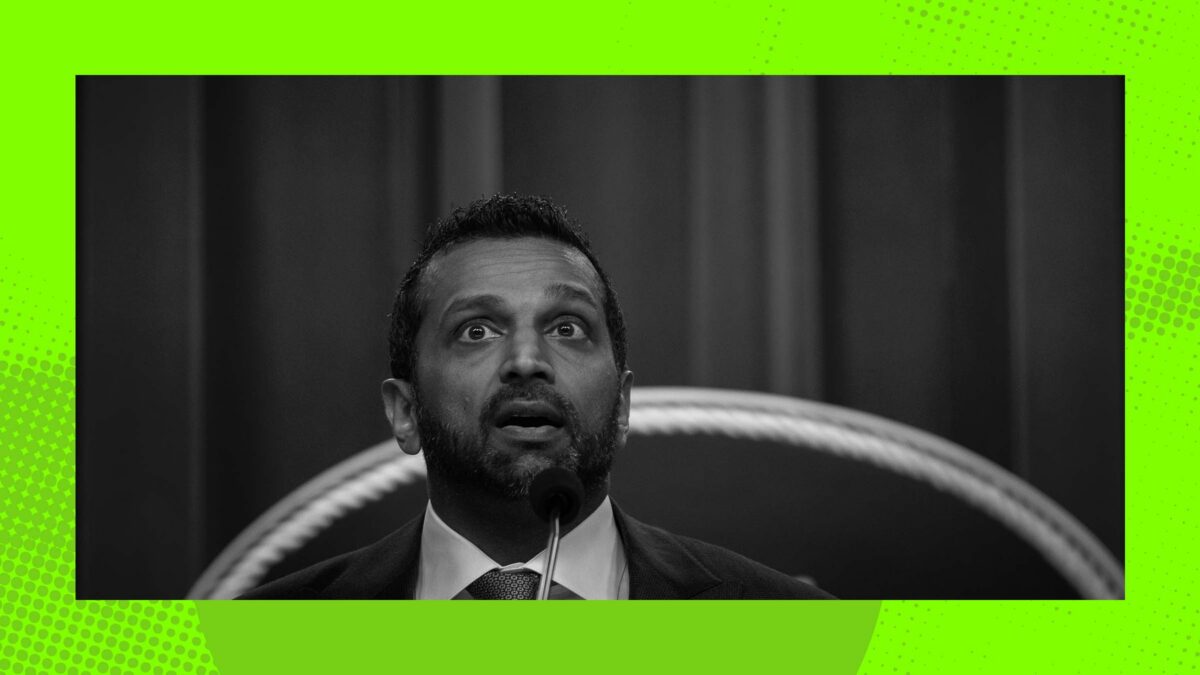
Kash Patel, the conservative podcaster whom President Donald Trump appointed as the director of the FBI in 2025, is currently suing The Atlantic for $250 million over its reporting that his predilection for drinking “to the point of obvious intoxication” has been a “recurring source of concern across the government.” In a lawsuit he filed in federal court on April 20, Patel characterized the article as a “sweeping, malicious, and defamatory hit piece.” In an interview on April 23, the writer, Sarah Fitzpatrick, said that in the days since The Atlantic published the story, she’d been “inundated” with new sources corroborating it.
As it turns out, Patel has a history of filing ambitious lawsuits against people who say things on the internet that make him upset. Back in 2023, he sued the blogger Jim Stewartson in federal district court in Patel’s home state of Nevada, alleging that Stewartson was “habitually” defaming Patel and other “prominent conservative figures” on social media and in his Substack newsletter. Among the statements from Stewartson that Patel alleged are part of this “smear campaign”: that Patel is a “Kremlin asset”; that Patel is a “traitor” and a “criminal”; and that Patel is a “blatantly incompetent chud.” (Please note the citation to Wiktionary.)
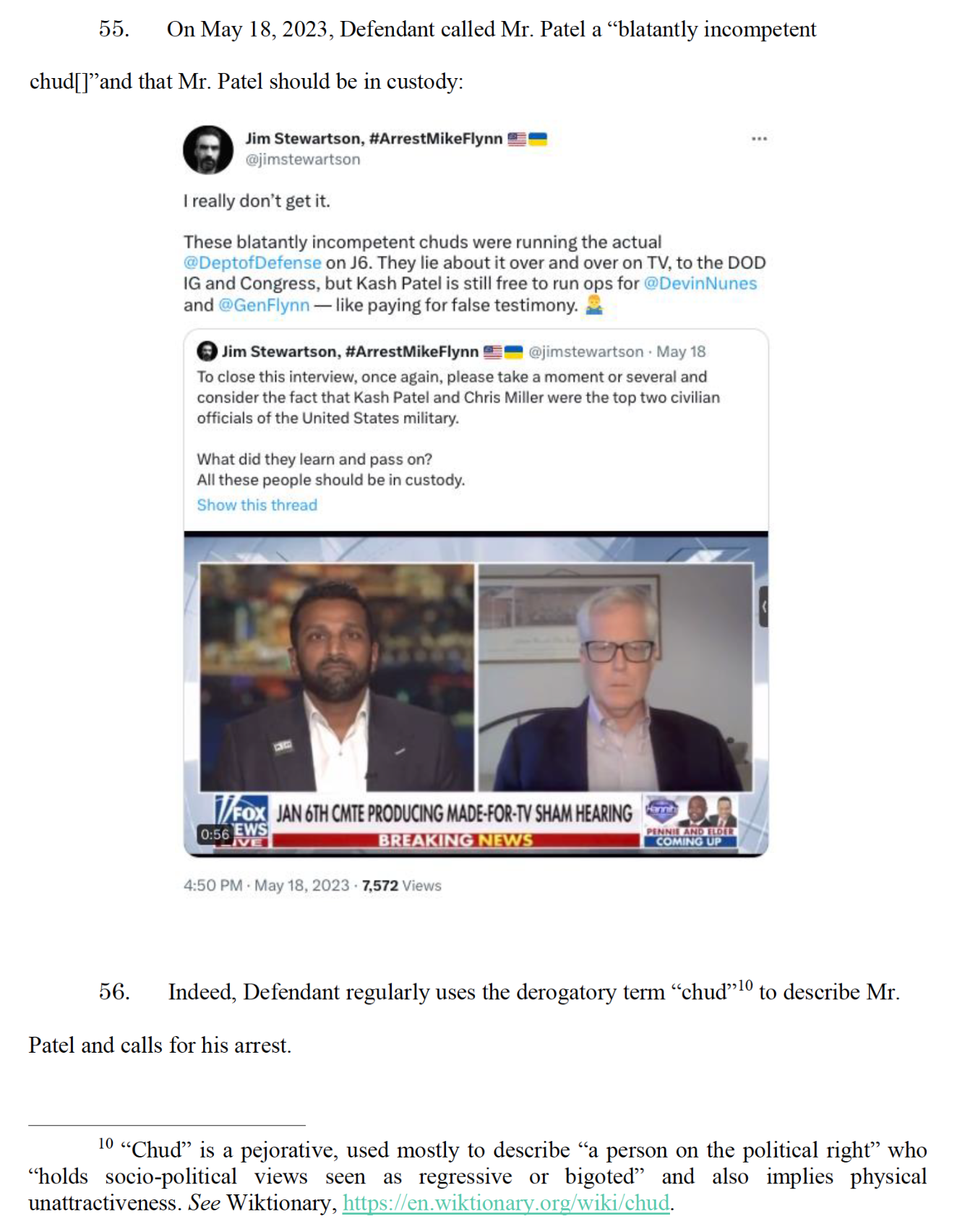
Stewartson, who lives in California, responded by doing the one thing you really, really should not do if you are sued in federal court, no matter how silly or baseless the case might be: He ignored it. As a result, in August 2025, Judge Andrew P. Gordon granted Patel’s motion for default judgment, effectively declaring Patel the winner by virtue of the fact that Stewartson did not show up. After reviewing the complaint and concluding that it provided “scant evidence” that Stewartson had actually harmed Patel, Gordon awarded Patel and his nonprofit organization a total of $250,000 in compensatory and punitive damages. This is much less than the $10 million Patel sought in his original complaint, but it is not nothing, either.
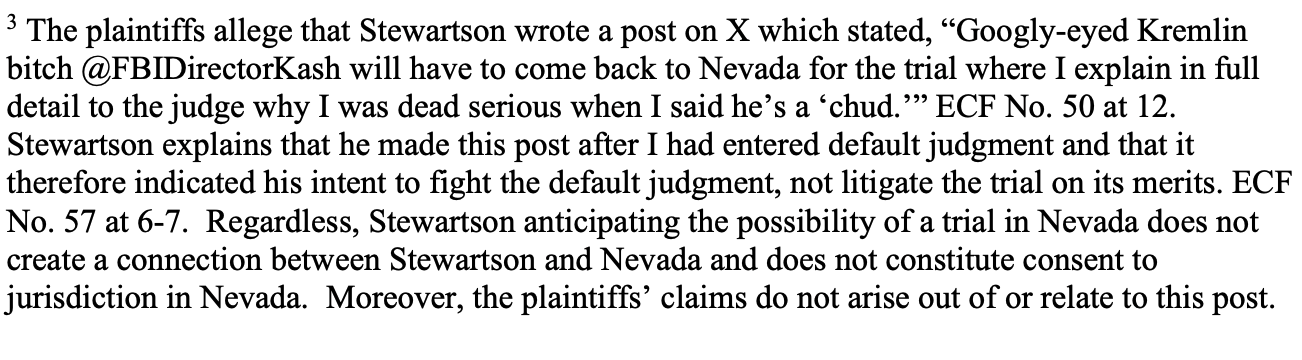
At this point, Stewartson sensibly decided to get involved—first by hopping on X to call Patel a “googly-eyed Kremlin bitch,” and then by hiring a lawyer, who in September 2025 filed a motion to dismiss the case and set aside the default judgment. But the bulk of Stewartson’s legal argument does not relate to the veracity of Stewartson’s assertions that Patel is, for example, a “traitor” who is “guilty of sedition” and “attempted to overthrow the government.” Instead, Stewartson contended that Nevada’s federal district court does not have “personal jurisdiction” over him, and that Gordon thus lacked the power to hear the case in the first place.
Personal jurisdiction, as any law student for whom the phrase “minimum contacts” still triggers a wave of mild nausea will tell you, is a concept grounded in the Constitution’s guarantee of due process, and just refers to a given court’s authority to bind a given party. Essentially, Stewartson contended that because he does not live in Nevada or do business in Nevada or have any meaningful connections to the state, it would not be fair to allow Patel, a Nevada resident, to drag Stewartson into a Nevada courtroom based on a couple of posts on X.
Earlier this week, Gordon agreed. In his order, he wrote that Stewartson’s use of a “generally accessible website” to make statements “aimed at the American body politic writ large,” rather than at Nevadans in particular, is just not enough for a Nevada court to get involved. Gordon pointed out that Stewartson has not visited Nevada since 2016, and highlighted Patel’s failure to allege that “even one Nevadan has subscribed to Stewartson’s Substack or podcast.” The inclusion of this fact is maybe a little rude to Stewartson, but given that it helped relieve him of a quarter-million dollars in legal liability, I suspect he will not be too upset about it.
From Gordon’s order:
Gordon does make clear that he is not entirely thrilled with the outcome: He criticized Stewartson for having “wasted the plaintiffs’ and the court’s time,” and wrote that if he had the discretion to require Stewartson to pay Patel’s attorney’s fees, he would have exercised it here, in light of Stewartson’s decision to spend two years functionally ignoring the lawsuit while also incessantly mocking Patel on social media for filing it. Fortunately for Stewartson, though, “being kind of annoying online” is not a prong of the test for when courts may require a party to foot the other party’s legal bills. As a result, Gordon voided the judgment in full.
Because Gordon’s ruling does not address the substance of Patel’s claims, the specific legal question of whether characterizing FBI Director Kash Patel as a “googly-eyed Kremlin bitch” is defamatory or mere rhetorical hyperbole protected by the First Amendment remains, for now, unresolved. As of this writing, Patel has yet to indicate whether he plans to sue Stewartson in a different, more appropriate forum. If he does so, and argues in a future legal filing that it would be objectively false to describe him as a “blatantly incompetent chud,” rest assured that I will be following up.