On Tuesday, a federal appeals court panel upheld West Virginia’s policy denying Medicaid coverage to people seeking surgical treatment for gender dysphoria. In a lawsuit, transgender patients had argued that the state’s exclusion of what it calls “transsexual surgery” from Medicaid-covered services violates their right to equal protection under the Fourteenth Amendment, as well as their rights under the Affordable Care Act and the Medicaid Act. But the Fourth Circuit declared in Anderson v. Crouch that the policy is not discriminatory, because it bans trans-specific healthcare for cisgender and transgender people alike.
“Whether West Virginia Medicaid patients receive coverage for medical services does not turn on their sex or transgender status,” wrote Judge Julius Richardson, joined by his fellow Trump appointee Allison Rushing, and Paul Niemeyer, who was appointed by President George H.W. Bush. “It classifies based on medical diagnosis and applies evenhandedly to everyone.”
“Everyone” does not get diagnosed with gender dysphoria, the medical term for psychological distress caused by incongruence between one’s gender assigned at birth and the gender one experiences or expresses. The Fourth Circuit insists that West Virginia did not single trans people out because it denies Medicaid coverage to all patients with gender dysphoria who want surgery to relieve their distress. Yet by definition, the only patients with gender dysphoria are trans.
The Fourth Circuit’s opinion displays a formalistic and abstract understanding of equality that is detached from the reality of discrimination, and lacks any appreciation for the substantive rights to which transgender people are entitled. West Virginia’s Medicaid program discriminates on the basis of transgender status by, for example, permitting a cisgender man concerned about excess breast tissue to get reimbursed for breast reduction surgery, but prohibiting a transgender man with gender dysphoria from doing the same.
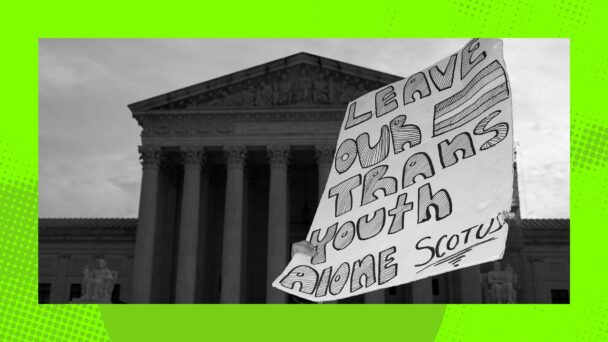
Medicaid, the nationwide health insurance program for low-income people, is used by 1 in 5 Americans and 1 in 3 West Virginians. And due to higher rates of poverty among transgender adults, they are roughly twice as likely as cisgender adults to rely on Medicaid as their primary source of health insurance. Gender-affirming medical interventions like surgery demonstrably improve mental health outcomes and reduce suicidality. West Virginia’s exclusion of gender-affirming surgery from Medicaid coverage is therefore a direct threat to the continued existence of trans people in the state. By declaring this policy constitutional, Anderson v. Crouch lends legal legitimacy to the eradication of trans people.
The three-judge panel’s reasoning broke sharply with recent Fourth Circuit precedent. Just two years ago, the full Fourth Circuit ruled 8-6 that West Virginia’s Medicaid program violated the Constitution, the Affordable Care Act, and the Medicaid Act. But last year, the Supreme Court vacated that ruling and remanded it for reconsideration in light of United States v. Skrmetti, the Court’s 2025 decision upholding Tennessee’s ban on gender-affirming care for transgender youth. As a result, three of the dissenting judges from the earlier Fourth Circuit case got the opportunity to repackage their losing arguments as the unanimous opinion in Anderson v. Crouch—and bolster it with dozens of citations to Skrmetti.
Just as the Supreme Court did in Skrmetti, the Fourth Circuit declared that laws banning healthcare for trans people have nothing to do with transgender status, and further reasoned that “if a State can reasonably ban it, of course a State can reasonably refuse to pay for it.” Chief Justice John Roberts claimed in Skrmetti that Tennessee’s law did not discriminate against trans people because it merely prohibited doctors from providing specified treatments “to minors for certain medical uses.” And to justify this willful obtuseness, he cited Geduldig v. Aiello, the Supreme Court’s 1974 decision holding that California did not discriminate on the basis of sex when it excluded pregnancy-related injuries and illnesses from its disability insurance program. Geduldig said that regulating a condition unique to one sex did not constitute a sex-based classification, and that the insurance program benefited all sexes equally.

Roberts neglected to mention that the legal academy, lower courts, and ultimately Congress all responded to Geduldig with anger and derision: Just four years later, lawmakers repudiated the Supreme Court’s ruling by passing the Pregnancy Discrimination Act of 1978, which made clear that discrimination because of pregnancy qualifies as sex discrimination under the Civil Rights Act. Between 1978 and 2020, the Supreme Court did not cite Geduldig in any equal protection decisions. And as the Court’s equal protection jurisprudence continued to evolve, scholars generally regarded Geduldig as superseded in practice, if not explicitly overturned.
Nevertheless, the Supreme Court is now rehabilitating the reasoning of Geduldig. And some federal appeals courts are following its lead. Reproducing Geduldig’s logic, the Fourth Circuit wrote in Anderson that West Virginia denies coverage “to everyone for certain services when sought to treat a given medical diagnosis.” Last year, the Eleventh Circuit similarly cited Skrmetti and contended, in a 7-5 en banc ruling, that a policy restricting healthcare coverage for gender-affirming surgery was not discriminatory under Title VII of the Civil Rights Act of 1964 because the exclusion applied universally. If the trans woman plaintiff “were instead a natal woman who wanted a female-to-male sex change,” the court reasoned, the insurance policy still wouldn’t pay for it.
Together, the revival of Geduldig and extensions of Skrmetti pose grave dangers to transgender people specifically, and to the very concept of equal protection under law. Federal courts are already moving from restricting the availability of gender-affirming care for minors to restricting the availability of gender-affirming care for adults. And they are creating a legal infrastructure built on ignoring the obvious that facilitates further harm to disfavored groups.