Last week’s ruling in Chiles v. Salazar, the Supreme Court’s case about “conversion therapy” in Colorado, lays bare the disturbing world that awaits us if we continue to let the First Amendment run amok. Conversion therapy, in which “therapists” attempt to change an individual’s sexual orientation or gender identity into something more “traditionally” cisgender or heterosexual, has long been discredited by mental health professionals as dangerous to patients.
Colorado largely banned the practice in 2019, but in 2022, a therapist named Kaley Chiles filed a pre-enforcement challenge to the law: Chiles, represented by the Alliance Defending Freedom, argued that the law violated her First Amendment rights, by limiting her abilities as a practicing Christian to counsel adults and minors who seek out her faith-inflected services.
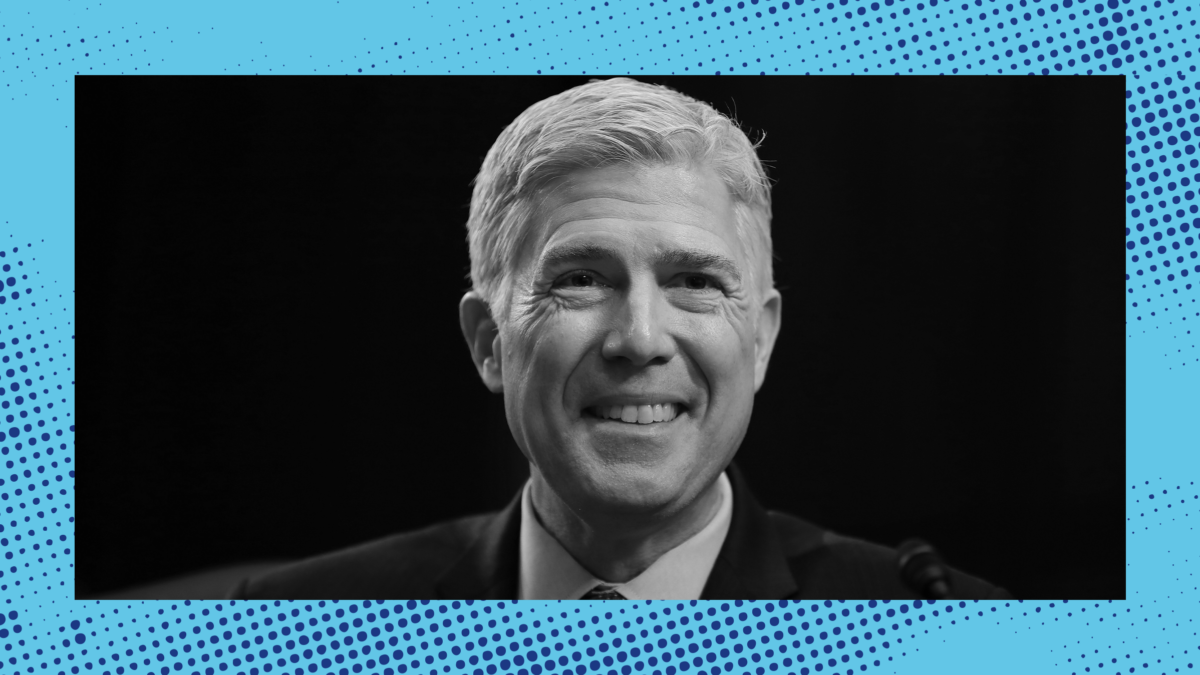
As it so often does when confronted with the claims of Christian petitioners seeking relief from antidiscrimination statutes, the Court agreed. Its opinion in Chiles strongly signals that the states that have banned conversion therapy have violated the First Amendment; in the words of Justice Neil Gorsuch, who penned the majority opinion, Colorado’s law “trains directly on the content of [Chiles’] speech and permits her to express some viewpoints but not others.”
Because the case will now return to the lower courts to analyze the law under strict scrutiny, as commanded by Gorsuch’s opinion, Colorado faces a tough road, as strict scrutiny is the most difficult test for the government to satisfy in constitutional law. What’s at risk, as Justice Ketanji Brown Jackson’s dissenting opinion notes, is not just this one Colorado law, but rather an entire regulatory system now implicated by the formalist, brittle logic of this Court’s vision of a deregulatory First Amendment.

Gorsuch’s opinion won’t surprise anyone who listened to the Chiles arguments last fall, in which several justices expressed skepticism of the law’s constitutionality. The Court’s precedents make it quite difficult for states to regulate anything that might be characterized as First Amendment-covered speech (including, apparently, talk therapy). In other words, once Kaley Chiles got the Court to agree that Colorado was encroaching on her speech, she’d effectively won.
Gorsuch’s opinion rather gleefully dismisses the arguments proffered by Colorado as something akin to a “word game.” According to Gorsuch, it’s foolish to characterize the law as merely regulating the conduct of mental health professionals, which is how Colorado justified the law. Because the law targets the words that Chiles wants to utter, the majority prefers to frame the law as a speech restriction, rather than a law that regulates conversion therapy.
Jackson’s dissent sets forth how the Colorado law resembles a Pennsylvania informed consent statute regarding abortion, which the Court upheld in Planned Parenthood v. Casey in 1992. In Casey, a First Amendment challenge by doctors to Pennsylvania’s informed consent requirements failed because it only restricted the doctors’ speech as part of the practice of medicine. Jackson would characterize the Colorado law as akin to the law in Casey; Gorsuch instead frames it as silencing “a viewpoint [Chiles] wishes to express.”
Gorsuch also thinks it’s misguided to designate a category of “professional speech” outside of traditional First Amendment protections. The Court had previously pooh-poohed this argument in NIFLA v. Becerra, a 2018 case striking down California regulations of crisis pregnancy centers that required such centers to inform pregnant women about the availability of state services. NIFLA denied the existence of a “professional speech” category in which the state might have more freedom to regulate speech, and Chiles reiterates that holding. Jackson’s dissent attempts to contextualize NIFLA alongside Casey—a move that Gorsuch dismisses.
Having dispatched Colorado’s arguments and Jackson’s framework, the majority closes by confidently comparing Colorado’s conversion therapy regulation to the laws passed by “censorious governments throughout history.” Apparently, counseling queer kids that they should compartmentalize their feelings and act straight, no matter the cost, is just like writing The Prison Notebooks.
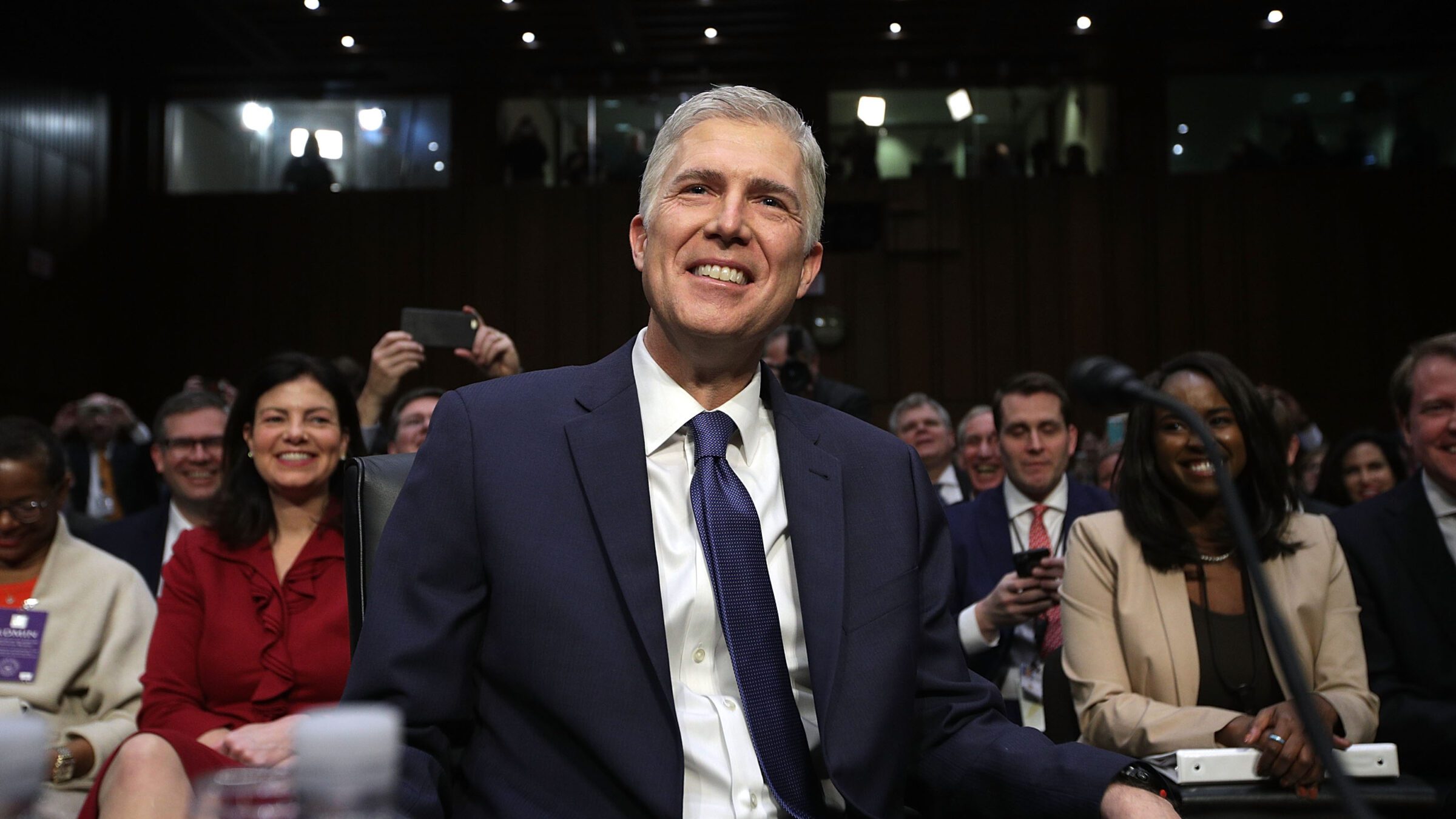
(Photo by Alex Wong/Getty Images)
But, in my view, the real failure of the Supreme Court remains the entire doctrinal edifice surrounding professional speech and health care, which allows states to mandate that doctors describe the “risks” of abortion (Casey) but prevents them from requiring crisis pregnancy centers to disclose that state-run centers provide abortion care (NIFLA).
Take a step back: What exactly are we doing here? I suspect that most non-lawyers would think of the licensure and regulation of professional service providers as falling far outside anything the First Amendment would protect, for the same reasons that states can regulate things that rely upon words but don’t constitute First Amendment-protected speech (like perjury or fraud). But as Jackson’s dissent observes, the majority completely ignores the context in which Colorado enacted its law: the regulation of health care professionals like Kaley Chiles.
States have rules about this in order to keep residents safe—for example, requiring medical providers to state the risks of a certain course of treatment, or to obtain their patients’ informed consent. If a doctor tells you to take arsenic to treat your allergies, they can’t rely on the First Amendment as a defense. By continuing to deny the existence of something like professional speech, the Court recommits to its convoluted and rigid approach to free speech, in which “things that use words” almost certainly trigger the First Amendment and its hostility towards regulations of speech, absent any larger framework.

Justices Elena Kagan and Sonia Sotomayor joined the majority in this case, but wrote a concurrence that seems intended to help Colorado save its law when the lower courts reexamine it. My colleague Mike Dorf observed the potential upside of this approach, which might similarly prevent a conservative state from banning gender-affirming talk therapies for trans youth.
But the concurrence buys into the larger First Amendment structure that the majority employs, without critiquing the lack of rationality of the doctrine as a whole: Effectively, the concurrence argues that Colorado’s law is particularly bad, because it discriminates against a certain viewpoint, but that maybe a better law regulating conversion therapy could work. I think this is quite unlikely to work even if a state could come up with such a law, given that laws that discriminate on the basis of content still trigger strict scrutiny.
Why try to save this Court’s First Amendment, in which challengers who can persuade judges that a law targets their speech will almost always prevail—even if their claims are tenuous, or if states have good reasons for enacting them? Kagan and Sotomayor assume that a majority of this Court would cite Chiles in a hypothetical red-state law banning gender-affirming talk therapy as a viewpoint-based restriction of speech. Given this Court’s willingness to engage in “heads I win, tails you lose” reasoning, I’m less confident that Chiles has any upside.
Jackson’s framework for how to analyze the Colorado law—as speech incident to regulations of professional conduct—provides a stronger, more consistent, and democratic approach to professional speech. She explicitly raises the core issue that Gorsuch omits: that the “speech” Colorado tried to prevent is medically discredited and dangerous to children. By framing Chiles as more about the big bad state trying to trample on Kaley Chiles’s First Amendment rights rather than protecting kids from harming themselves, Gorsuch stacks the deck.
Jackson’s dissent indicates the limits of relying upon First Amendment precedents to grapple with contemporary problems that states try to regulate. The Court’s whipsawing among different approaches and justifications demonstrates why the current approach to free speech doesn’t work. The Chiles majority fails to properly reconcile its precedents in a quest to achieve its policy goals. The Court may think it’s taking a brave stance against governmental orthodoxy against disfavored speech like conversion therapy, but Chiles ultimately shows how willing the Court is to manipulate its cases to get what it wants.