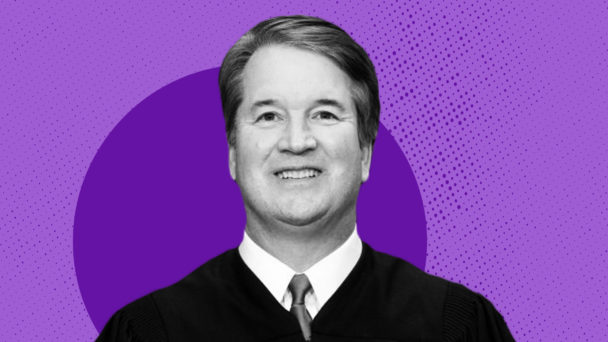
In March, Justice Amy Coney Barrett gave a talk at the Library of Congress in which she urged Americans to take responsibility for upholding the rule of law and legal institutions. “Respect for the law, reverence for the Constitution, really begins with American citizens,” she said.
As a law professor who teaches constitutional law, I want to respect the law and the Court. And as a transgender woman, I want to believe that the law and the Court protect everyone, including people like me.
But respect is earned. If Barrett wants Americans to respect the law and legal institutions, the best thing the Court can do is sustain the rule of law and basic principles of justice. Earning Americans’ respect also means living in the real world, where facts matter, and not falling for obvious lies.
Too often, the Court has willingly embraced falsehoods urged on it by parties making excuses for bigotry. Trans kids are the latest victims of that weaponized gullibility.
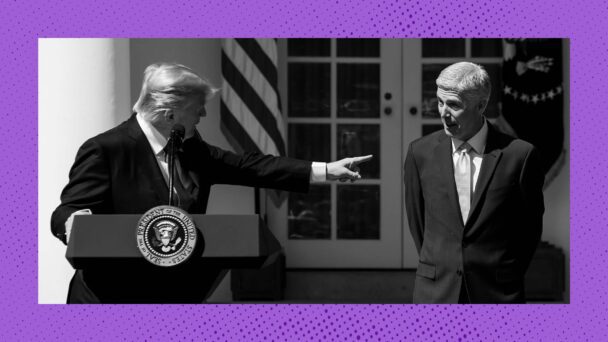
Last year, in United States v. Skrmetti, the Court allowed Tennessee to ban gender-affirming care for minors. The law’s structure shows that the Republican lawmakers who passed it were motivated by bigotry against trans people, not medical concerns: Under the statute, cisgender minors could get the exact same medications and treatments that were banned for trans kids. And the law itself admitted that one of its purposes was “encouraging minors to appreciate their sex.”
But in his majority opinion, Chief Justice John Roberts wrote that the law “does not exclude any individual from medical treatments on the basis of transgender status but rather removes one set of diagnoses—gender dysphoria, gender identity disorder, and gender incongruence—from the range of treatable conditions.”
As a law professor, I split hairs for a living. But this is absurd: The Court’s argument is that the law is not discriminating against trans people, but is just prohibiting treatment for the specific conditions that only trans people suffer from.
As if this pretense wasn’t enough, Barrett wrote a separate concurring opinion to explain that anti-trans laws shouldn’t be viewed with any special skepticism because the United States has no history of anti-trans discrimination. It’s heartbreaking that Supreme Court justices, with some of the best legal staff and resources in the country, are apparently denied access to Google.

(Photo by Tom Williams-Pool/Getty Images)
Now the Court is about to do it again. In two pending cases, the Court will rule on state laws that prohibit trans women and girls from competing on school sports teams. Once again, the Court will have to decide whether to ignore the fact that, as the journalist Erin Reed and others have documented, the anti-trans movement in this country has targeted trans sports bans as part of a carefully structured campaign against trans people. Terry Schilling, president of the American Principles Project and a leader in the anti-trans movement, has been cheerfully open about this: “The women’s sports issue was really the beginning point in helping expose all this because what it did was, it got opponents of the LGBT movement comfortable with talking about transgender issues,” she said.
In the pending cases, Idaho and West Virginia defended their exclusion of trans girls with claims that science shows trans girls to have advantages over cisgender girls. In fact, the science is hardly clear that trans girls have any biological advantage: Studies show that trans athletes have no observable differences in upper or lower body strength or other measures of fitness, and hormones and puberty blockers seem to take away whatever advantage might have existed. On the other hand, there’s good evidence that allowing trans kids to play sports has real benefits for participants, as it can reduce psychological distress, self-harm, suicidal thoughts, and suicidal behavior.
But arguments about science won’t change anything, because the massive, well-funded campaign against trans athletes isn’t motivated by science. If you’re not sure, consider that the same people pitching trans sports bans have claimed that trans women have a “biological advantage” at darts, fishing, and chess. When West Virginia passed its ban, its governor couldn’t name a single trans athlete in his state. But the Supreme Court seems determined to pretend that these bans are about sports, rather than fear of trans people being themselves.
This pattern—the Court’s willingness to accept implausible justifications for discriminatory policies—is not new. In 1944, the Court in Korematsu v. United States upheld a military order that forcibly removed more than 100,000 people of Japanese ancestry from the West Coast and forced them to live in internment camps. Of the many things wrong with the decision, one is the Court’s willingness to believe lies about minority groups, weaponizing its own gullibility to support a bigoted policy. A dissenting justice in Korematsu pointed out that the government had failed to support its claim that race-based internment was a military necessity. But the majority took the government at its word, accepting the contention that there were “disloyal members of that population, whose number and strength could not be precisely and quickly ascertained.”
The government was lying—knowingly. In the 1980s, litigation by the petitioner, Fred Korematsu, and others revealed that government officials altered documents to make the Supreme Court think Japanese-Americans had been secretly transmitting radio signals—a claim the officials knew to be false. There was no evidence of Japanese-Americans’ disloyalty. In fact, the policy was based on military leaders’ racist view that people of Japanese ancestry couldn’t be trusted. In 2011, years after the lies had been exposed, the Justice Department finally admitted that it had deliberately deceived the Court.

Fred Korematsu (left) at a press conference announcing his lawsuit against the federal government, January 1983 (Bettmann/Getty Images)
The Supreme Court has said that it considers Korematsu overruled. But it continues to repeat one of Korematsu’s fundamental mistakes: giving the benefit of the doubt to policies that are openly motivated by bigotry. When President Donald Trump took office in 2017, he signed an executive order banning people from Muslim-majority countries from entering the United States. Trump had been supremely clear about the reasons for this policy: On the campaign trail, he had said that “Islam hates us,” and the 2017 ban was a codification of his 2015 call for “a total and complete shutdown of Muslims entering the United States.”
The Muslim ban was challenged in court, and two years later in its decision in Trump v. Hawaii, the Supreme Court acknowledged that the president is not allowed to adopt a policy “for the unconstitutional purpose of excluding Muslims.” But government lawyers had claimed that there were national security justifications for the policy—specifically, that the targeted countries didn’t adequately participate in screening procedures. Trump made the lawyers’ job harder by merrily admitting to reporters that this wasn’t the real reason for the policy, saying that the ban “should be far larger, tougher, and more specific,” but “stupidly that would not be politically correct.”
Even so, in Trump v. Hawaii, the Supreme Court declined “to probe the sincerity of the stated justifications for the policy.” Regardless of what the president had said about his reasons, the justices decided to treat the travel ban like a genuine national security policy.
Lastly, in 2018, the Court allowed Indiana to require photo ID at polling places, in part because of concerns about people showing up at polls pretending to be other people. In-person voter fraud is essentially a myth, a conspiracy theory invoked to justify requirements that inevitably disenfranchise people of color. One of the opinions in the case, Crawford v. Marion County Election Board, even acknowledged that there had been zero cases of in-person voter fraud in the state’s history. Nonetheless, six justices treated the policy as if it were motivated by real concerns, rather than a desire to suppress votes.
Across these cases, a consistent dynamic emerges: The Court declines to interrogate obvious contradictions between stated justifications and underlying motives—and in doing so, enables discrimination to persist under the guise of neutral legal process.
I want to teach my students that the Court is worth respecting. But too often, the Court hasn’t earned that respect. I want to tell my fellow trans people that the Constitution’s promises protect them as much as anyone else. But when the Court won’t afford them the decency of acknowledging that bigotry against trans people is real, I can only tell them to give the Court the amount of respect it deserves.