This article was published in partnership with Slate.
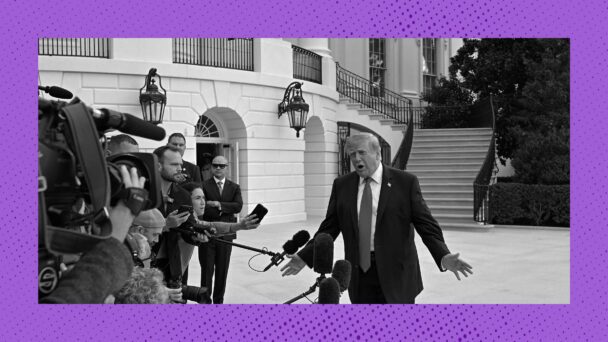
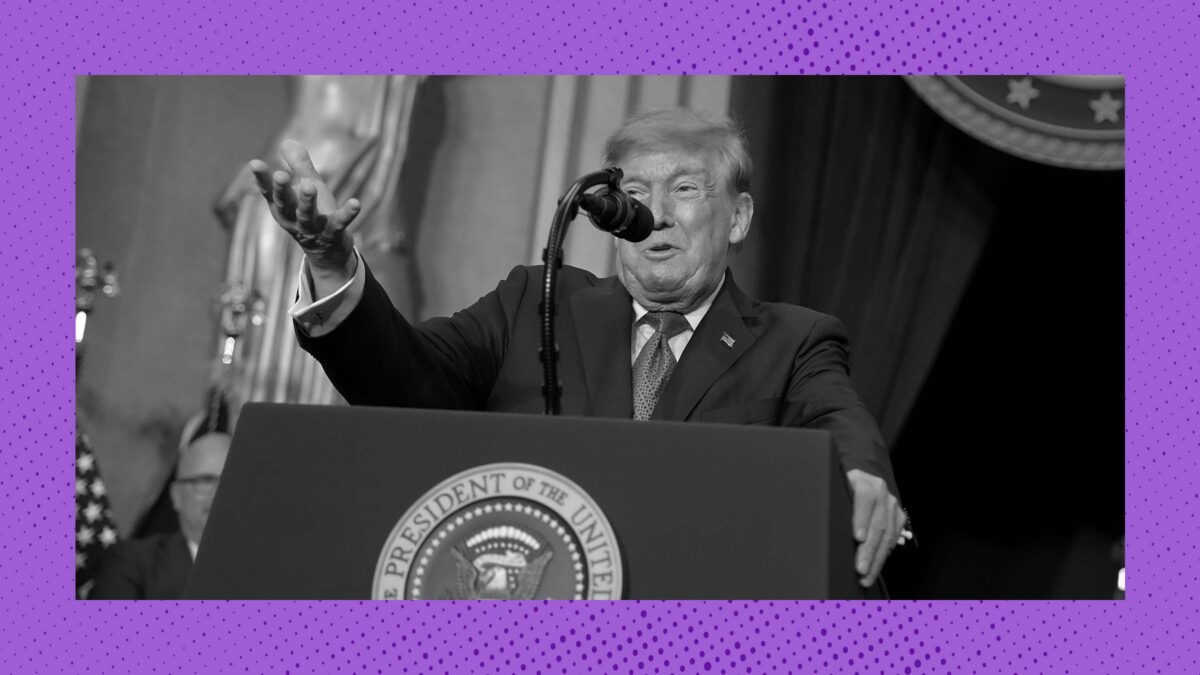
On Thursday, a federal district judge in Florida allowed parts of President Donald Trump’s $15 billion defamation lawsuit against the New York Times and Penguin Random House to move forward, denying a request from the newspaper and book publishing company to dismiss Trump’s case in full.
The court’s order in Trump v. New York Times reflects a dramatic reversal of fortune for Trump: Back in September 2025, when the president initially filed this lawsuit against the Times and Random House, Judge Steven Merryday struck the complaint in its entirety, calling its allegations “tedious,” “enervating,” and “decidedly improper and impermissible.” Last week, however, Merryday concluded that the allegations in Trump’s amended complaint “quite plausibly” and “reasonably” create an inference that the Times and Random House defamed Trump.
The about-face raises an obvious question: “What changed?” And the answer is: “Honestly, not much.”
In the earlier order, Merryday noted that Trump’s original complaint “consume[d] eighty-five pages,” even though it alleged “only two simple counts of defamation.” Trump’s later complaint was lightly trimmed around the edges, and hit 62 pages.
Merryday criticized the original complaint’s repeated references to Trump’s “historic” victories in the 2016 and 2024 presidential elections, allegedly achieved in spite of the Times’ “persistent election interference.” Trump’s later complaint limited its extraneous accusations of election interference to one paragraph.
Merryday pilloried the original complaint’s “repetitive” and “superfluous” praise for the president. Trump’s later complaint lauded the president’s “business acumen” a mere three times and his “charisma” only twice, and managed to leave out the original complaint’s references to Trump’s “genius” and “singular brilliance.”
Basically, Trump’s later filing showed minor revisions to the complaint’s style. But it showed no meaningful changes to the complaint’s substance. And the legal standard for public officials to win a defamation lawsuit is famously high. Trump’s legal argument didn’t get any more meritorious between September 2025, when Merryday gave Trump’s complaint the boot, and November 2026, when Merryday permitted Trump’s case to proceed. Yet Merryday was perfectly willing to help Trump overhaul defamation law, so long as Trump made his complaint slightly less annoying to read.
Trump’s lawsuit arises out of the president’s dissatisfaction with a couple of articles published in the Times, as well as a book titled Lucky Loser, which was co-authored by Times journalists and published by Random House. Both the book and the articles in question discussed Trump’s many alleged financial crimes, and were published shortly before the 2024 presidential election. Trump alleges that several statements in the articles and the book wrongly disparage his “hard-earned” reputation as a “successful businessman,” and contends that he is entitled to billions of dollars in compensation for “tarnishing” his purportedly good name.
Under the Supreme Court’s landmark 1964 decision New York Times v. Sullivan, public officials cannot win financial awards for defamation unless the statement was made with “actual malice.” In the legal context, that means the speaker needed to actually know that the statement was false, or act with “reckless disregard” as to whether it was true or not. Merryday’s own opinion calls this standard “formidable,” and recounts at length all the reasons why Trump’s lawsuit should fail, before bewilderingly allowing it to move forward.
Quoting heavily from the Times’s brief—and decades of binding precedent—Merryday acknowledged that a public official can’t show “actual malice” if the statements at issue were “reasonably supported by numerous prior reports” in reputable news media. Merryday also recognized that a public official can’t establish actual malice just because the speaker failed to fully “investigate” their claims, or chose not to consult witnesses who “could have refuted the allegedly defamatory statements.” And Merryday noted, in this case, that the authors of the published statements did, in fact, investigate their claims and consult numerous experts who told them that Trump’s conduct was “highly suspicious” and “could constitute a crime.”
In short, Merryday carefully recounted the Sullivan standard and showed why Trump’s case should be dismissed. Then he inexplicably substituted Sullivan’s standard with his own and decided that Trump’s case could proceed.
According to Merryday, the expert guidance that the Times journalists sought and received was “far from a formal legal opinion,” and insufficient to “remove serious doubt about the truthfulness and accuracy” of their statements. Merryday also stressed that the journalists accused Trump of “complex” crimes, and claimed that “only a relatively small cohort of specialized practitioners” can competently determine whether someone has committed such a violation.
Ultimately, Merryday suggested that some crimes are so complicated, accusing someone of them may be inherently defamatory. In his view, anyone who publishes a claim that someone committed a crime of a “complex nature,” and does so without receiving “an explicit opinion from a qualified source after a thorough examination of pertinent facts,” must “necessarily” know that their statements are probably false. Put another way, any publisher who doesn’t do their research to Merryday’s liking opens themselves up to a defamation lawsuit.
Merryday’s opinion radically departs from the careful balance struck in Sullivan between protecting people’s reputations from published false statements, and protecting people’s First Amendment right to criticize public officials. And in doing so, Merryday puts Americans at risk of the precise kind of harm that Sullivan sought to prevent. Before Sullivan, segregationist government officials regularly used expensive defamation lawsuits as a way to sue newspapers into silence and suppress their coverage of racial injustice. Today, Trump is similarly wielding defamation lawsuits to shut down coverage of news he would prefer goes unreported, and make people pay for free speech.
Trump sued the Wall Street Journal for $10 billion, for example, because it reported on Trump’s lewd birthday card to child sex trafficker Jeffrey Epstein. Trump also sued the BBC, for reporting on his role in the January 6 attack on the Capitol, and CNN, for reporting on his false claims about the 2020 presidential election, and ABC, for reporting on his sexual assault of E. Jean Carroll, and more.
Trump is deploying these same intimidation tactics against the New York Times and Random House. And Merryday was right to reject them last year as lawless clownery. But his latest opinion suggests that he is happy to legitimize lawlessness if Trump can just make his filings a little less clownish. For Merryday, assaulting the First Amendment is a forgivable offense. Bad writing is not.