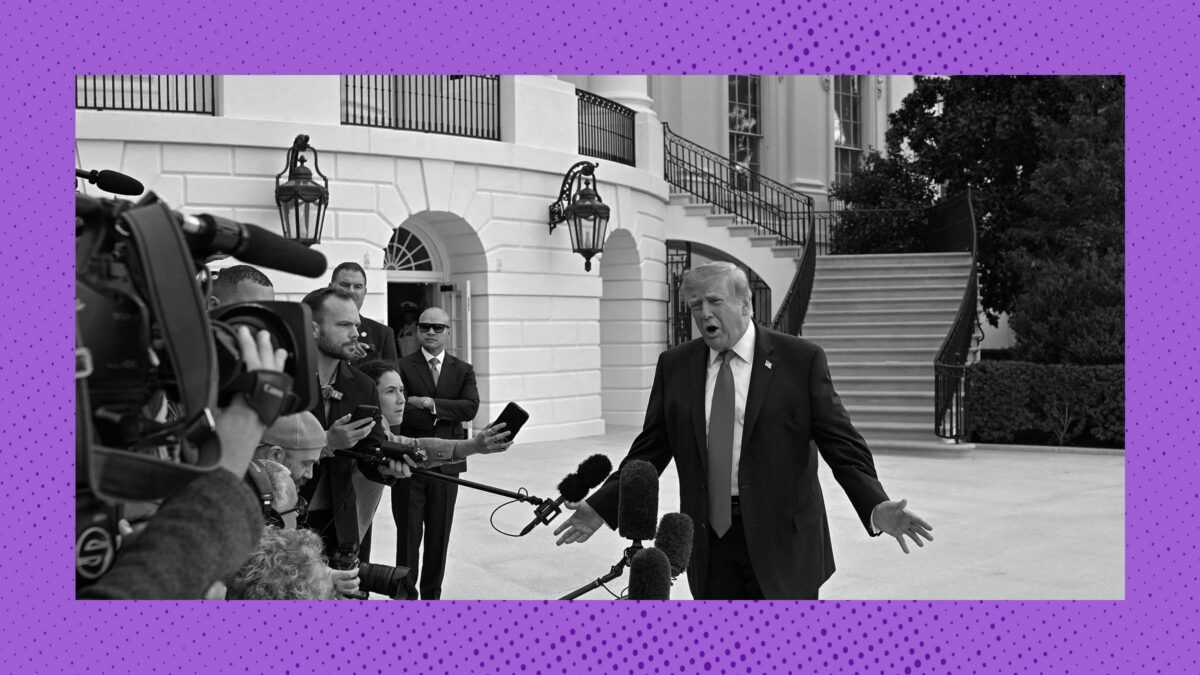
Last week, the Trump administration attempted to block journalists from Politico, CNN, and MS NOW from the White House, citing “national security” concerns. It did not succeed: Judge Timothy Kelly, a Trump appointee to the federal district court in Washington, D.C., issued a temporary restraining order that restored those outlets’ access after about 12 hours.
But that victory in court represents only a piece of the larger story about the Trump administration’s vendetta against the press. No matter how many judges rule in favor of the media organizations, the administration has proven it won’t stop attacking those who try to bring its lawlessness, corruption, and bullying to light. Its purpose in doing so is to create an environment in which journalists feel besieged and thus less likely to investigate the government. And the administration has largely succeeded in creating that environment, even with its many losses in court.
The litigation between the White House and the media organizations shows how frequently the administration uses “national security” as a magic phrase to justify its actions. No one actually believes these outlets endangered national security with their reporting; instead, the White House tried to ban outlets it dislikes. Trump said as much when he announced the ban, posting on Truth Social that these outlets “constantly write or report fiction or lies.” Most administrations dislike the scrutiny of the news media, but never before has a president taken such drastic steps to clamp down on reporting.
The affected outlets quickly filed a lawsuit in federal court, alleging that the administration had violated their constitutional rights in two ways. First, they said, by arbitrarily revoking the passes without notice or any opportunity to be heard, the White House had infringed on their due process rights as protected by the Fifth Amendment. And second, by deciding to revoke credentials based on the perspectives taken by the media organizations, the White House violated the First Amendment’s ban on viewpoint discrimination.
The media organizations had a very forceful case. Multiple decisions from the U.S. Court of Appeals for the District of Columbia Circuit dating back almost fifty years have established the process a president must follow to constitutionally revoke a “hard pass,” and revoking badge access without warning does not suffice. In his opinion granting the requested restraining order, Kelly held that the Trump administration had not complied with due process requirements. He did not rule on the First Amendment claims, in large part because the administration’s procedural sloppiness made it an easy case.
Even if the White House had satisfied constitutional due process requirements, though, the media organizations had strong First Amendment arguments in their favor. Some government spaces, like public parks or sidewalks, constitute public forums in which the government cannot make decisions based on content—for example, allowing rallies for charities but not for political parties. In nonpublic forums like the White House briefing room, the government can make content-based decisions about access—for example, allowing news media organizations but preventing access by the general public. But it cannot make viewpoint-based decisions. In other words, viewpoint discrimination is never permissible, even in nonpublic forums where the government has more power to constitutionally limit access.
In this case, Trump’s complaints about “fake news” make it pretty obvious that the White House sought to ban specific news outlets because of the viewpoint of their coverage. It is almost always impossible under the First Amendment to ban some speakers but not others just because the government doesn’t like what some speakers are saying.
Because viewpoint discrimination is treated as the most offensive type of government regulation of speech, the White House had to invoke “national security” to try to explain its actions. But even though national security often functions as a free pass for administrations asking judges for permission to do things that would never fly in another setting, it made little sense in this instance. Kelly said as much in granting the temporary restraining order, dryly observing that “nothing in the record…suggests that the revocation of Plaintiffs’ hard passes was motivated by national security concerns,” and noting Trump’s myopic focus on “the alleged lack of truthfulness and negativity of Plaintiffs’ reporting.” Donald Trump opening his mouth to tell the truth made it impossible for his lawyers to depict the government’s actions as something lawful.
Though the press prevailed in this case, Trump and his administration’s actions have real consequences. Litigation may slow or even stop some of what the administration is trying to do, but lawsuits can’t repair the weakened political and social environment created by a president and executive branch committed to constantly undermining First Amendment values. And when the press becomes the story, it makes it harder for the public to see coverage of the government’s failures. A public distracted by a press freedom dispute, rather than reading about the administration’s latest corrupt actions, is exactly what Trump wants.