
President Donald Trump’s ambitious efforts to pack the federal courts with judges who are loyal to him above all else is running headlong into the simple fact that there just aren’t that many vacancies left to fill. There are no more appellate court vacancies without nominees. Many district court vacancies are in states represented by Democratic senators, who, under the Senate Judiciary Committee’s blue slip policy, would have to approve any potential replacements. And the Senate calendar is already beginning to narrow the administration’s options.
That reality helps explain Trump’s latest nominees. Rather than rolling the dice on younger, more extreme lawyers, Trump chose two sitting district judges—Daniel Traynor and Daniel Domenico—for elevation to appeals court judgeships. Both have established themselves as dependable conservatives willing to side with religious employers, undermine reproductive rights, and advance the broader legal priorities of Trump’s Republican Party.
More importantly, both already survived Senate confirmation once, which is precisely the point. Trump does not need auditions anymore. He needs reliable votes on the courts of appeals—and he needs them quickly.
Vacancies
In the last month, three district judges—Alan Albright of the Western District of Texas, Thomas Rice of the Eastern District of Washington, and Josephine Staton of the Central District of California—have decided to either retire or assume senior status, a form of semi-retirement that allows the president to select a full-time replacement. Albright was appointed by Trump just eight years ago in 2018, and apparently dislikes the job so much that he’s stepping down in August. As reported by Bloomberg, Albright has also largely stopped doing the job in the meantime: His docket accounts for 70 percent of civil cases pending in his district for the last three years, as well as 63 percent of undecided civil motions in the last six months—more than twice the number of outstanding civil motions of any other district judge within the Fifth Circuit. Best of luck to Albright’s colleagues in cleaning up his mess.
Since Albright sits in a state with two Republican senators, Trump should have little trouble replacing him. But both Staton and Rice, who were appointed by President Barack Obama in 2010 and 2012, respectively, sit in states with two Democratic senators, who can effectively veto potential nominees by withholding their blue slips.

Nominees
On May 11, Trump announced nominees to the remaining two appeals court vacancies: Traynor, a North Dakota district court judge, to the Eighth Circuit, and Domenico, a Colorado district court judge, to the Tenth Circuit.
Traynor was appointed to the district court by Trump in 2020. Before taking the bench, he practiced personal injury law and spent a lot of time on Twitter posting about Hillary Clinton and using hashtags like #SheCantTellTheTruth.
Putting on a robe did little to temper Traynor’s fondness for conservative talking points. In May 2022, Traynor sided with religious employers and blocked guidance from the Department of Health and Human Services requiring employers to provide health coverage for gender-affirming care. In his opinion, Traynor worried about whether “a newborn child could be surgically altered to change [their] gender” under the rule, as though that’s something that actually happens and not just another right wing conspiracy theory. In September 2024, Traynor again sided with religious employers, this time taking aim at abortion: Bemoaning that the country has entered a “post-Christian age,” Traynor held that Catholic employers did not have to comply with provisions of federal law that required employee accommodations for conditions related to pregnancy, including abortion and birth control.
Domenico was previously considered by Trump for the Tenth Circuit in 2017 after Neil Gorsuch’s appointment to the Supreme Court, but ended up on the District of Colorado in 2019 instead. Before that, he was Colorado’s Solicitor General, counsel to South Dakota Republican Senator (and now Majority Leader) John Thune’s campaign, and a law clerk to Judge Timothy Tymkovich, whom Domenico has been nominated to replace.
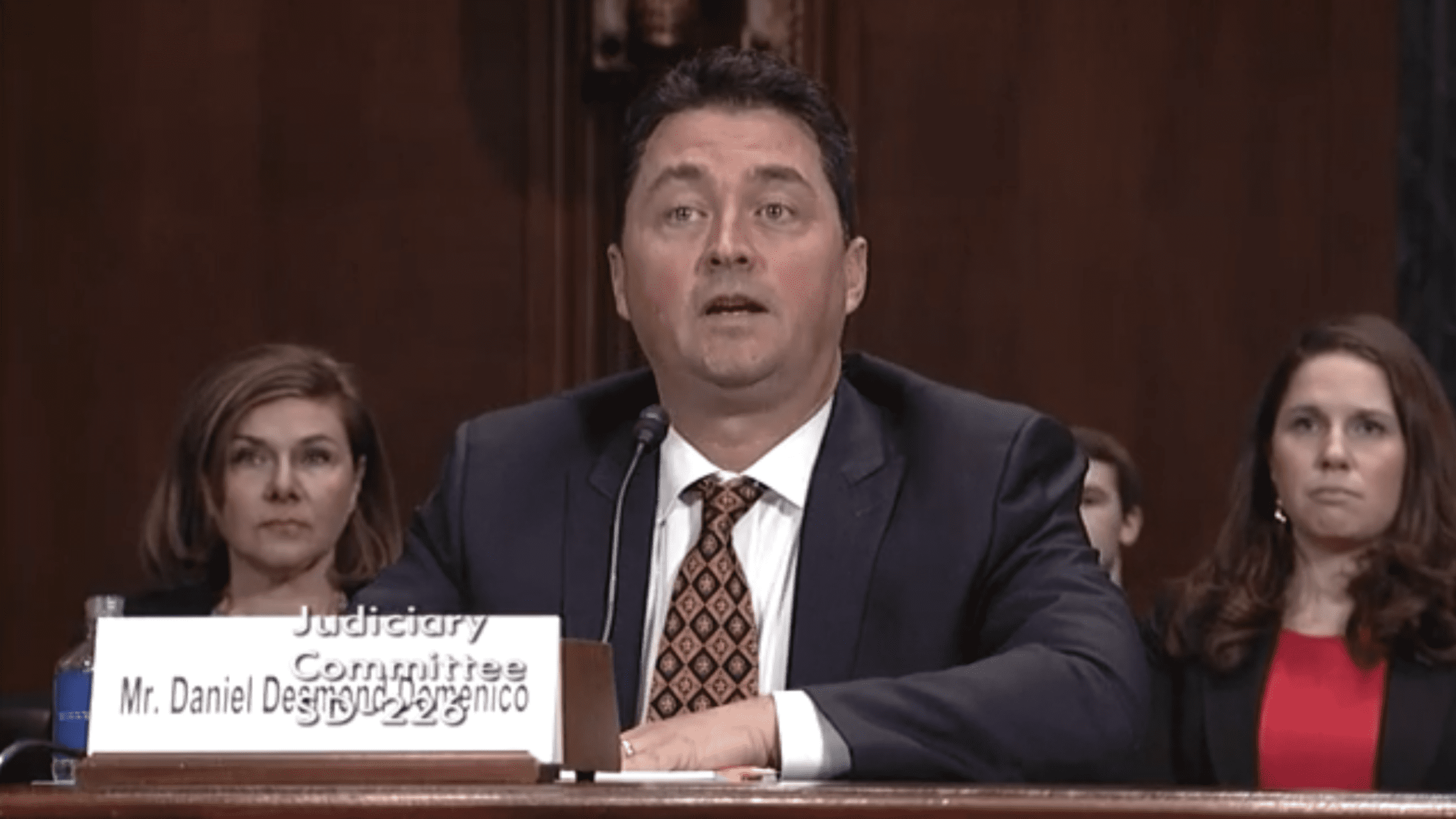
Domenico at a confirmation hearing in 2018 (Screencap via SJC)
Although he is not as openly partisan as Traynor, Domenico has nevertheless reliably ruled against government safety regulations and in favor of religious organizations. For example, in 2020, he struck down COVID-19-era capacity limits and mask mandates for churches, and in 2025 he required Colorado to provide public funding to a religious preschool that wanted to discriminate based on sexual orientation and gender identity. In 2023, Domenico also barred enforcement of Colorado’s ban on so-called abortion pill “reversals,” a practice that is neither approved by the federal government nor supported by science, according to doctors in the field.
Most recently, Domenico sided with the Trump administration in its effort to defend its anti-immigrant agenda, holding that the mandatory detentions authorized by statute for people who are “seeking admission” to the United States also apply to people who have lived in the United States for decades without incident. Domenico’s view is the extreme minority: Of the nearly 500 judges who have addressed this issue since Trump took office, only about 50 have sided with Trump.
At 55 and 53, respectively, Traynor and Domenico are significantly older than Trump’s other nine appeals court nominees, who have an average age of 42. They’re also the first district judges Trump has elevated to the courts of appeals, which is not an accident. Trump knows that time is running out before the 2026 midterm elections, and Traynor and Domenico are known quantities: Because they’ve already been vetted and gone through the Senate confirmation process, there is less risk that a second process turns up skeletons in their closets. Should Trump get any more appeals court vacancies in the coming weeks, look for the White House to use the same playbook to fill them as quickly as possible.
Trump also announced four district court nominees: Michael Martin to the Eastern District of Michigan, Antonio Pozos to the Eastern District of Pennsylvania, Angela Colmenero to the Southern District of Texas, and Kasdin Mitchell to the Northern District of Texas. Martin, 51, is a career prosecutor in Detroit. Pozos, 43, is a law firm partner and former federal prosecutor. Colmenero, 47, is the deputy chief of staff to Texas Governor Greg Abbott and previously worked in the Texas Attorney General’s Office under Attorney General Ken Paxton. Mitchell, 40, is a law firm partner who clerked for Justice Clarence Thomas and Eleventh Circuit Judge William Pryor.
Unlike the two Texas nominees, Martin and Pozos have been nominated to judgeships in states with at least one Democratic senator. The three Democratic senators involved—Gary Peters, Elissa Slotkin, and John Fetterman—have repeatedly voted to confirm Trump’s executive branch nominees, so one might think that these judicial nominations, too, are evidence of their cooperation with the White House. When asked, though, none of the senators committed to returning blue slips for their respective nominees, and Martin’s and Pozos’s responses to the Judiciary Committee’s questionnaire indicated only that they interviewed with their state’s judicial selection committees, not with their Democratic senators directly. (It’s not uncommon for senators to use selection committees to initially filter applicants, but the candidates often interview with staff from the senators’ offices as well before their names go to the White House.)
Even if Martin or Pozos are “compromise” picks, it’s not clear what the incentive is to compromise at this point. Trump’s popularity is plumbing new depths, and he’s already short on vacancies in states with Republican senators. Democrats are all but assured to at least narrow the Republican Senate majority (if not flip the chamber outright) in November, which would only increase their leverage in any nomination negotiations after the midterms. Then again, Democrats have never had a tactical advantage they couldn’t wait to squander.
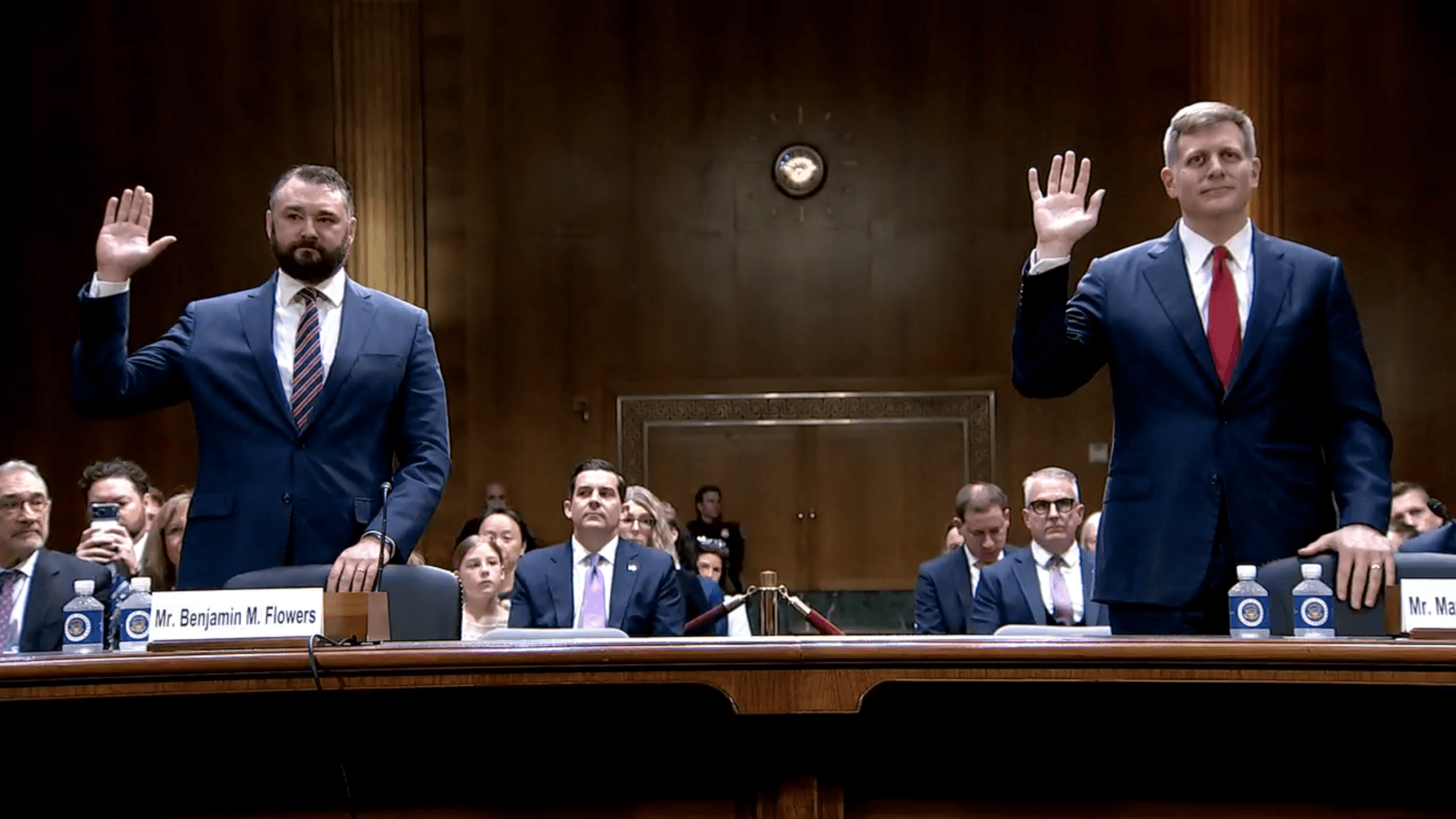
Flowers and Schwartz at their confirmation hearing on Wednesday (Screencap via SJC)
Hearings
On May 20, Second Circuit nominee Matthew Schwartz and Sixth Circuit nominee Benjamin Flowers appeared before the Senate Judiciary Committee. Clearly frustrated by all the coverage of Trump’s nominees refusing to say that President Joe Biden won the 2020 election, Judiciary Chairman Senator Chuck Grassley began the hearing by offering a new defense: that during her Supreme Court confirmation hearings, then-Judge Ketanji Brown Jackson responded to questions about the 2020 election by asserting that it would be inappropriate for her to weigh in on “any subject of political debate.” The implication here is that because Jackson’s language is similar to the language used by Trump’s nominees—all of them—it’s actually Jackson’s fault that Trump’s nominees can’t answer these questions, and Democrats should take their complaints to her. Checkmate, libs!
Throughout the hearing, both Flowers and Schwartz latched on to Grassley’s argument, invoking Jackson’s response in order to refuse to offer forthright answers to straightforward questions about the 2020 election and the January 6 insurrection. But Grassley’s defense falls apart with minimal scrutiny. First, the question for Jackson was different: It asked only whether she had “commented, publicly or otherwise, on the results of the 2020 election,” not whether she would acknowledge the basic and indisputable fact of who won it. Second, the purpose of the question wasn’t to get her to perpetuate a baseless conspiracy theory to soothe the ego of the president who nominated her. And more to the point, even if Jackson’s response did set some kind of precedent about issues of so-called “political debate,” the winner of the 2020 election is no more debatable than whether the Earth is round or whether dinosaurs were real.
What’s Next
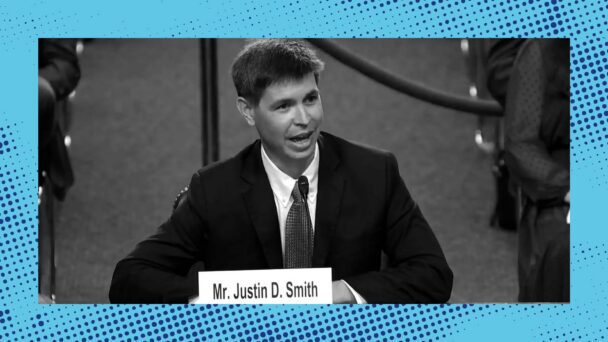
Five nominees are currently awaiting confirmation on the Senate floor: Eighth Circuit nominee Justin Smith, District of Montana nominee Katie Lane, and District of Kansas nominees Anthony Powell, Tony Mattivi, and Jeffrey Kuhlman. Northern District of Ohio nominee Michael Hendershot, Southern District of Florida nominee Jeffrey Kuntz, and Southern District of Texas nominees Rob Jones and John Marck will be voted out of Committee on June 4 and will be eligible for floor consideration on June 8.
Given the Senate schedule, a nominee must have their hearing before the August recess to leave enough time for confirmation before the midterm elections in November, and there are only four such hearing dates left: June 10, June 24, July 15, and August 5. Trump has already announced the nominees for the June 10 hearing. Because of the tight timeline, nominees for the June 24 or July 15 hearings can only fill vacancies that already exist, because there just isn’t enough time to vet a candidate for a new vacancy and still comply with the Judiciary Committee’s 28-day notice requirement before it will hold a hearing. The August 5 hearing is Trump’s only hope to fill any new vacancies that arise between now and early June, because Trump must pick his nominees for that hearing no later than July 8.
The net is this: Given that schedule and the current state of vacancies, Trump can likely fill at most two additional appeals court vacancies before the midterms, assuming he gets them in the next two weeks. Without a major change to the Senate calendar—always tough in an election year—most of the judgeships available for Trump to fill before the midterms have been announced, and a Democratic takeover of the Senate could put a stop to Trump’s judicial confirmations entirely.