Over the weekend, The New York Times published a flurry of internal Supreme Court memos related to its unsigned, unexplained February 2016 order that blocked the Clean Power Plan, an Environmental Protection Agency rule that required states to implement plans to reduce carbon emissions within their borders, from taking effect. At the time, this was (to use a legal term of art) pretty weird: When the Court issued its ruling, a Republican-led challenge to the rule was still pending before a federal appeals court in D.C. By leapfrogging that court, the justices extended special treatment to this country’s fossil fuels industry, effectively concluding that the viability of its business model was simply too important to leave to the usual legal process.
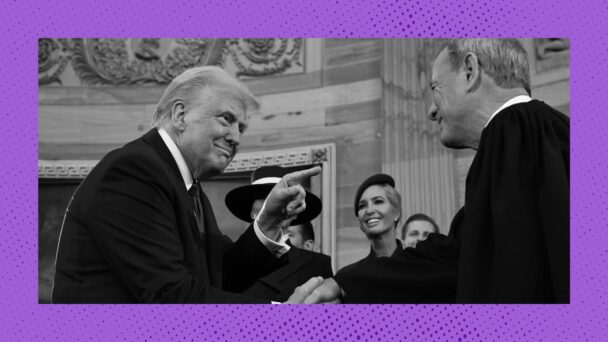
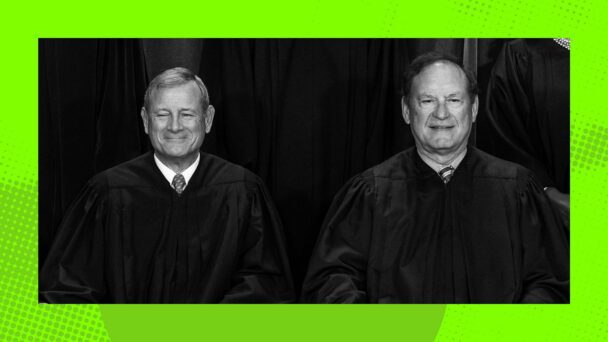
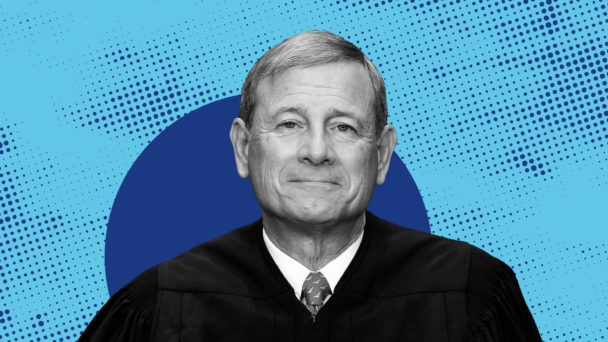
The Court’s order gave rise to what is now known as the Supreme Court’s “shadow docket”—a form of expedited review that the conservative justices have since wielded at their convenience to stymie Democratic presidents on the one hand, and, on the other, to give President Donald Trump just about anything he wants. The memos obtained by the Times make clear that one of the principal reasons the Court acted as it did is that Chief Justice John Roberts, a lifelong Republican, really did not like what would have been President Barack Obama’s signature climate initiative, and decided to use the powers of his office to spike it.
There is, as they say, a lot going on in these memos. But it is worth remembering that of the many, many justices who would bristle at the notion that the Court would ever allow partisan politics to taint its deliberative process in this manner, none do so quite as officiously as Roberts. In 2018, after Trump disparaged a particular court ruling as the work of an “Obama judge,” Roberts issued a rare public rebuke: “We do not have Obama judges or Trump judges, Bush judges or Clinton judges,” he said. “What we have is an extraordinary group of dedicated judges doing their level best to do equal right to those appearing before them.”
During his 2005 Senate confirmation hearings, Roberts tried to assuage concerns about his long career in Republican politics by emphasizing a judge’s obligation to demonstrate the “humility to recognize that they operate within a system of precedent.” This website takes its name from the baseball umpire analogy he adopted as a mantra during those hearings: If confirmed, Roberts said, he would always remember that his role is to apply the rules, not to make them—in his words, to “call balls and strikes, and not pitch or bat.”
The Times’s reporting is only the latest bit of proof that Roberts has been merrily lying to you all along. His first memo, dated February 6, laid out the stakes: He argued that the challengers had a “fair prospect” of winning their challenge to the rule; that in the meantime, they were “committing time and resources” to comply with it; and that the Court’s failure to step in would trigger a “substantial and irreversible reordering of the domestic power sector.”
Throughout, Roberts seemed particularly annoyed that in a BBC interview, then-EPA Administrator Gina McCarthy had described the Clean Power Plan’s standards as “bak[ed]…into the system” going forward. In response, Roberts wrote to his colleagues that “solar plants are not built in a day”—in other words, that even after the Court eventually ruled for the challengers (as he assumed it would), America’s beleaguered coal-burning energy companies would never get their money back (the horror!).
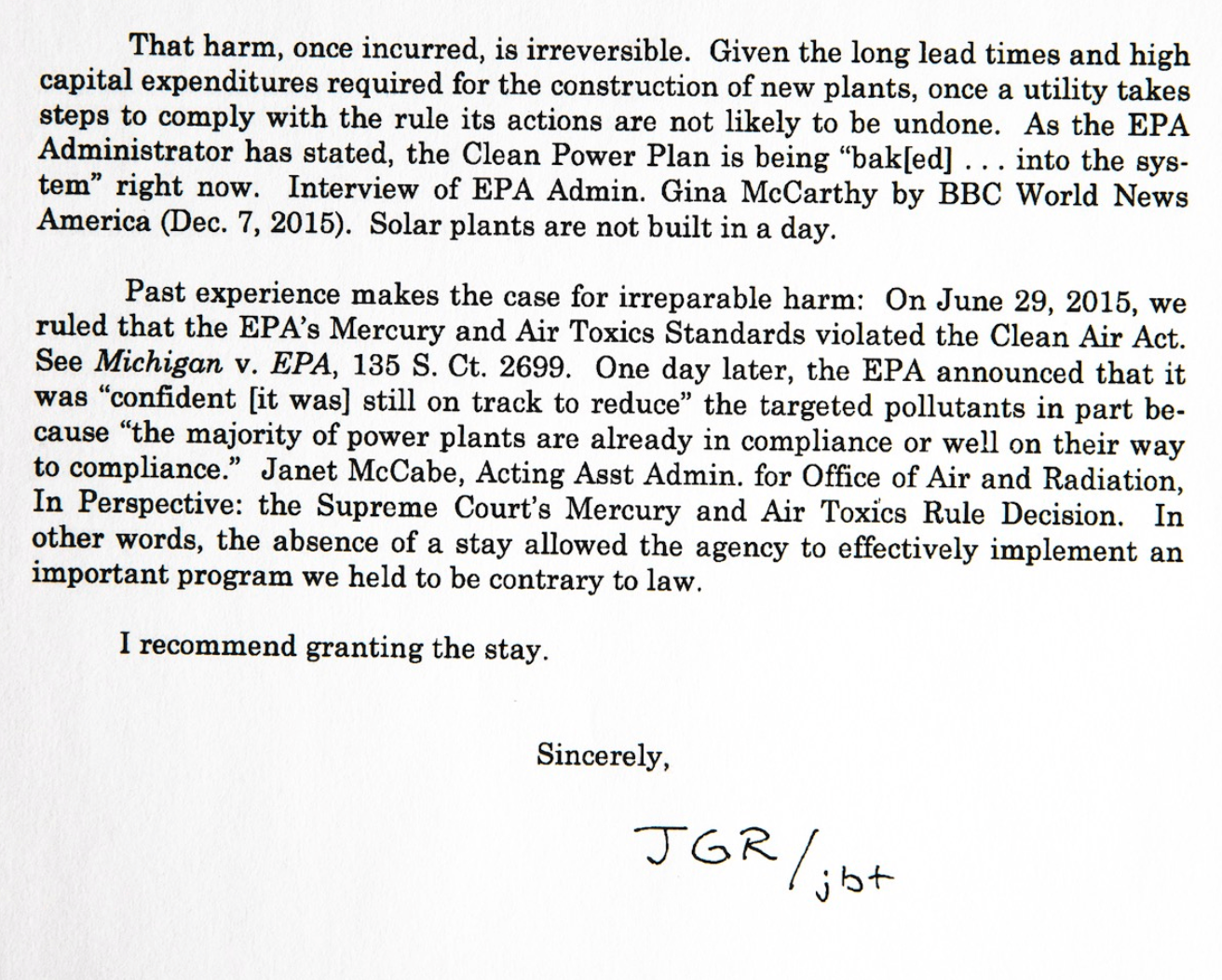
In their memos, the liberal justices sounded baffled by Roberts’s insistence that the rule was inflicting anything close to the degree of harm that would merit their unprecedented early intervention. Justice Stephen Breyer politely pointed out that the Clean Power Plan did not require states to do anything until 2022, and that it was pretty easy for states to request and receive two-year extensions on submitting their compliance plans. Justice Elena Kagan called the requested remedy “drastic and unusual,” while Justice Sonia Sotomayor stressed that the factual record was “hotly contested,” and argued that the Court would be “greatly aided” by simply letting the appeals court hear the case in the normal course of business.
In response, Roberts sounded even less like a dispassionate judge applying binding precedent and even more like a strident young Justice Department lawyer cranking out a white paper on a policy proposal his boss opposes. (Which, to be fair to Roberts, is a role he is familiar with.) Although he acknowledged that the states’ request was “not typical,” Roberts warned that the Clean Power Plan was “the most expensive regulation ever imposed on the power sector,” at $480 billion. In a footnote, he acknowledged that this estimate came from the challengers, and was likely “at the high end.” Just as quickly, though, he cited a White House fact sheet that described the Clean Power Plan as facilitating an “aggressive transformation” of the industry, which, for Roberts, was evidence that that scary $480 billion price tag was at least spiritually correct.
Throughout his second memo, Roberts emphasized the rule’s “real-world impacts” on his beloved energy sector, and closed by again citing McCarthy’s BBC interview as evidence that the Clean Power Plan would become “functionally irreversible” if the Court did not act immediately. “Each passing day,” Roberts wrote, “sees the rule further entrenched.”
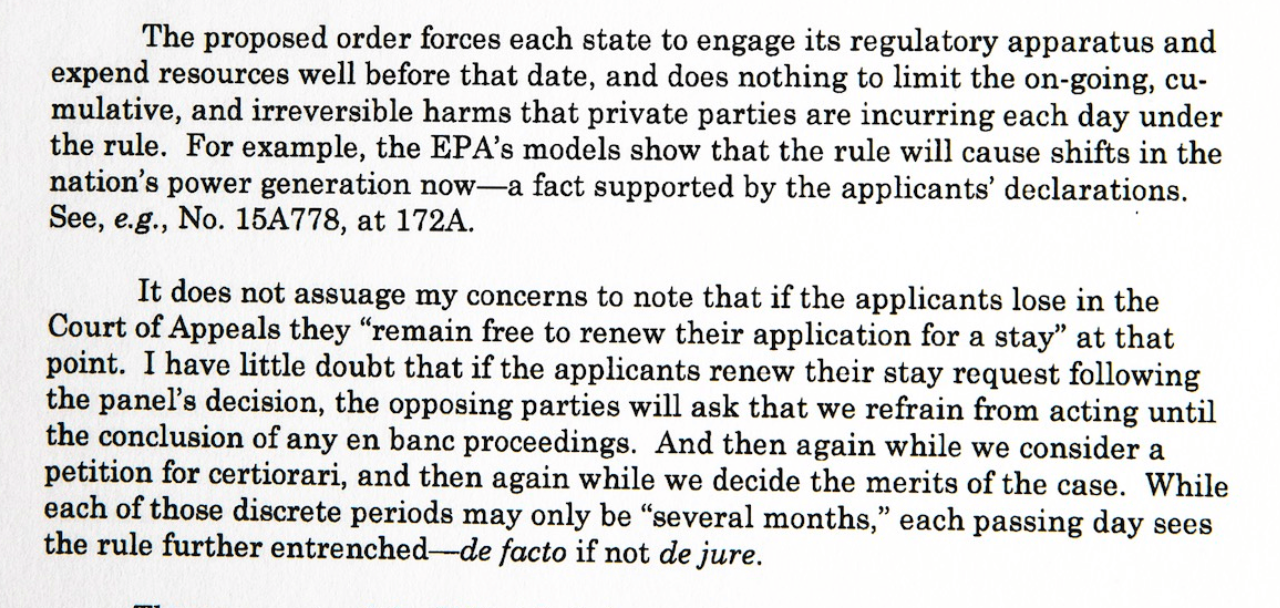
In a four-line memo on February 9—just three days after this glorified email chain started—Justice Anthony Kennedy announced he would vote with Roberts, apparently sealing the deal. The Clean Power Plan never took effect, a fact that did not deter the Court from using it as the basis of a 2022 ruling that will make it more challenging for future Democratic presidents to address climate change, if they even have the temerity to test Roberts again.
In the years since 2016—and especially after Justice Amy Coney Barrett’s confirmation in 2020 yielded the current six-justice conservative supermajority—the Court has not been nearly as solicitous of parties challenging executive actions when the executive in question has been Donald Trump. As Chris Geidner points out at Law Dork, Roberts’s concerns about the “real-world impacts” on the compensation packages of energy company CEOs were nowhere to be found when, for example, the Court allowed the Trump administration to mass-cancel immigration parole status for a half-million people last year. As I have written before, whether the Court considers a case to constitute an “emergency” depends a lot on whether the conservative justices personally sympathize with whomever is asking for their help.
Just as telling, I think, are the factual bases on which Roberts relied to make his case. In public, Roberts emphasizes that the Court’s work is neither political nor ideological; in his opinions, he frames his work as the product of faithful application of legal principles and Supreme Court precedent. This messaging is consistent with what he promised to be at his confirmation hearings in 2005: a chief justice who would “fully and fairly analyze the legal arguments that are presented,” and “be open to the considered views of my colleagues on the bench,” and “decide every case based on the record, according to the rule of law, without fear or favor.”
But behind the scenes, Roberts was not interested in “legal arguments” or the “considered views” of his colleagues. Instead, he was preoccupied with McCarthy’s contention that the Clean Power Plan would prove impactful even if a future Republican president—the 2016 election was less than a year off—were to try to roll it back. After block-quoting her interview with the BBC, Roberts issued his retort: “I am of the mind that a rule designed to transform a substantial swath of the nation’s economy should be tested by this Court before it is presented as a fait accompli,” he wrote. As it turns out, nothing was as important to his decisionmaking process as a Democratic administration official’s willingness to celebrate a (fleeting) political victory in public.
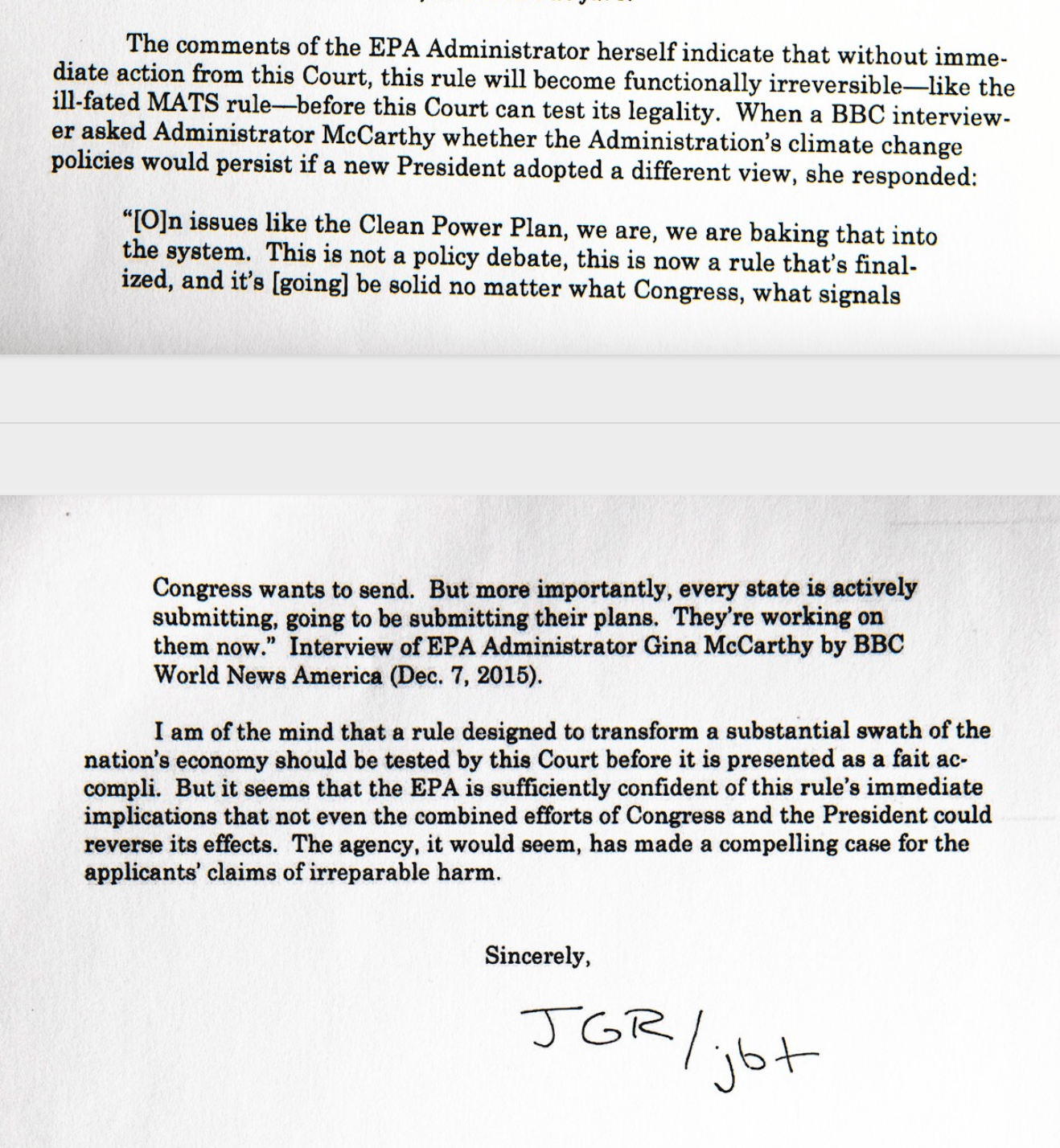
McCarthy was answering a journalist’s questions about a groundbreaking effort to slow the climate change-induced immolation of the planet; in context, I would argue that her language here is, if anything, actually kind of modest. She probably did not think anything of it at the time, because she probably did not think that the five Republican justices would cite it as grounds to create a bespoke standard of judicial review that allows them to transform their policy preferences into limits on the powers of a chief executive whom they do not support.
But in John Roberts’s worldview, no statute or executive action is really “solid” until he, John Roberts, has had the opportunity to pass judgment on it. He has spent his entire career demonstrating that if he agrees with the policy, he will find a reason to conclude that, as a matter of law, he has a solemn obligation to preserve it. If he doesn’t, he will find a reason to conclude that, as a matter of law, he has no choice but to stuff it in the garbage.