In April 2025, the Department of Justice launched an investigation into Yale University, accusing its medical school of making admissions decisions based on race and, in so doing, violating the Civil Rights Act of 1964. On Thursday, May 14, the agency published its predictable findings: “Yale discriminated against other applicants to benefit preferred race classes of Black and Hispanic.” About a week earlier, Trump’s DOJ reached the identical conclusion about UCLA School of Medicine.
In both cases, there was no real doubt it would do so. The conservative legal movement has spent decades arguing that laws designed to remedy the effects of white supremacy—in education, elections, and elsewhere—require the entrenchment of white supremacy instead. And throughout his second term, Trump has aggressively built on this legal foundation for resegregation. The DOJ’s latest findings treat the mere existence of Black students as legal grounds for threatening a school’s federal funding—a standard that could make other medical schools more reluctant to admit Black students, which would have a devastating impact on the health of Black communities.
The DOJ first purports to show Yale’s “intent to discriminate” through a review of the medical school’s internal policies and practices. Specifically, the government alleges that Yale conducts interviews “that enable the committee to know applicants’ race and ethnicity,” and considers applicants’ socioeconomic status, which functions as a “racial proxy.”
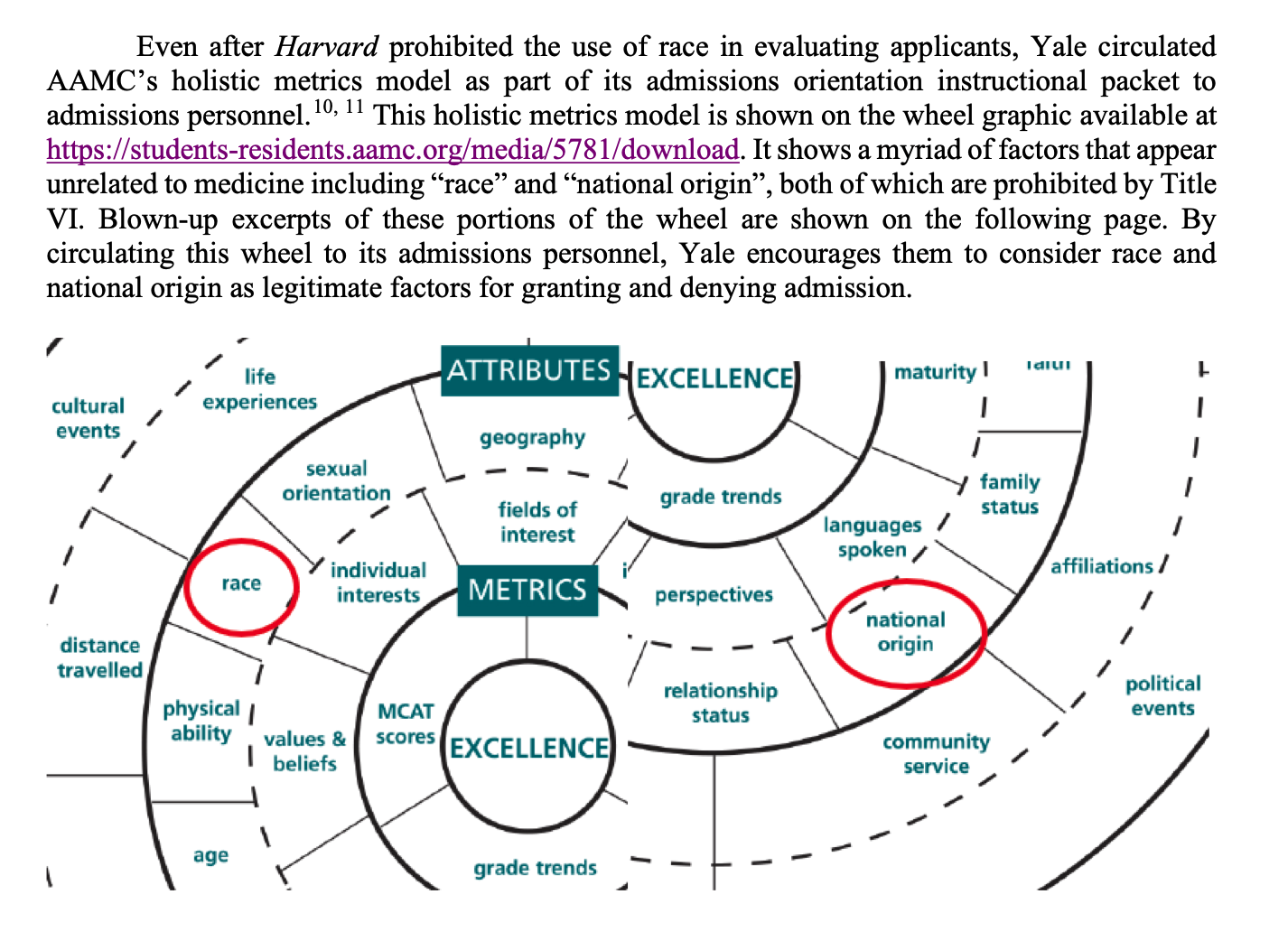
The Trump administration’s smoking-gun evidence for this conclusion is an orientation packet that Yale provided to admissions personnel, which included a “holistic metrics model” produced by the Association of American Medical Colleges, an organization that helps accredit medical schools. The DOJ findings letter complains that AAMC’s model “shows a myriad of factors that appear unrelated to medicine.” And it features an image of AAMC’s graphic, with the most offensive characteristics—“race” and “national origin”—circled in red.
From there, the DOJ provides the results of its own “preliminary statistical aggregation” of Yale’s medical school admissions data for the incoming classes of 2023, 2024, and 2025, and found “no change in racial disparity between admitted students” before and after Students For Fair Admissions v. Harvard, the Supreme Court’s 2023 decision restricting race-conscious admission programs. In an amicus brief in that case, Yale argued that “no workable race-neutral alternatives” to affirmative action would produce a sufficiently diverse student body. “Given this statement,” the DOJ wrote, “the lack of any change in Yale’s admissions outcomes” demonstrates the school’s “willful failure to comply with that decision.” Put simply, there are more Black students at Yale than the Trump administration expected, and so, it suspects Yale is breaking the law.
The Yale findings show that the Trump administration is literally treating the presence of Black students as evidence of illegal racial discrimination. Because the Civil Rights Act prohibits recipients of federal financial assistance from engaging in such discrimination, this means that schools’ federal funds are at risk unless they reduce their Black student population to something Trump is more comfortable with. The report did not specify what this level might be, which means that for schools, the safest way to avoid suspicion is to not admit Black students at all.

In a press release touting its findings, the DOJ said that it is “continuing its focus on eradicating illegal race politics from admissions at medical schools, where quality and excellence are vitally important to public safety.” But even if one were to accept the premise that the DOJ’s investigation was motivated by “public safety” concerns, “public safety” is precisely why it’s so important to have doctors of color. Decades of research has proven that racial discrimination causes significant disparities across a broad array of health metrics, and the Centers for Disease Control has recognized racism as a public health crisis.
Research further shows that doctor diversity meaningfully improves patient outcomes. A 2023 study by researchers at the Department of Health and Human Services, for instance, showed that greater Black representation among primary care physicians led to increased life expectancy and decreased mortality rates for Black people. And a 2025 study by researchers at UCLA showed that when Hispanic surgeons operated on Hispanic patients, those patients spent less time in the hospital, and were less likely to be readmitted to the hospital post-operation.
But even though people of color are often better- served by medical professionals who are also people of color, there are not enough doctors of color to meet community needs. Black people make up roughly 13.7 percent of the U.S. population, but 10.3 percent of medical school students and 5.3 percent of physicians. Hispanic people are similarly underrepresented in medicine, making up 20 percent of the U.S. population, but 12.3 percent of medical school students and 6.7 percent of physicians.
Academic excellence and racial diversity are not in conflict. In fact, you can’t have the former without the latter, as demonstrated by the DOJ’s own findings about Yale’s medical school, which show comically little difference between the test scores of admitted students. But the national shortage of doctors of color is already costing lives. The Trump administration’s investigations and threats to federal funding will only exacerbate this crisis.