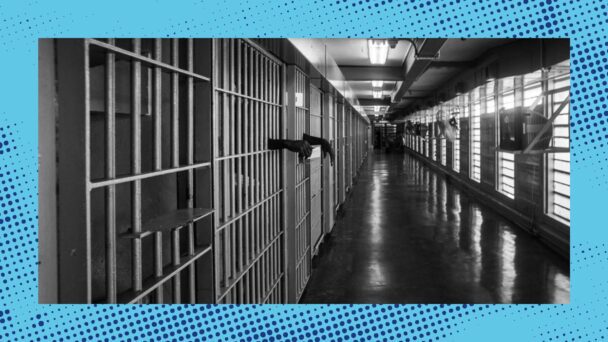
For nearly 20 years, Damon Landor adhered to the Nazarite Vow to let his hair “grow long” and let “no razor come upon his head.” And by August 2020, when he began a five-month sentence for drug possession in a Louisiana state prison, his dreadlocks nearly reached his knees.
That changed in late December when Landor was transferred to a new facility: With just three weeks of his sentence remaining, prison officials shaved his head bald.
On paper, a federal law called the Religious Land Use and Institutionalized Persons Act prohibits the government from infringing the religious freedom of incarcerated people. And the officials at Raymond Laborde Correctional Center knew fully well that they were violating Landor’s rights. Upon his arrival, he told them that he practiced Rastafarianism, a faith rooted in embracing pan-African identity and opposing colonial oppression, and he provided them with proof of past religious accommodations at other facilities. Landor even gave them a printed copy of a 2017 federal court decision which already held that Louisiana’s policy of cutting incarcerated Rastafarians’ hair violated the RLUIPA.
The officials threw all of Landor’s documents in the trash, handcuffed him to a chair, held him down, and sheared him down to the scalp. “It felt like I was raped,” Landor said later, in The New York Times. “They knew better than to cut my hair, but they did it anyway.” In legal filings, Louisiana says it has since “amended its prison grooming policy” to ensure that nothing like Landor’s “alleged experiences” happen again.
Congress enacted the RLUIPA in 2000 in recognition of the fact that prisons sometimes restrict religious liberty in “egregious and unnecessary ways.” And the RLUIPA expressly permits people to file lawsuits and “obtain appropriate relief” from government entities or employees who violate their rights. Yet when Landor sued the prison officials who shaved him bald for compensatory and punitive damages, a federal district court dismissed his case.
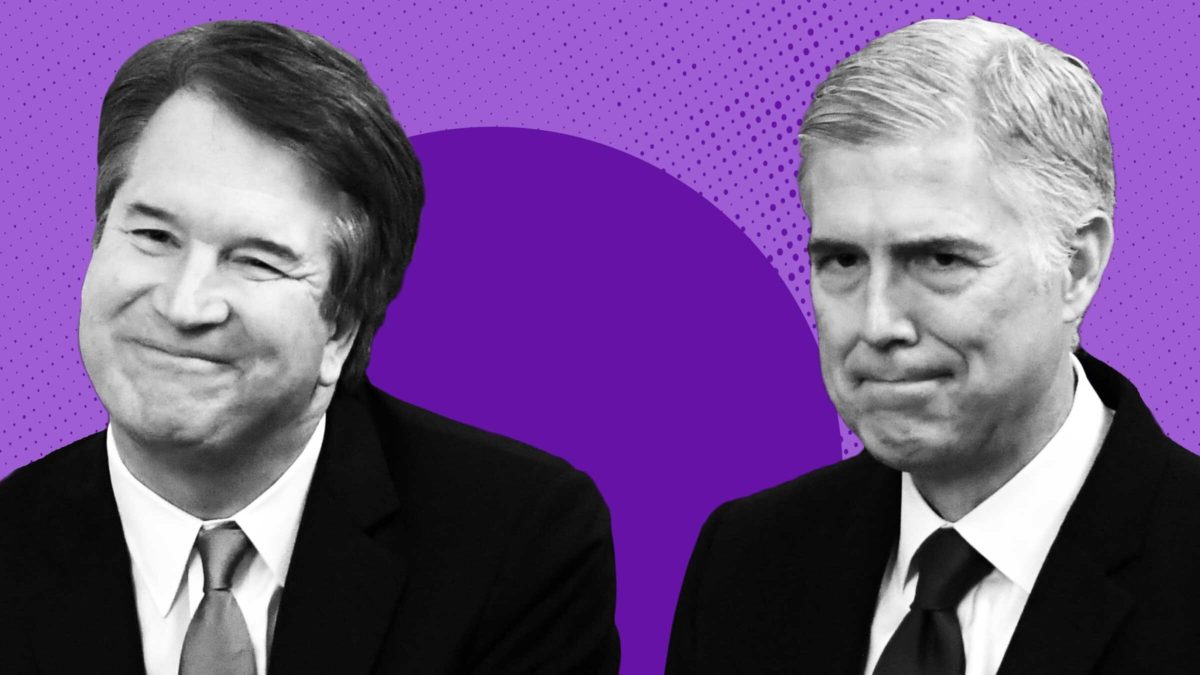
Landor appealed up to the Supreme Court. But on Tuesday, the six-justice Republican majority ruled that Landor cannot sue the individual officials who violated his rights under the RLUIPA for monetary damages. Even though the prison guards broke the law, the Court’s holding in Landor v. Louisiana Department of Corrections and Public Safety ensures that they will not have to pay for what they did.
Writing for the majority, Justice Neil Gorsuch explained this perverse outcome by stressing that Congress enacted the RLUIPA pursuant to the Spending Clause of the Constitution. The Spending Clause empowers Congress to enter funding agreements with states and other entities, attach strings to that funding, and cut the funding off if the recipients fail to comply with the terms of the agreement. But according to Gorsuch, it “confers no authority” to impose additional sanctions on funding recipients “without their knowing and voluntary consent.” Instead, he wrote, Congress “must ask” and funding recipients “must agree” to face liability.
To be clear, prisons like Louisiana’s did agree, as a condition of receiving federal funding, to be sued by plaintiffs like Landor who allege violations of their religious rights under the RLUIPA. But relying on “contract principles,” Gorsuch said that that doesn’t matter: Since the agreement is between the government and the prison, not the government and the prison guards, Gorsuch wrote, Landor’s case “cannot proceed against them any more than a breach of contract action might proceed against a defendant who never formed a contract.”
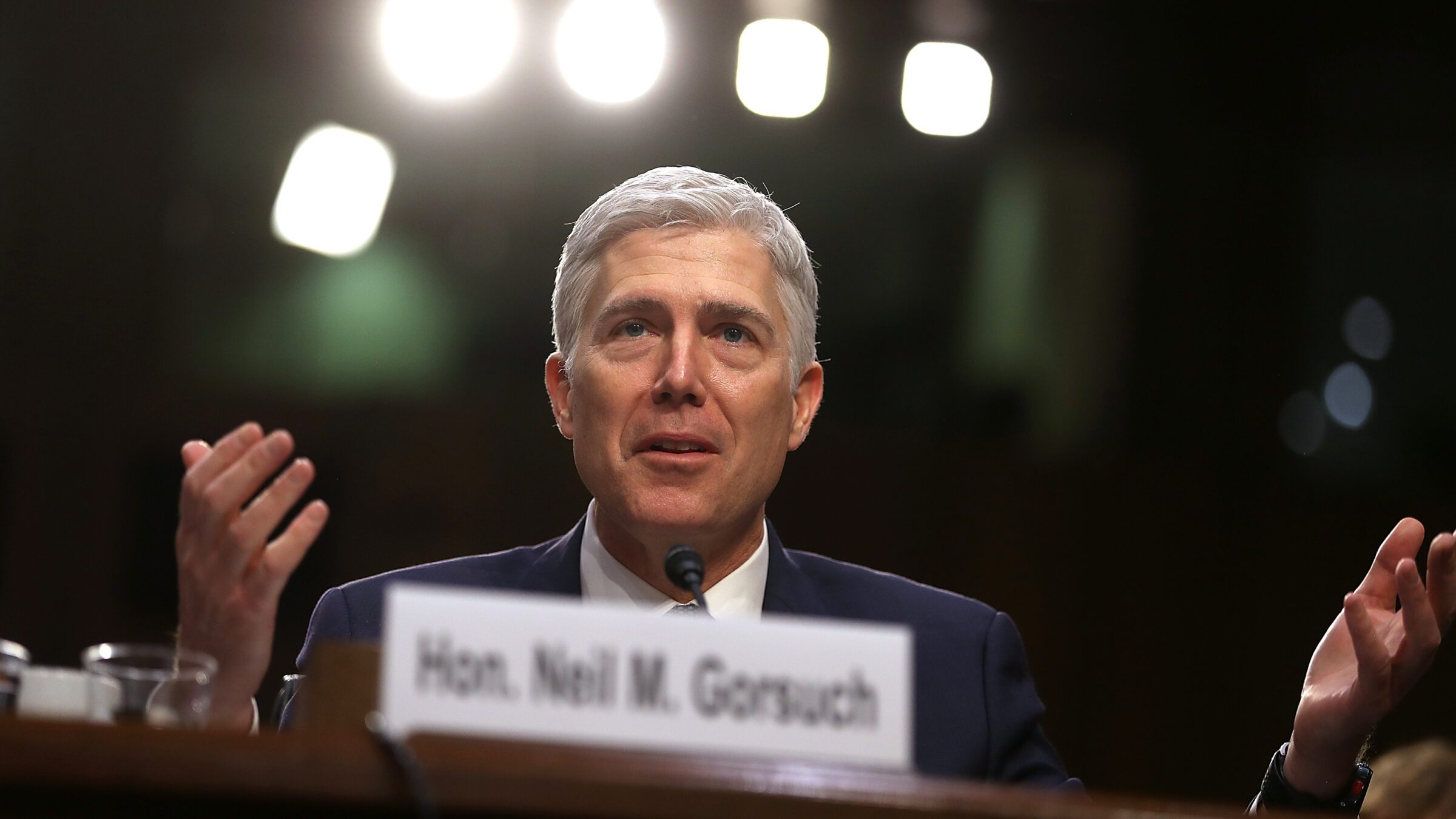
(Photo by Justin Sullivan/Getty Images)
In her dissent for the three liberals, Justice Ketanji Brown Jackson characterized the majority’s position as “peculiar,” and as a threat to “some of Congress’s greatest legislative achievements.” First of all, the RLUIPA is not a contract; it is a law with an enforcement mechanism. And as Jackson pointed out, Congress has enacted many federal laws like it, that rely on the Spending Clause to “reach beyond direct recipients of federal funds” and “secure civil rights, environmental stability, healthcare, and more.” The Court’s conflation of “law making” with “agreement making,” she wrote, allows it to substitute the majority’s “rigid contract-based preferences” in lieu of “Congress’s considered statutory design.”
Second, the Court recognized decades ago that employees in federally funded programs must perform their duties in accordance with laws passed by Congress. And Louisiana conceded in its brief to the Court in Landor, that “prison officials must comply with RLUIPA’s substantive protections for religious exercise.” In the majority’s view, Jackson wrote, Congress has the power to impose the “substantive directive” of the RLUIPA, but is powerless to create “a damages remedy against officials who violate that directive.”
Third, Jackson said, the Court “already interpreted identical language in RLUIPA’s sister statute.” Congress modeled the RLUIPA on the Religious Freedom Restoration Act, and courts frequently interpret RFRA and RLUIPA in the same way. And in the 2020 decision Tanzin v. Tanvir, Justice Clarence Thomas explained for the unanimous Court that money damages are not just “appropriate” relief under RFRA, but sometimes “the only form of relief” that can remedy some violations of religious rights.

Landor experienced precisely the kind of harm that can only be remedied by money damages. A court order preventing prison officials from cutting off your hair can’t help you if they’ve already cut off your hair. And a court’s declaration that cutting off your hair is illegal can’t help you if everyone knew that already and they still shaved you bald. Quoting an amicus brief filed by Rastafari scholars, Jackson wrote that prison officials ignored the law, held Landor down, and “uncrowned him before God.”
The Republican justices are extraordinarily concerned about whether it is fair to hold prison guards responsible for violating incarcerated people’s rights. They were not at all concerned with whether it is fair to incarcerated people to allow prison guards to violate their rights with impunity. The majority’s reasoning in this case, Jackson wrote, “casts a shadow that will not easily be escaped.”
The conservatives on the Court often posture as great defenders of religious rights. But in reality, they only care about the religious rights of some people. Damon Landor, a Rastafarian Black man who was incarcerated in Louisiana, isn’t one of them.