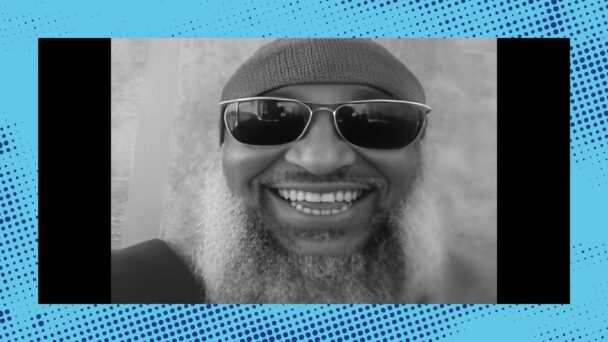
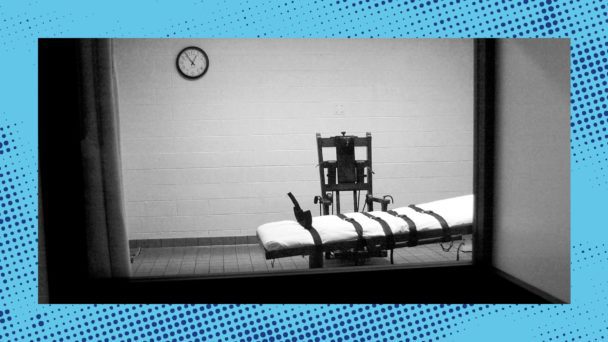
On Thursday, June 11, the Alabama Department of Corrections filed an emergency request to the Supreme Court, asking for permission to proceed with that evening’s scheduled execution of Jeffrey Lee by nitrogen hypoxia, a method of capital punishment authorized by the state legislature in 2018. To carry out such executions, state officials strap a condemned person to a gurney and put a mask over their face that replaces breathing air with 100 percent nitrogen.
The United Nations warns that suffocation by nitrogen gas may “amount to torture.” Nitrogen hypoxia does not only cause death; it also causes extreme “air hunger,” the perception of not getting enough or needing more air. According to the American Thoracic Society, a medical association of respiratory health experts, air hunger activates the brain’s base survival instincts and “summons a primal fear response.” That feeling of panic worsens the struggle to breathe, creating a “vicious cycle” of physiological and psychological distress.
Alabama has executed seven people by nitrogen hypoxia to date, and it wanted Jeffrey Lee to be the eighth. In 2000, an Alabama jury convicted Lee on multiple counts of murder and attempted murder, arising out of the armed robbery of a pawn shop in 1998. Lee is Black, the victims were white, and the prosecutor used all 21 of his peremptory strikes against Black potential jurors.

After a two-day trial, the jury voted for a sentence of life imprisonment without parole, but the judge overruled the jury’s verdict and sentenced Lee to death anyway. Alabama abolished judicial overrides in 2017, but only for future cases. There are over two dozen people like Lee still on death row in Alabama because of a practice the state now recognizes as wrong.
Last year, Lee filed a lawsuit arguing that the state’s plan to execute him by nitrogen hypoxia violates the Eighth Amendment’s prohibition on cruel and unusual punishment. The lawsuit did not ask for Lee’s life to be spared, but merely for him to be executed by firing squad instead.
Last week, federal courts agreed to his modest request. Specifically, a federal district court in Alabama acknowledged that air hunger causes “extreme emotional distress, panic, anxiety, and fear,” and later determined that death-by-firing-squad would significantly reduce the “substantial risk of serious harm” caused by nitrogen hypoxia. The Eleventh Circuit Court of Appeals agreed, finding that the suffering associated with nitrogen hypoxia is constitutionally “intolerable.”
Crucially, the lower courts did not prohibit Alabama from executing Lee. The courts only ruled that Alabama may not execute Lee on Thursday in a particularly horrible way. When Alabama asked the Supreme Court for emergency relief last week, what it really asked was: Can we impose immediate and fatal suffering on a man who a jury said should live?
In a one-sentence order, a majority of the Court answered this ghoulish question with a no. But three justices wanted to prevent even that small mercy: Justices Clarence Thomas, Sam Alito, and Neil Gorsuch all noted their dissent in Lovelace v. Lee, meaning they would have allowed the horrorshow to proceed.
Lee’s case is the second time in three weeks that a splintered Court rebuffed one of Alabama’s attempts to play fast and loose with the Eighth Amendment. Alabama appealed to the Court last year after lower courts ruled that a man on death row was intellectually disabled and therefore cannot be executed. The issue in that case was how courts should determine whether a person is intellectually disabled. The Court heard oral argument in Hamm v. Smith in December, but on May 21, the Court dismissed the petition as improvidently granted, which means the lower court order prohibiting the execution stands.
The dismissal of Hamm v. Smith was a per curiam order, which means it was attributed to the whole Court. But it clearly caused a lot of division: Alito wrote a dissent, joined by Thomas in full, and Gorsuch and Chief Justice John Roberts in part. The four of them argued that defendants bear the burden of proving that they have an IQ of 70 or less in order to be spared from execution, and that an IQ test result of at least 70 should be a can-kill cutoff point. In the portions of the opinion that Roberts and Gorsuch did not join, Alito and Thomas contended that the lower courts “did not apply any defensible method” to determine the defendant’s IQ.
Justice Sonia Sotomayor wrote a concurrence, joined by Justice Ketanji Brown Jackson, showing that Alito’s discussion of the Court’s precedents and the scientific consensus on how to evaluate IQ scores was “incomplete and potentially misleading.” Meanwhile, Thomas dissented alone, calling for the Court to overrule its precedent prohibiting the execution of disabled people. According to Thomas, the Eighth Amendment was “originally understood” to only ban cruel and unusual methods of punishment. “Executing someone with a particular IQ does not implicate a method of execution at all,” he said.
The questions at stake in these cases—whether the state can subject a man to a terrifying death, and whether it is wrong to execute people with intellectual disabilities—should not be especially difficult. That the Court struggles with such small acts of decency underscores the huge tension between the death penalty and the Constitution, and the vastness of the Court’s capacity for cruelty.