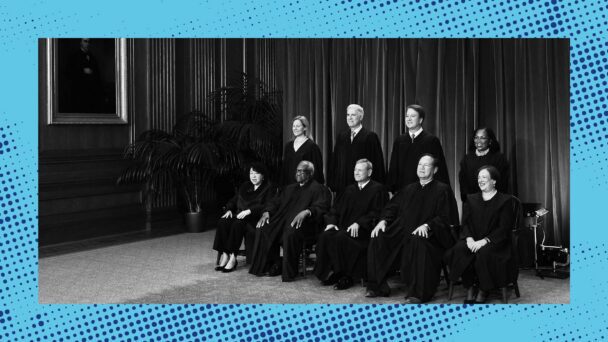
During its most recent term, the Supreme Court issued landmark decisions that upheld President Donald Trump’s right to discriminate against immigrants from majority-Black countries, empowered Republican politicians to gerrymander voters of color out of electoral existence, and authorized Trump to fire (almost) any independent agency head he doesn’t like. On the term’s final day, the Court rejected his attempt to unilaterally overturn the Fourteenth Amendment’s guarantee of birthright citizenship, which would feel like a more reassuring outcome if his harebrained constitutional argument hadn’t come up a single vote short.
A new Washington Post-Ipsos poll suggests that normal people really, really did not care for any of this. The poll, conducted earlier this month, found that just 41 percent of respondents approve of the Court’s job performance. This is down three points from when the Post last polled the question in February 2022, and 19 points from July 2020, right before the confirmation of Justice Amy Coney Barrett yielded a six-justice conservative supermajority that has been merrily implementing its reactionary policy preferences ever since.

This data point is not really a surprise; in the years since 2020, pollsters have pretty reliably found that voters are as skeptical of the Supreme Court’s nonpartisan bona fides as they’ve ever been. What’s new about this poll, which comes on the heels of the Court’s first full term since Trump took office in January 2025, is the inclusion of a question about the Court’s work that pertains specifically to Trump and his priorities: whether the justices’ rulings on Trump administration policies are “based on the law” or “based on their political views.”
Democratic candidates gearing up for the 2026 midterm elections should be paying special attention to the results: Just a quarter of respondents say they believe the Court has been basing its Trump decisions on the law—a 14-point drop from May 2023, and a 21-point drop from February 2022. Almost half—46 percent—understand the Court’s Trump-adjacent cases to be based primarily on the justices’ politics.
The Post also asked respondents in the second group whether the outcomes in Trump cases generally favor or oppose him. The results for this question are even more lopsided: 66 percent say these cases usually come out his way, compared to just 17 percent who say they do not. A different way of understanding this poll is that, on net, the share of people who perceive the Court as an explicitly pro-Trump political body is 30 percent—five points greater than the share of those who still believe the Court merely does law, not politics.
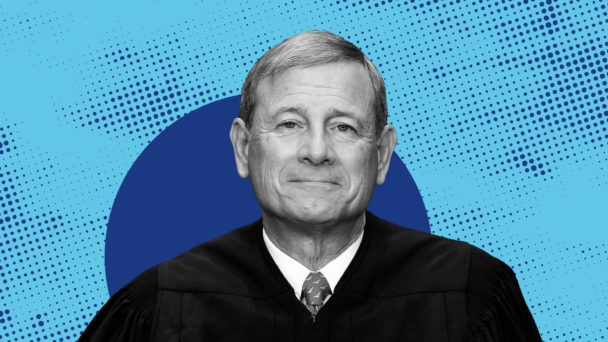
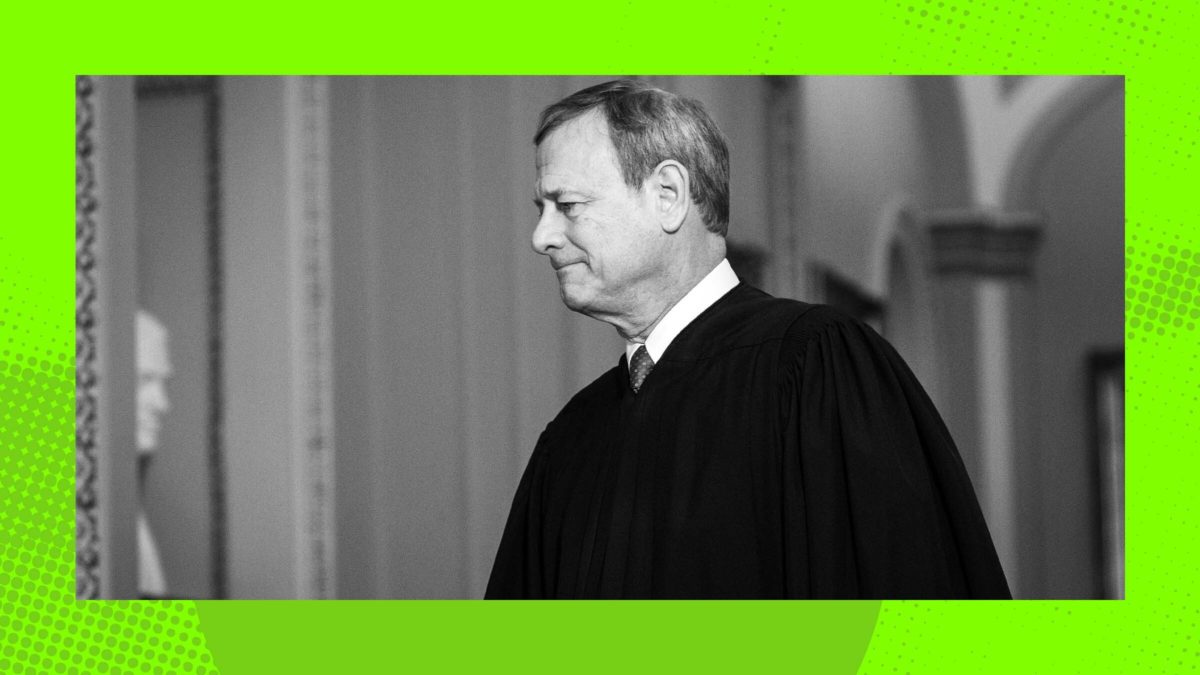
For someone like Chief Justice John Roberts, whose official position is that Supreme Court justices do not and would never resolve cases based on their personal political beliefs, this is disastrous and embarrassing. During the Biden administration, voters already understood that the Court was moving to the right. What the last 18 months have made clear is just how far gone the Court actually is, now that its six-justice conservative supermajority can exercise its power to rubber-stamp a Republican president’s agenda instead.
Despite all the harms the Barrett Court has inflicted, the Democratic establishment has mostly continued to treat the Court not as an existential threat, but as a fundamentally good and noble institution that has temporarily lost its way. President Joe Biden maintained his opposition to Court expansion throughout his tenure in the White House, and the blue-ribbon commission he convened to study Supreme Court reform could not muster anything more than a tepid endorsement of term limits, which may or may not be constitutional. It took Biden until July 2024 to decide that he would actually support legislation to impose term limits. He dropped out of the Democratic primary five days later.
What the Post-Ipsos results demonstrate is that the Supreme Court has created a real opportunity for any Democratic candidates who are smart enough to take advantage. In poll after poll, voters have made clear that the party’s deference to the Court is both bad policy and bad politics. As I’ve written before, they do not want more politicians who invoke the same old solemn obligation to respect Sam Alito’s decisions, no matter how wrong or stupid or morally bankrupt those decisions might be. They want politicians who understand the Court as it functions in the real world, and who have the courage to do something about it.