The following paragraph includes a lot of scare quotes, but I promise that you will soon understand why: On Monday, the Justice Department announced that it had “settled” a “lawsuit” brought by President Donald Trump “against” the Internal Revenue Service, which he’d accused of failing to prevent a contractor from leaking his tax returns in 2020. In exchange for Trump’s willingness to drop his claims—such a magnanimous gesture!—the Justice Department has agreed to create an “Anti-Weaponization Fund” to compensate people who were victimized by “Lawfare and Weaponization” at the hands of “Democrat elected officials.”
The announcement only vaguely defines the scope of lucky “victims” who get to cash in, but based on the settlement’s structure, the term appears to be a catch-all for anyone whom Trump likes, and who has at some point faced some sort of legal consequences for their actions. It almost certainly includes the more than 1,500 January 6 insurrectionists whom Trump pardoned on his first day in office, an act he framed as necessary to “correct” for the Biden administration’s “weaponization of prosecutorial power to upend the democratic process.”
Monday’s agreement dedicates $1.776 billion—yes, like the year the Declaration of Independence was signed—in public resources for the fund. This amount is roughly equivalent to the annual budget of Omaha, Nebraska; the endowment of the University of Miami; and the gross domestic product of Turks and Caicos.
By “settling” the case in this manner, Trump is attempting to leverage the federal court system to create a secret slush fund that includes zero accountability mechanisms. If his efforts to insulate it from judicial review and congressional oversight are successful, the next time the people who stormed the Capitol in order to murder Vice President Mike Pence decide that they don’t like the results of a presidential election, they will be able to buy their costumes at taxpayer expense.

(Photo by Win McNamee/Getty Images)
Every detail of this story sounds like it was fabricated by a constitutional law professor trying to write an issue-spotter exam in the middle of a mushroom trip. Per the terms of the settlement, the fund will be administered by five people appointed by the attorney general, who is, for now, former Trump criminal defense lawyer Todd Blanche. (Congressional leadership gets to “consult” with Blanche on one appointment.) But the president can also remove any member at any time for any reason, provided that the attorney general then selects a replacement using the same method. This arrangement allows Trump, in consultation with his hand-picked attorney general, to just cycle through anyone whom he deems insufficiently generous to his friends until he finds someone he likes better.
The other “accountability” provisions—sorry, I am back to scare quotes for a second—are similarly circular. For example, the Justice Department’s press release states that the fund “may be audited,” but only at the direction of the attorney general, which is sort of like saying that the fox is authorized to test the structural integrity of the henhouse walls anytime he pleases.
The settlement also obligates the fund to provide quarterly reports about who receives relief, and how much—but the reports are to be filed to the attorney general on a “confidential” basis, which sort of defeats the usual government-transparency purpose of requiring reports. It also notes that the fund will “protect private personal and financial information,” which sounds to me like a euphemism for any other relevant information about the fund or its beneficiaries that the White House would really prefer you not find out about.
Perhaps most egregiously, a memo from Blanche asserts that once the Justice Department receives the $1.776 billion from the Treasury Department, the federal government will bear “no liability whatsoever” for any alleged “fraud or misuse of the funds” that may be perpetrated by those who receive payouts. The fund’s deadline for processing claims is December 1, 2028, which ensures that once the end of Trump’s presidency is within sight, none of the money he is funneling to his most loyal foot soldiers will accidentally go to anyone else.
If you find yourself wondering how anything I have described above can possibly be legal, the short answer is that none of it is supposed to be. Even setting aside the substance of the agreement, a basic rule of litigation is that in order for a federal court to hear a case, parties must be “adverse” to one another—that is, they must have opposing interests that require the services of a judge to resolve. You do not need to be a lawyer to clock the howlingly obvious potential for collusion in a “legal dispute” between Donald Trump, who is the president, and the Internal Revenue Service, which is an agency under the president’s control.
None of this was lost on the presiding judge, Florida District Court Judge Kathleen Williams, who in April ordered additional briefing on whether Trump and the IRS are “truly antagonistic” to one another. To get around this hurdle, the Trump administration turned to the Federal Rules of Civil Procedure: In a filing in Williams’s courtroom on Monday, Trump did not mention a settlement at all, but only announced that he was voluntarily dismissing his case “with prejudice,” which means he cannot refile it again.
Sure enough, in an order a few hours later, Williams canceled the remaining hearings and deadlines, denied pending motions as moot, and dismissed the case. In doing so, she also ceded her ability to decide the legal question that Trump presumably wanted to avoid: specifically, whether the DOJ can “settle” his claims against the IRS by setting aside $1.8 billion for a gaggle of MAGA dead-enders who once attempted to overthrow the government.
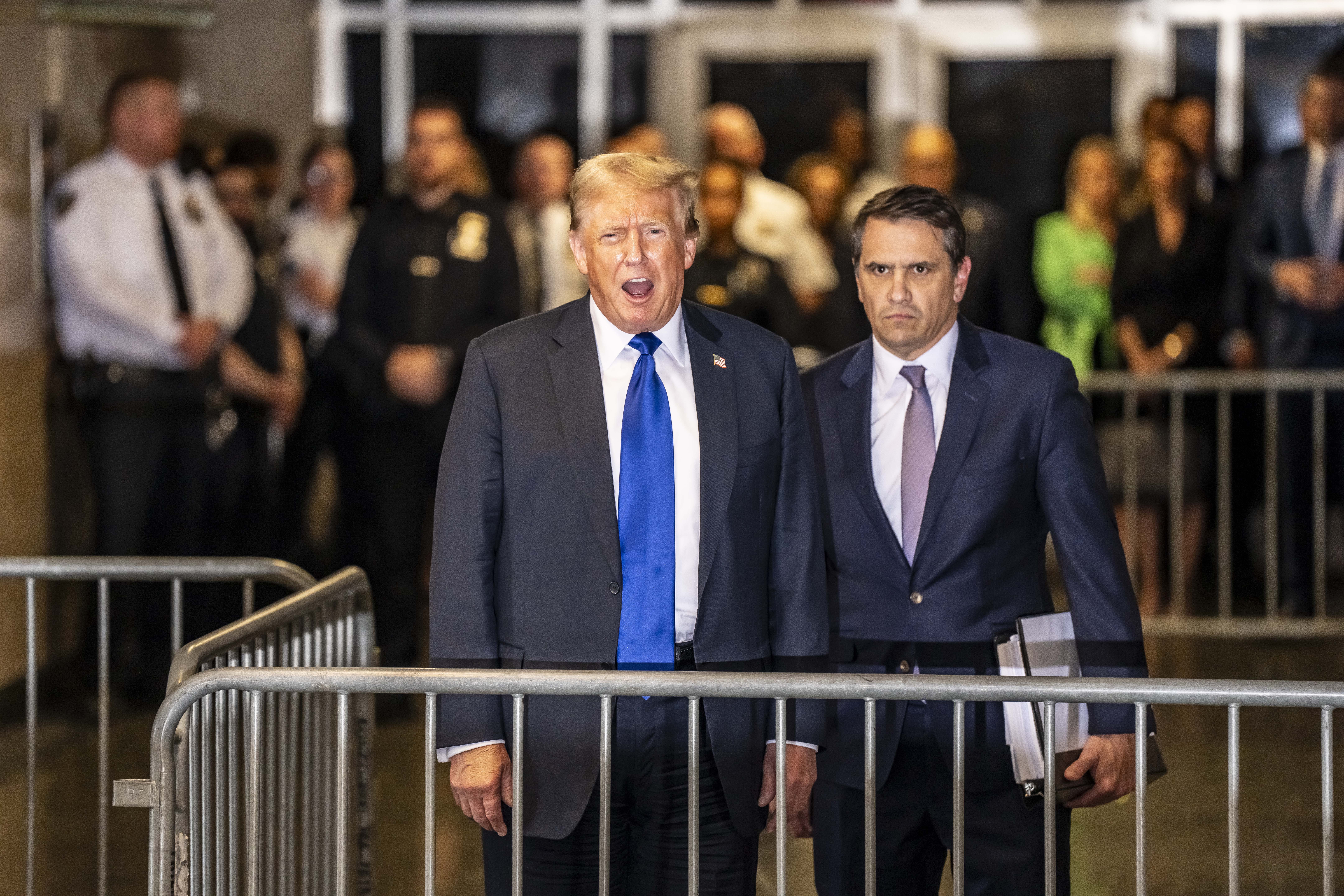
Trump and Blanche speak to reporters after Trump was found guilty following his hush money trial in New York City, May 2024 (Photo by Mark Peterson – Pool/Getty Images)
As is usually the case in the Trump administration, there is more than a little slapdash lawyering going on here. In an interview with The New Republic’s Greg Sargent last week, Maryland Democratic Congressman Jamie Raskin flagged a handful of potential constitutional and statutory problems with the fund’s design. My guess is that several lawsuits challenging the Anti-Weaponization Fund’s existence—long-shot lawsuits, sure, but it can’t hurt to try—will have been filed in federal courtrooms by the time you read this sentence.
Whatever the fund’s eventual fate, the fact that Trump feels comfortable pulling a stunt like this demonstrates just how much contempt he has for the work of governing; how completely he has repurposed the Justice Department to serve as his personal law firm; and how unencumbered he feels by the rules that apply to everyone else. The goal of his lawsuit was never to hold the IRS accountable for leaking his tax returns six years ago. It was to use the vehicle of a litigation settlement to do something Trump could not otherwise accomplish—and to try and prevent anyone else in a position of power from doing anything about it.
This post has been updated with additional details from the settlement agreement, which the Justice Department released after publication, as well as details from Williams’s order on Monday evening.