
Justice Samuel Alito has been ruling on cases involving the oil and gas industry for years. And all the while, fossil fuels have been making him filthy rich.
Back in 1990, when President George H.W. Bush nominated Alito to a federal judgeship, Alito disclosed to Congress that his net worth was slightly over $300,000, and he reported no direct interest in oil and gas extraction. By 2005, when Alito was nominated to the Supreme Court, he reported a net worth of roughly $2.1 million, about 7.6 percent of which was attributable to stock in Exxon Mobil.
By 2024, Forbes estimated Alito’s net worth to be $10 million. And yesterday, a new analysis of Alito’s financial disclosures conducted by True North Research revealed that over a quarter of that wealth—up to $2.9 million—may be attributable to oil and gas interests.
Calculating exact values is challenging because Supreme Court justices disclose the value of their assets in broad ranges. On Alito’s 2024 financial disclosure, for example, he reported holding stock in Phillips 66, a major oil company, worth “$15,001–$50,000”; for the largest fossil fuel asset he disclosed, a “mineral interest” in a property in Grady County, Oklahoma, he reported the value as “$100,001–$250,000.” Even using the low end of the disclosures, though, Alito has gained over $330,000 from oil and gas interests while sitting on the Supreme Court. Put differently, the amount of money Alito has made from fossil fuels while on the bench is greater than all the money he had to his name before he joined it.
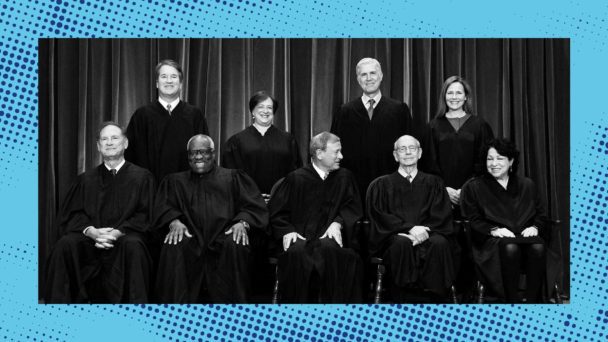
Alito’s oil riches have helped make him the second-wealthiest person on the Court, according to Forbes’ estimate, behind Chief Justice John Roberts—the only other justice with an eight-digit net worth. Although all the justices have various investment holdings, like retirement accounts and mutual funds, only Alito and Roberts hold stock in individual companies, which creates clear conflicts of interest. And while Roberts has disclosed stock in two companies, Alito has a personal stake in dozens, which regularly leads Alito to recuse himself from cases before the Court.
Alito has failed to recuse himself, however, from Suncor Energy v. Boulder County, a major case that the Supreme Court will hear in October. The result in Suncor Energy will impact the oil and gas industry and, thus, Alito’s bottom line. But Alito claims he has no obligation to recuse himself.
Suncor Energy arises out of a 2018 lawsuit filed in state court by Boulder County, Colorado, which seeks monetary compensation from ExxonMobil and Suncor for the “past and future damages and costs” of climate change. Boulder County alleges that the companies “knowingly caused and contributed” to the state’s shifting climate conditions while “hiding” and “affirmatively misrepresenting” the dangers that “they knew were occurring and would occur” because of their conduct.

(Photo by Brooks Kraft LLC/Corbis via Getty Images)
Specifically, Boulder County argues, the companies’ unchecked fossil fuel use has led to more days with “extreme heat,” less “water availability,” “larger and more frequent wildfires,” and other harms that continue to threaten property and public health. And under state tort law, Boulder County says, Exxon and Suncor must pay for that harm.
Oil companies are unsurprisingly opposed to the prospect of accountability. So for years, they’ve been trying anything and everything to keep the Suncor Energy case and others like it out of court. Most relevant here, the companies contend that state lawsuits can’t proceed because Congress already regulates greenhouse emissions via the Clean Air Act. Colorado’s state supreme court rejected that argument in May 2025, joining the state high courts of Hawaii and California in holding that these cases can go to trial.
Suncor Energy’s appeal is now before the Supreme Court. And unless Alito recuses himself, the possibility of financial accountability for the climate crisis will be left up to someone financially invested in the perpetuation of the climate crisis.
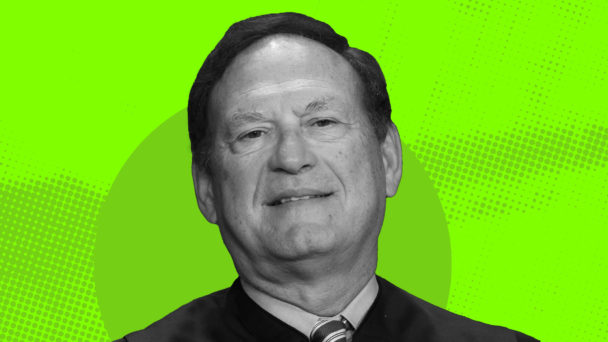
Dozens of government watchdog groups and environmental organizations sent a letter to the Senate Judiciary Committee pushing for an investigation into whether Alito’s recusal practices violate the Supreme Court’s code of conduct, as well as a federal law that requires judges to recuse themselves from proceedings in which “impartiality might reasonably be questioned.”
In response, a spokesperson for the Court told NBC News that Alito’s recusal is “not required” in Suncor Energy because, unlike related cases in which he recused, Alito “does not have a financial interest” in any of the parties involved in Suncor Energy. The argument here is basically that, even though Alito is entangled with oil and gas generally, he doesn’t own stock in Suncor or Exxon specifically, so he has nothing to gain or lose by the outcome of the case.
The oil industry understands that this argument is nonsense. In September 2025, for instance, the American Petroleum Institute filed an amicus brief urging the Court to take up Suncor Energy, and arguing that the Court’s decision would have “broad implications for the entire petroleum and natural-gas industry,” since state climate lawsuits threaten to “destabilize the whole sector.” In a 2022 filing, Suncor and Exxon Mobil explicitly argued that the case was the “best approaching opportunity” for the Court to decide whether any state climate lawsuit may proceed without running into “recusal issues.” In other words, Alito’s hands would appear slightly less dirty, but he would still be able to put a thumb on the scale.
The Supreme Court’s token ethics guidelines are easy for both Alito and the oil industry to manipulate. And until Congress gets serious about imposing meaningful, enforceable standards, the public and the planet will keep bearing the costs of the Court’s corruption.