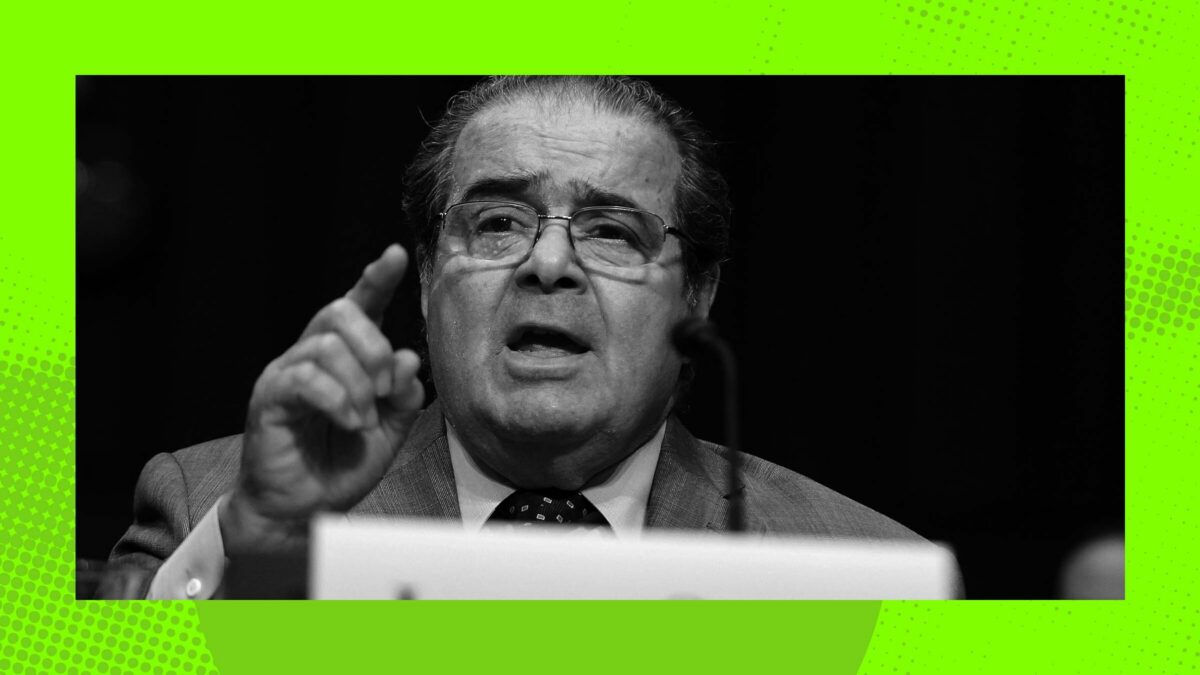
In recent years, Justice Clarence Thomas’s fondness for taking luxury vacations on billionaire-owned superyachts has made Supreme Court ethics reform perhaps the single easiest campaign promise for Democratic politicians to make. But two decades ago, the real-world particulars of Supreme Court conflict-of-interest scandals were smaller in scale: for example, the physical proximity of Justice Antonin Scalia to Vice President Dick Cheney when the two men were sitting in duck blinds, shotguns in hand, waiting to kill some birds.
The saga began in January 2004, shortly after Cheney and Scalia—good friends since their time working together in the Ford administration—traveled to Louisiana for an annual duck hunt hosted by an acquaintance of Scalia’s. Cheney invited Scalia to join him on a government plane for the flight from Washington; Scalia, along with his son and son-in-law, accepted.
The objectionable part of this story (legally speaking, I mean) was that several weeks earlier, the Court had granted certiorari in a case about whether Cheney had to disclose details about clandestine meetings with fossil fuels executives while he was leading a task force responsible for the Bush administration’s energy policy. The Sierra Club had argued that Scalia, fresh off a vacation with the vice president and a free flight on Air Force Two, should recuse himself from the case, on the grounds that his impartiality “might reasonably be questioned.”
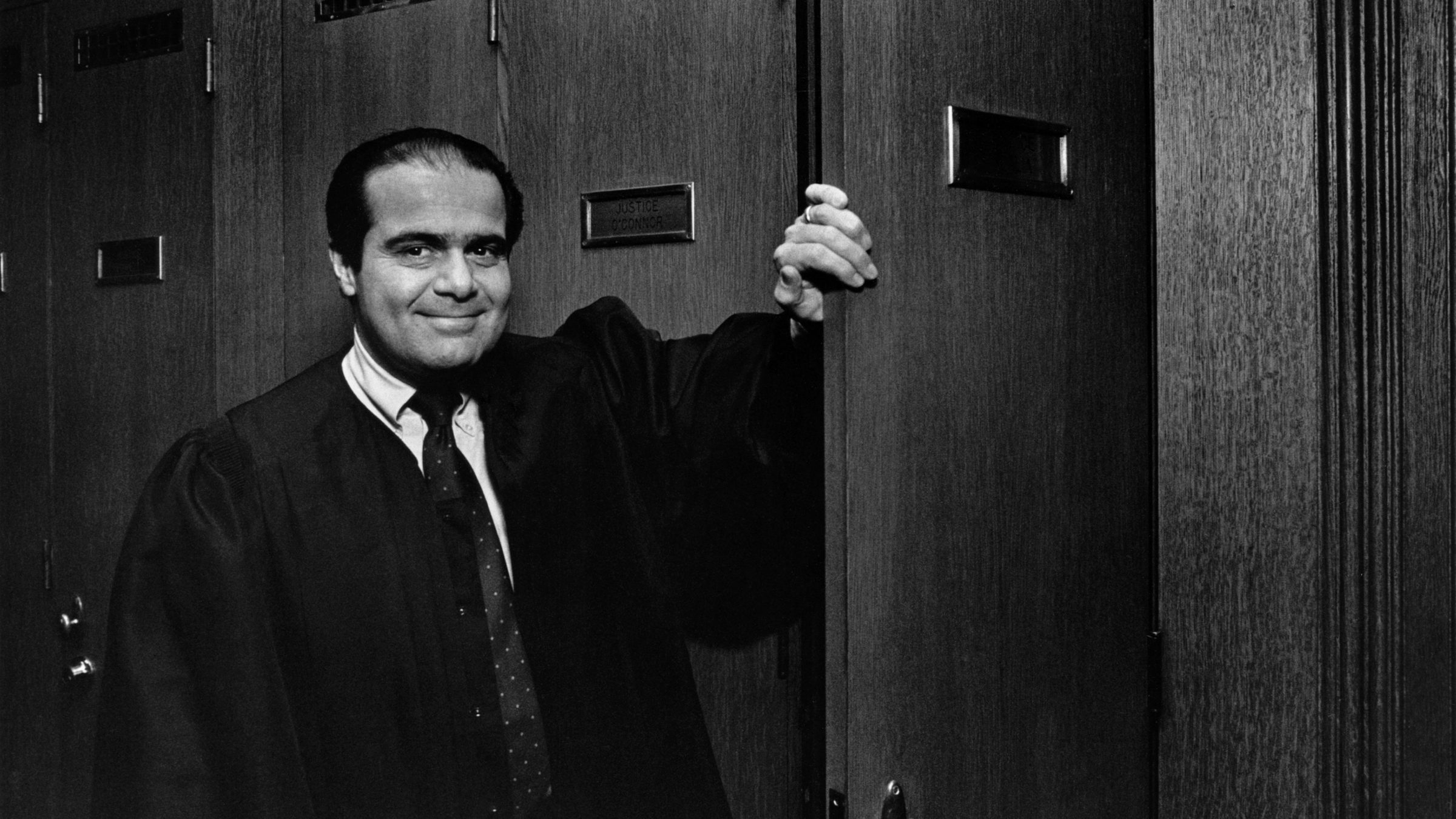
(Photo by Janet Fries/Getty Images)
Scalia refused, however, releasing a 21-page memo in which he assured the public that he and Cheney had not discussed the case, and had never even been alone together—in duck blinds or otherwise—during the entirety of the trip. After running through a brief history of social relationships between Supreme Court justices and elected officials, from poker games to dinner parties to Chief Justice Harlan F. Stone’s early-morning medicine-ball workouts with members of the Hoover administration, Scalia asserted that a rule requiring the justices to recuse themselves from cases involving their famous friends would be “utterly disabling.”
As it turns out, Scalia was far more involved in the Court’s handling of Cheney’s case than he let on. As CNN reported earlier this week, the papers of the late Justice John Paul Stevens indicate that, as of late 2003, the justices were ready to reject Cheney’s case, which would have upheld a lower court ruling against the vice president. But several months before his planned trip with Cheney, Scalia began lobbying his colleagues to reconsider. We do not know for sure whether he did so because of the approaching trip, or simply because he wanted to do Dick Cheney a solid. What we do know is that he succeeded: Shortly before Scalia and Cheney left town, the Court elected to take the case after all.
In his memo, Scalia argued that because he and Cheney (ostensibly) did not hunt in the same blind, Americans could trust him to cast a vote in Cheney’s case without fear or favor. Strangely, the fact that Scalia was more or less personally responsible for persuading the Court to hear Cheney’s case did not come up.
The substance of CNN’s report underscores just how much Scalia, like many of the conservative justices, understood his ability to help out his allies as a job perk to which he was entitled. But what is also striking about reading Scalia’s memo in 2026 is how much time he spent railing against what he considered to be the real villain of the story: the media. At the time, many of the country’s largest newspapers had published editorials calling for Scalia’s recusal, which the Sierra Club described as evidence that his participation would create, at the very least, the “appearance of favoritism.”
In his memo, Scalia described this argument as “staggering.” After listing details about the trip that he claimed the offending newspapers got wrong, Scalia warned of the dangers posed by “so-called investigative journalists” demanding recusal for “inappropriate” and “increasingly silly” reasons. If the justices felt pressured to step aside in politically sensitive cases merely because of their “social contacts” with politicians, he argued, that would give “elements of the press” the power to “veto” justices’ right to participate—a result he deemed “intolerable.”
“The people must have confidence in the integrity of the Justices,” Scalia wrote. “That cannot exist in a system that assumes them to be corruptible by the slightest friendship or favor, and in an atmosphere where the press will be eager to find foot-faults.” It is an argument that turns the entire point of recusal on its head: A justice’s howlingly obvious conflict of interest does not obligate them to recuse themselves from cases involving their powerful friends, and instead requires them to participate in order for the legal system to function.
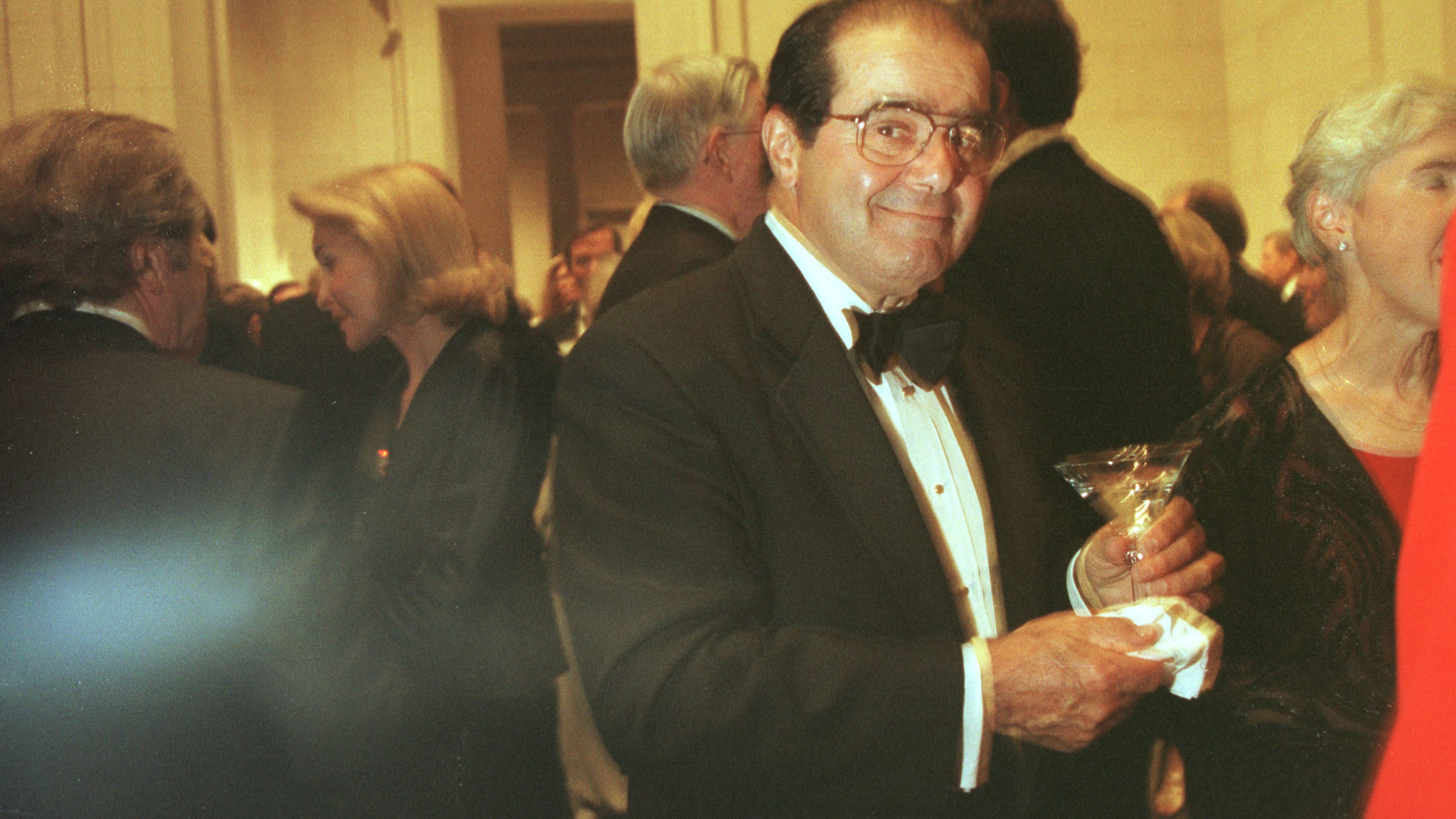
(Photo by Karin Cooper/Liaison)
Especially in his later years, Scalia often indulged in the sort of own-the-libs bombast familiar to anyone who has listened to President Donald Trump denounce the “fake news media” while rallygoers lose their minds. In 2013, for example, Scalia told New York magazine that he’d unsubscribed from The Washington Post because of its “slanted and often nasty” treatment of conservatives, and suggested that the Post had lost subscriptions because it was “so shrilly, shrilly liberal.” He also revealed that he preferred to get his news by reading The Wall Street Journal and The Washington Times, and listening to Rush Limbaugh’s radio show during his commute.
Like Trump, though, what Scalia really found objectionable about the press was the idea that anyone would attempt to hold him accountable for his actions. In perhaps the most revealing line of the memo, he summarized the Sierra Club’s argument as asserting that he should recuse from Cheney’s case “because a significant portion of the press, which is deemed to be the American public, demands it.”
In Scalia’s view, the greatest threat to the Court’s legitimacy was not the appearance of impropriety that his participation would create. Nor was it, as Stevens’s papers make clear, the fact that behind the scenes, Scalia was indeed abusing the power of his office to do his old hunting buddy a favor. Instead, it was newspapers who had the temerity to cover the story in ways he did not like.
In the years since Scalia’s death in 2016, revelations of the justices’ ethical misadventures have made abundantly clear that reporters were correct to be skeptical of Scalia’s assurances that Supreme Court justices, by virtue of being Supreme Court justices, can be trusted to do the right thing. But in his memo, Scalia showed his colleagues exactly how to respond to criticism: by blaming waning trust in the Court not on the justices, but on journalists who do not give them the benefit of the doubt.