It’s not that the U.S. Supreme Court’s right-wing justices don’t recognize the bad-faith arguments that have worked so splendidly in advancing the right’s anti-constitutional agenda. It’s that they don’t care.
So when the country’s vast and well-coordinated conservative legal apparatus shoves a case before the Court’s six-justice conservative supermajority—pretending to care about protecting women’s sports, let’s say, or pretending that Jim Crow-style gerrymanders have nothing to do with race—Chief Justice John Roberts and the rest can give their rubber stamp.
That has not been true of most of the federal judiciary over these past 18 months, though. Time and again, lower court judges have called out the bad faith inherent in the Trump regime’s arguments, which it is using to intimidate and persecute its opponents and push its nakedly plutocratic, anti-democracy agenda. It’s why the Roberts Court is at war with federal judges who feel obliged to abide by the most basic constitutional principles: These judges won’t play the regime’s bad-faith game.
The fact that Roberts and Samuel Alito and Clarence Thomas operate in the worst faith imaginable remains important—maybe more important than anything in our descent into competitive authoritarianism, since none of the Trump administration’s attacks on the constitutional order would fly if the Court refused to play this game. But the overall rejection of bad-faith legalism, I think, should be seen as an encouraging development, and a clear signal that our Government of Memes can’t overthrow 250 years of constitutional order.
In September 2025, for example, a federal judge in Massachusetts issued an order denying the Trump Justice Department’s attempt to subpoena doctors who treat transgender patients. The administration, taking cues from the rabid anti-trans activists that support it, had claimed to be looking out for the health and safety of young people seeking gender-affirming care, just as they have spent decades feigning concern for women seeking abortion care. In July 2025, then-Attorney General Pam Bondi, a champion of children if there ever was one, vowed to take action against “medical professionals and organizations that mutilated children in the service of a warped ideology.”
Massachusetts District Court Judge Myong Joun, though, chose not to ignore the regime’s frothing hatred of trans people. Instead, Joun recognized what the regime was actually doing by targeting doctors at Boston Children’s Hospital: trying to bully them into refusing to provide treatment to trans patients. “The administration has been explicit about its disapproval of the transgender community and its aim to end [gender-affirming care],” Joun wrote. “It is abundantly clear that the true purpose of issuing the subpoena is to interfere with Massachusetts’s right to protect [gender-affirming care] within its borders.”
The DOJ subpoenas, Joun correctly concluded, were “motivated only by bad faith.”
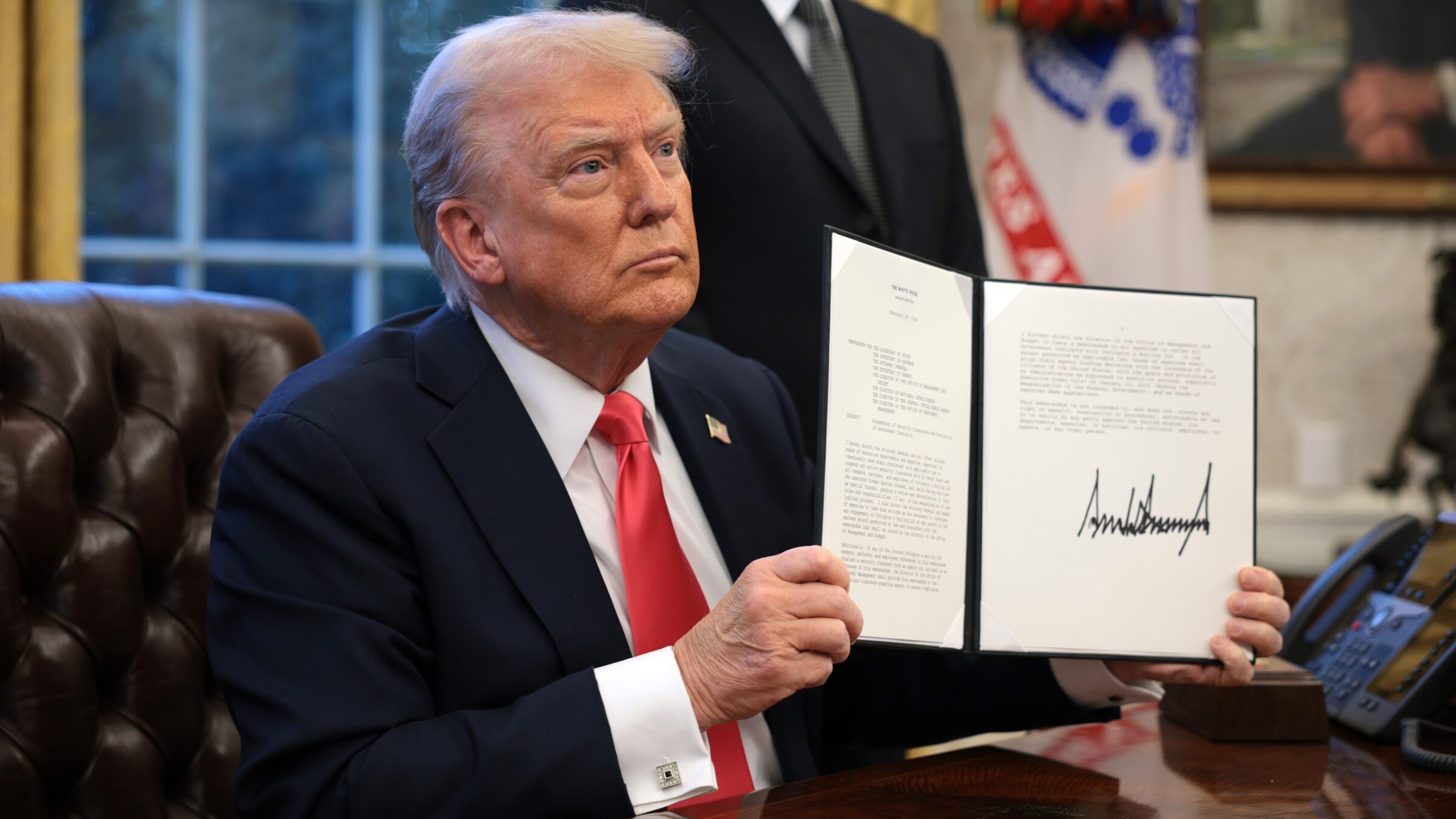
(Photo by Alex Wong/Getty Images)
The judiciary’s contempt for the Trump administration’s lawlessness is also evident in a 2025 case about the Department of Education’s efforts to strip federal funding from public schools that refused to end efforts to promote diversity among educators, students, and the curriculum. In an April 2025 order, New Hampshire District Court Judge Landya McCafferty saw right through this bad-faith interpretation of diversity, equity, and inclusion, and said plainly that the department’s policy made no sense.
The “isolated characterizations of unlawful DEI” referenced in Trump’s order, McCafferty wrote, are “inconsistent with the ordinary meaning of that phrase.” Citing only The Merriam-Webster Dictionary, McCafferty wrote that DEI refers to “a set of values and related policies and practices focused on establishing a group culture of equitable and inclusive treatment,” which includes attracting “people who have historically been excluded or discriminated against”—in other words, it is not some grand left-wing policy to discriminate against white people.
The fact that teachers would violate the administration’s anti-diversity directive if they expressed the view that structural racism exists, but would not violate it if they denied the existence of structural racism, McCafferty concluded, is “textbook viewpoint discrimination.”
What McCafferty did here is pop the bubble in which the American right exists, in which white people are the aggrieved victims of DEI-fueled racism. When policies, directives, and proposals based on this unreality enter a reality-based courtroom, though, they deflate. McCafferty killed this policy simply by correctly defining DEI. It’s the One Weird Trick to defeating Republicans’ anti-constitutionalism.
Finally, just last month, a federal judge said that Trump’s kayfabe lawsuit against the Internal Revenue Service constituted a manipulation of the judicial process. The president was not suing the IRS—which, as president, he controls—for legitimate purposes, but because he had installed loyalists in the government who would play along. Sure enough, in May 2026, then-Acting Attorney General Todd Blanche announced that, as part of a “settlement” of the case, the government would establish a $1.8 billion fund to reward Trump supporters who were “victims of lawfare and weaponization” during the Biden administration—a group that includes those who tried to overthrow the government on January 6, 2021.
In an order following the announcement of the settlement, Florida District Court Judge Kathleen Williams found that the settlement was (you guessed it) in bad faith. Both the nature of the lawsuit and the parties’ conduct throughout, she wrote, “make plain that this was an attempt to use the Court to provide some legitimacy to an agreement to confer immunity to people and entities affiliated with the President and to earmark billions of dollars from American taxpayers to redress grievances not defined in the law.”
Williams found the lawyers’ conduct in this case so egregious that she referred one to the Florida Bar for disciplinary proceedings, and blocked another lawyer who represented Trump from appearing in the Southern District of Florida for the coming year. Imagine that: someone facing a consequence for trying to manipulate the country’s legal system.
I point out these rejections of the Trump regime’s bad-faith legalism not to claim some grand victory over those who would overthrow the constitutional order, but because I think it’s critically important to imagine what it would be like to have this kind of clear-eyed approach to the law on the land’s highest court. Imagine a Supreme Court with a majority that acknowledges what the anti-constitutionalists are really after. Imagine a Court that takes the Constitution seriously and does not function as a backstop against progressive policymaking.
These judges aren’t saying or doing anything extraordinary. They are saying they have read the news, and that they have seen the incendiary and often outrageously prejudiced comments from administration officials and the president himself. But a Court controlled by six conservatives is never going to do this sort of analysis. Until Democrats are serious about expanding the Supreme Court, anyone pushing back against the GOP’s authoritarian blueprint just has to hope that they draw a serious judge—and that Roberts and company don’t then swoop in afterward and save their right-wing teammates from defeat.