
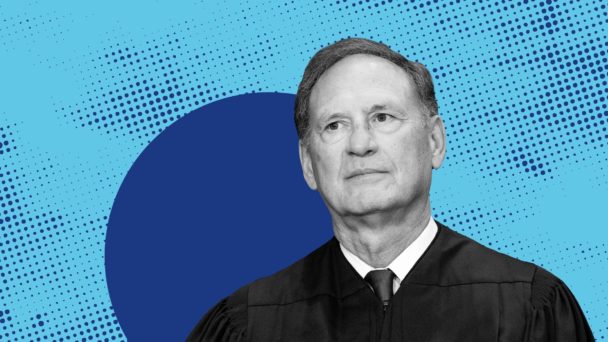
Earlier this month, Justice Samuel Alito published So Ordered, a collection of selected speeches that he has delivered during his tenure on the Supreme Court. In the book, he reflects on his preferred approach to constitutional interpretation, originalism, which he defines as “the theory that constitutional provisions should be understood to mean what the public would have taken them to mean when they were adopted.”
In order to determine the original public meaning, Alito writes, he sometimes wonders what the Bill of Rights might have meant to the average patron “at one of the colonial-era taverns,” rather than “the most-well-read and philosophically minded men of the day.” Evidently, women, enslaved people, and literally everyone alive today do not factor into Alito’s constitutional imagination.
For someone who claims to be so concerned with history and tradition, Alito presents a deeply misleading history of how originalism came to be. In So Ordered, Alito admits that the originalist movement arose as a reaction to “certain judicial decisions” in the 1950s and 1960s that “were perceived to rest on judges’ personal policy preferences”—especially cases that protected “non-economic rights,” and were “seen as hampering law enforcement.” In response to these rulings, he says, conservatives set out to craft a new model of legal interpretation that could “explain where the Court had gone wrong” and “change the direction of the Court’s work.”
But Alito says very little about the substance of the decisions that critics hated so much. For reference, in the 1961 case Mapp v. Ohio, the Court held that the Fourth Amendment prohibition on unreasonable searches and seizures bars prosecutors from using unconstitutionally seized evidence in state criminal trials. In the 1963 case Gideon v. Wainwright, the Court held that the Sixth Amendment right to an attorney in criminal trials requires states to provide an attorney to defendants who can’t afford one. And in the 1966 case Miranda v. Arizona, the Court held that cops need to actually tell people in custody of their rights to remain silent and to an attorney before they start interrogating them.
To a normal person, decisions like these might seem like pretty reasonable interpretations of pretty basic constitutional commitments. To Alito, they were unprincipled exercises of raw power. In So Ordered, Alito portrays the justices in the Civil Rights Era as self-righteous men, “confident that they could see the arc of history and that they were simply guiding the country down the road to a better future.” According to Alito, the Court went down this road without articulating a sound theoretical basis for doing so, and as a result, “approval of the Court’s decisions was heavily dependent on acceptance of the Court’s vision of progress.” He does not acknowledge that the vision originalists deemed unacceptable was the Constitution’s own vision of egalitarian democracy.
The most striking aspect of Alito’s whitewashing of originalism’s history is the book’s treatment of Brown v. Board of Education, the 1954 case in which the Court, under the leadership of Chief Justice Earl Warren, unanimously declared that laws requiring racial segregation in public schools are unconstitutional. Alito recognizes that originalism was born from the backlash to unspecified Warren Court decisions that critics thought went “too far” in “imposing” the Court’s values on the rest of the country. Yet he suggests that Brown is not among the Court decisions that originalists reject as flawed. “When Warren’s personal values coincided with the Constitution, as they did in Brown v. Board of Education, this approach produced magnificent results,” said Alito.
That would be news to the architects of originalism. In Brown, the state of Kansas defended its segregated school policies in part by arguing that the Congress that passed the Fourteenth Amendment “did not contemplate or understand” the provision to abolish segregated schools. Kansas contended that the framers of the Fourteenth Amendment intended the “management” of public schools to be “left to the state legislatures,” and called the notion that the Court could take that power from the states “repugnant to the basic theory of written constitutions.”
When the Court issued its ruling in Brown, it explicitly rejected the originalist idea that the meaning of the Constitution is forever fixed in time. “In approaching this problem, we cannot turn the clock back to 1868 when the Amendment was adopted, or even to 1896 when Plessy v. Ferguson was written,” said Warren. The “only” way to determine if segregation in public schools violated the Constitution, he said, was to “consider public education in the light of its full development and its present place in American life throughout the nation.”

Roughly two years later, roughly 100 members of Congress, all representing former Confederate states, published a document arguing that Brown was an exercise of “naked judicial power” and “contrary to the Constitution.” To support this proposition, they noted that the Fourteenth Amendment says nothing about education, and that many of the same states legislatures that ratified the Fourteenth Amendment also established segregated schools. Thus, they argued, the framers “clearly” didn’t intend the Amendment to disturb state-mandated racial segregation, and the Court had no authority to rule otherwise.
The reasoning employed by the segregationist congressmembers would come to typify originalist decisionmaking. Just ask Alito, who likewise justified his ruling overturning Roe v. Wade in part by tallying up state laws regarding abortion in 1868. And their arguments illustrate how originalism was a direct outgrowth of the massive resistance to Brown v. Board.
In So Ordered, Alito presents originalism as a tool for restraining judges from “using constitutional decision-making as a vehicle for imposing their own policy preferences.” His sanitization of originalism’s history obscures the fact that originalism is precisely such a vehicle. Originalism did not emerge, as Alito suggests, because there was something dangerously unprincipled about the Court’s decisionmaking in the Civil Rights Era. It emerged because conservatives wanted constitutional support for the continued oppression of historically marginalized people. Originalism continues to provide that cover for opposition to civil rights.