In January 2026, President Donald Trump sued the Internal Revenue Service and the Treasury Department for $10 billion, alleging that the agencies failed to prevent a contractor from leaking the family’s tax returns in 2020. The lawsuit, which Trump filed along with his sons Don Jr. and Eric, puts the President of the United States in the position of suing the government he runs.
Rather than file a response to the complaint, Trump’s Justice Department—the same Justice Department he’d spent the last year transforming into his personal law firm—moved for an extension of time to reply so that it could complete settlement talks with Trump.
Trump’s case against the IRS is only one example of his prodigious use of lawsuits in service of his desired personal and policy outcomes. Long before winning his first term in 2016, Trump claimed that he was “like a Ph.D. at litigation,” and he has frequently sued adversaries for eye-popping sums. Now, in addition to personal lawsuits like the one against the IRS, Trump has pushed Justice Department lawyers to initiate civil and criminal cases against his political enemies; used the threats of lawsuits to pressure universities and law firms to implement policy changes; and made sham settlements with red states to set policy without legislative input.
However, some federal judges seem to be scrutinizing Trump’s legal maneuvers with increased skepticism. On April 26, Judge Kathleen Williams, an Obama appointee who presides over the IRS lawsuit in Florida, ordered briefing and a hearing on whether it is possible for Trump’s Justice Department to negotiate a settlement with Trump that is in the public interest. Williams’s order raised concerns about whether the case is sufficiently adversarial; courts, she noted, can only hear cases where there is an “honest and actual antagonistic assertion of rights by one individual against another, which is neither feigned nor collusive.” If Trump cannot convince the court that he meets this bar, he risks not only losing the ability to settle, but an outright dismissal of the case.
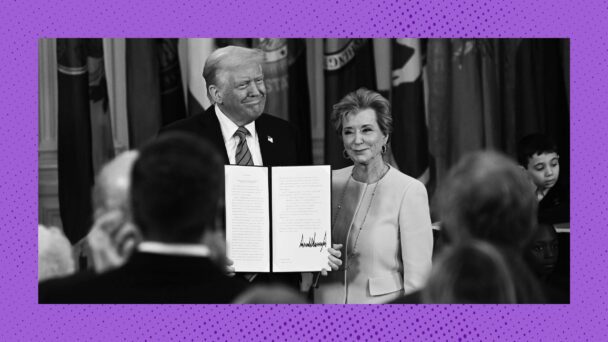
Generally, judges avoid second-guessing settlement negotiations between private parties. The governing principle treats settlements as a form of contract, in which two sides with legal capacity reach an agreement. Just as judges do not rewrite contracts simply because one party strikes a bad deal, they also prefer enforcing settlements to interfering with them.
At the same time, courts have recognized their responsibility to review settlement agreements that impact parties that are not involved in a lawsuit. And many of Trump’s most troubling lawsuits fall into two general categories of cases in which judges have more discretion: when the parties are not genuinely adverse, and when settlements effectively set public policy. When the settlement process is compromised in some way—or when it produces effects that extend beyond the parties in ways the law does not permit—courts are more likely to step in.
As in the IRS case, a major concern that can justify judicial intervention is the absence of meaningful adversarial representation. Courts rely on the adversarial system to arrive at ideal results, counting on each side to present its best case. When judges analyze whether settlements are “fair, reasonable, adequate, and in the public interest,” having both sides of a settlement controlled by aligned interests can raise concerns. Courts routinely scrutinize settlements in contexts in which one party purports to represent many others—for example, class actions and shareholder derivative suits—because the interests of the parties in a particular lawsuit may not reflect the full range of parties affected by its settlement.
Returning to the Trump lawsuits, if the government’s legal strategy is directed in a way that aligns it with the interests of an ostensibly opposing party—here, Donald Trump and his sons—then the court has reason to question whether the United States is being represented by an advocate capable of negotiating in good faith. A judge’s task is to determine whether the agreement emerged from a process that resembles genuine bargaining, or something closer to theater. In these cases, courts may require details of the negotiations, probe the independence of decisionmakers, and even reject settlements outright.

Second, there is the problem of settlements that go beyond dispute resolution to effectively set public policy. Again, courts generally presume that parties are best positioned to settle their own cases, but that presumption weakens when an agreement commits the government to a course of action that resembles legislation. Thus, courts often evaluate consent decrees involving government entities for their consistency with the public interest, and may refuse to approve agreements that exceed the legal authority of the parties.
When the Department of Justice enters into settlements with states that effectively establish policy—particularly where those policies would ordinarily require legislation or rulemaking—a court can decline to approve the agreement unless it is narrowed or subjected to oversight.
In June 2025, the Trump administration sued the state of Texas over a law that provides in-state tuition to undocumented residents. Within six hours, Texas officials agreed to a “settlement” that invalidated the law, and Judge Reed O’Connor, a district court judge in Texas, approved it. That cursory process is consistent with O’Connor’s broader record of support for the right: An appointee of President George W. Bush, O’Connor has established his court as a forum for ideologically motivated suits brought by Republican officials, who seek him out precisely because of his willingness to deliver rulings aligned with their policy goals
A court more attentive to its institutional role would have done lots of things differently: For example, it would have developed a factual record of the negotiations, questioned whether the parties were using settlement to circumvent the legislative process, and perhaps even declined to approve an agreement that effectively nullified a duly enacted law. O’Connor did none of those things, instead allowing the federal government, with the complicity of Texas Attorney General Ken Paxton, to overturn a law passed by Texas’s elected legislature.
Both settlement strategies that Trump has favored depend on coordination between his interests and the other party’s. But these strategies only work if courts play along with this charade, and decline to ask basic questions about adversity, authority, and the public interest. Williams’s skepticism in the IRS case shows that when judges are willing to step up, they may stop or slow the machinery of collusive or policy-driven lawsuits. The choice judges elsewhere face is whether to ratify these farces, or to do their jobs instead.