During the Biden administration, the Supreme Court’s six-justice conservative supermajority got very comfortable using the “major questions” doctrine to limit executive power. In his 2022 majority opinion in West Virginia v. EPA, for example, Chief Justice John Roberts argued that when an agency decides a question of “vast economic and political significance,” courts should not assume that Congress intended to grant that authority through broad or ambiguous statutory language. Instead, he wrote, the agency must identify “clear congressional authorization” for its action. If it can’t, the Court can strike down that action as beyond the agency’s authority.
The basic premise of the major questions doctrine is that because executive agencies exist to carry out Congress’s will, they can only act within the narrow confines of explicit delegations of authority. Under Roberts’s formulation, it is federal judges, not agencies, who get the final word on what Congress authorized and when an agency goes too far.
In news that will astonish you, since President Donald Trump took office for a second time, the Court has forgotten about all of this. Its jurisprudence during Trump’s second term has exposed the deep tension between two of the conservative legal movement’s signature projects: the major questions doctrine, which ostensibly constrains the executive’s policymaking power, and the “unitary executive” theory, which posits that presidents have near-unlimited authority to use the executive branch to set policy as they see fit.
The contradiction is more than just evidence of selective enforcement—it demonstrates that the Court’s true purpose is to put a constitutional gloss on judicial supremacy. The justices do not use these doctrines to protect legislative power from executive overreach, or the executive from unaccountable bureaucrats. They use these doctrines to reserve power for themselves.
The Court invoked an early version of the major questions doctrine in 2000 in FDA v. Brown & Williamson Tobacco Corporation, when Justice Sandra Day O’Connor rejected the Food & Drug Administration’s attempt to regulate tobacco under the Food, Drug, and Cosmetic Act; the fact that Congress had passed tobacco-specific legislation, O’Connor reasoned, was evidence that it did not intend to delegate tobacco regulation authority to the FDA. Similar decisions reflected skepticism toward agency interpretations of laws that would have produced major changes in national policy. However, the Court generally treated those cases as applications of ordinary principles of statutory interpretation rather than a separate rule governing administrative power.
That changed in West Virginia v. EPA. That case addressed an Obama-era challenge to the EPA’s Clean Power Plan, which sought to reduce greenhouse gas emissions from power plants by encouraging a shift from coal-fired electricity generation. But in a 6-3 vote, the Court held that the EPA had gone too far; Congress, Roberts wrote, had not given the EPA “clear Congressional authorization” to make decisions of such “economic and political significance.” This case transformed what had previously been a run-of-the-mill principle of statutory interpretation into an explicit doctrine for judicial review of agency authority.
This is not the only instance in which the Court invoked the major questions doctrine to frustrate a Democratic president’s agenda. In NFIB v. OSHA, for example, the Court blocked the Occupational Safety and Health Administration’s emergency COVID-19 vaccine-or-testing requirement for large employers, holding that OSHA lacked clear authorization to impose it. Existing federal law allowed OSHA to issue emergency standards addressing “grave danger[s]” in the workplace. But, the Court said, this language did not allow the agency to impose such a broad public health measure of “vast economic and political significance.”
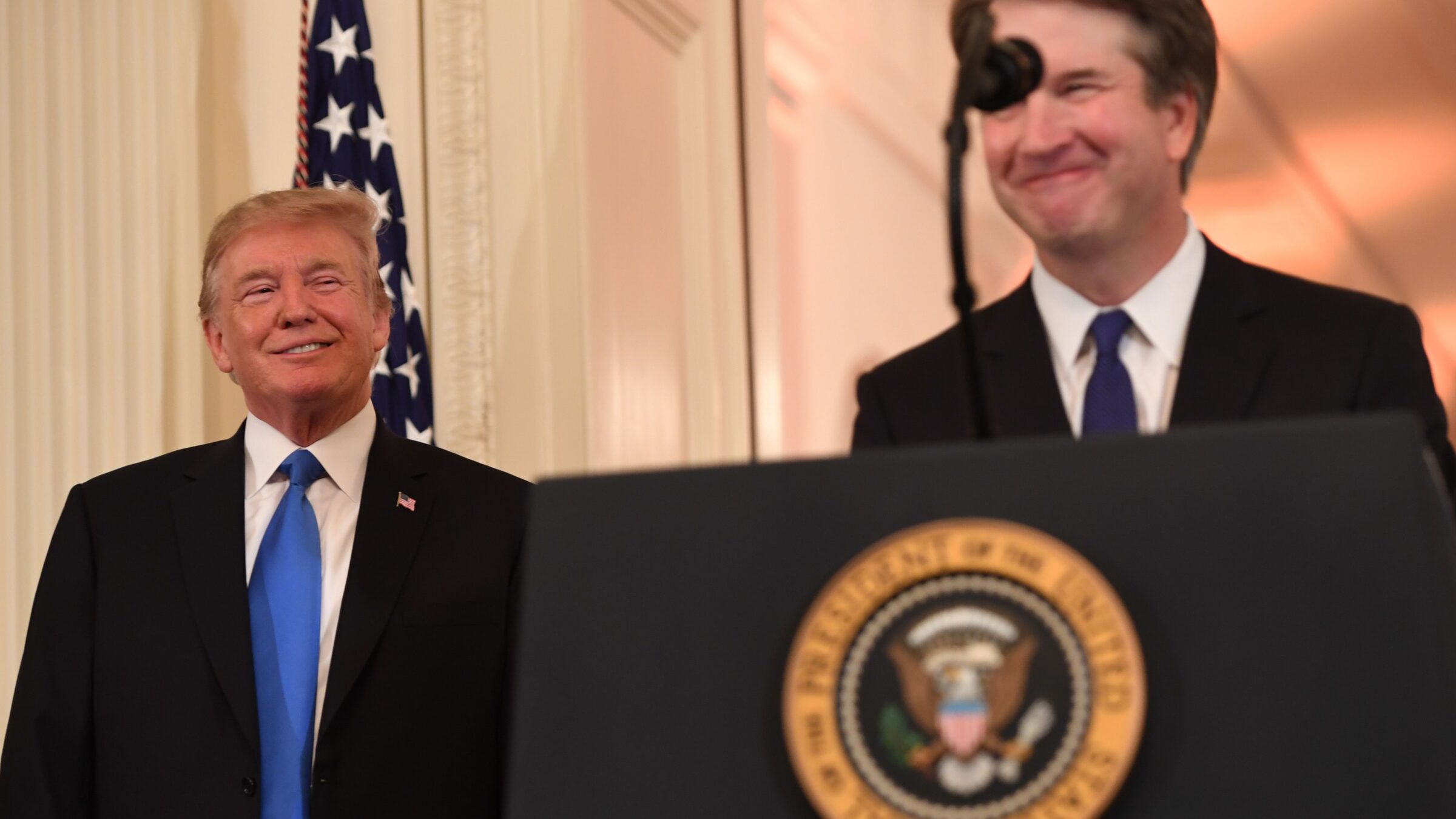
(SAUL LOEB/AFP via Getty Images)
The following year in Biden v. Nebraska, the Court struck down the Biden administration’s student loan relief program, which had relied on a federal law authorizing the Secretary of Education to “waive or modify” certain loan obligations during national emergencies. “However broad” it might be, Roberts wrote, such ambiguous language cannot authorize “exhaustive rewriting of the statute.”
In theory, the second Trump administration should put the major questions doctrine to the test. After all, since retaking the White House, Trump has pursued some of the broadest claims of executive authority in modern history, from asserting control over congressionally appropriated spending to dramatically restructuring agencies the conservative movement does not like.
Yet now that the president exercising power is a Republican, the Court has taken a very different approach. To date, it has invoked the doctrine only once during Trump’s second term, in Learning Resources, Inc. v. Trump, in which the Court struck down his tariffs regime as beyond the scope of the International Emergency Economic Powers Act. Roberts’s majority opinion ignored the doctrine and reverted to discussing the case as a simple matter of statutory interpretation. Only Justice Neil Gorsuch, a longtime champion of the major questions doctrine, wrote separately to argue that it independently supported the result.
Instead, under Trump, the Court has spent far more time discussing, developing, and defending a different principle related to executive power: the unitary executive theory, which asserts that Article II gives presidents broad authority to supervise executive officials, direct agencies, and ensure that federal law is carried out according to his or her agenda. Under Trump, the Roberts Court has used this theory to, among other things, limit restrictions on presidential removal authority and emphasize executive control over administrative institutions.
The practical challenge for the Court is the inherent tension between the major questions doctrine, which assumes that executive actors require explicit instructions from Congress, and the unitary executive theory, which holds that presidents possess broad authority to direct the executive branch. Rather than attempt to square the doctrines, however, the Court has simply applied them differently depending on who is in power. The major questions doctrine allows the Court to constrain (Democratic) presidents when it believes agencies have gone too far. Unitary executive theory allows the Court to reinforce (Republican) control over the executive branch when doing so aligns with the majority’s policy preferences.
By doing so, the Court has placed itself above the political branches as the institution that determines the scope of governmental power. And most importantly for Roberts, the final authority for determining when each doctrine applies lies with the Court itself.