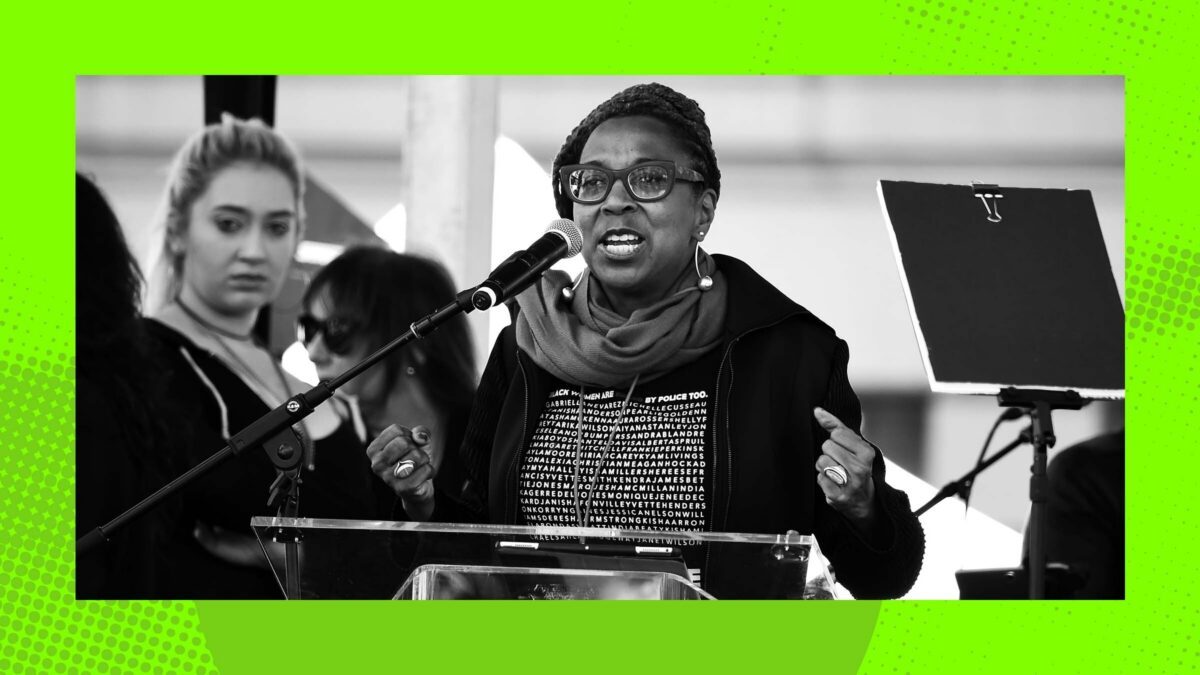
“Intersectionality” has reached such ubiquity that one can easily forget that someone had to theorize it. But it was Kimberlé Williams Crenshaw, a founding critical race theorist, who coined the term in 1989 as a junior law professor at UCLA to describe how the law fails to adequately respond to claims of discrimination from those whose identities sit at the intersection of different characteristics. In Crenshaw’s view, Black women were differently situated than both Black men and white women, but the law did not engage with that difference.
Crenshaw’s exploration of intersectionality dovetailed with the growth of critical race theory as a scholarly movement in legal academia. CRT, as it is often called, grew out of the critical legal studies movement; it critiques the structure and nature of law in its treatment of race, as critical legal studies questioned the nature and assumptions of law itself. CRT explores how law’s “colorblindness”—its obscuring of how “neutral” policies can lead to disparate effects along race and other vectors—re-establishes racial hierarchy.
The insights of intersectionality and CRT may seem obvious or quaint 40 years on. But Crenshaw’s new memoir, Backtalker, shows how when it comes to race and gender in American society, what’s old is new again.
In one early episode in CRT’s history, Crenshaw and her fellow travelers raised a question at a critical legal studies conference: “What is it about the whiteness of critical legal studies that keeps people of color at bay?” That question, which Crenshaw saw fitting in the tradition of critical legal studies’ questioning of power, elicited “howls of opposition,” she writes. Crenshaw and her comrades were labeled as promoting critiques that were too radical, “Mau Mauist” (a reference to a Kenyan uprising against British colonialism), and “the harangues that destroyed SNCC” (the Student Nonviolent Coordinating Committee, a leading 1960s civil rights group).
Apparently even mentioning race, and the ways in which institutions of power promote whiteness, was too much for those who claimed to critique the inequities of law. It’s an episode that with little updating could fit within our contemporary moment, in which mentioning race is treated as needlessly divisive by conservatives and centrists.
Crenshaw titled her memoir Backtalker to emphasize the importance of standing up for her values, even when it exacts personal cost. “Being a backtalker is like being lactose intolerant,” she explains. “There are things I cannot digest.” This is the core message of Crenshaw’s memoir: that fighting for social justice and legal reform is not just a lifelong struggle, but rather a calling one must constantly recommit to in the face of reactionary forces who will not cease in their opposition.
Crenshaw’s call to activism began during her Ohio childhood, growing up in the height of the Civil Rights Era. Just eight years old when Dr. Martin Luther King Jr. was assassinated, she stood up at a solemn memorial for King at a local church to exhort the community to continue fighting for King’s values even in the face of his tragic death.
Her commitment to her values continued through to her time as a Harvard Law School student. During her first year, Crenshaw and other students went to the dean to complain about the lack of minority professors; Derrick Bell, the famous civil rights lawyer and a leading architect of critical race theory, had just left Harvard to serve as the dean of the University of Oregon Law School.
Bell’s departure created a vacuum, both intellectually (no one took over his course on Constitutional Law and Minority Issues) and demographically (Harvard did not hire a minority law professor to replace him). But when Crenshaw and her fellow students expressed their frustration over the dearth of minority professors, the dean’s response was, “Wouldn’t you prefer an excellent white professor over a mediocre Black one?”
This tired shibboleth—that elevating any minority voice requires lowering one’s standards—persists even today, with the claims that affirmative action gives opportunities to underachievers who don’t deserve it. But the Harvard institutional response betrays something subtler as well: a belief that ignoring the intersections of race and law doesn’t hurt students, and that having an overwhelmingly white and male faculty is just fine. It certainly wasn’t fine by Crenshaw, who worked with her fellow students to invite minority law professors from other institutions to guest teach a student-designed course, and recruited Harvard Law faculty to supervise it as independent study. But amid all the students’ extra labor, the institutional coldness—even hostility—stands out.
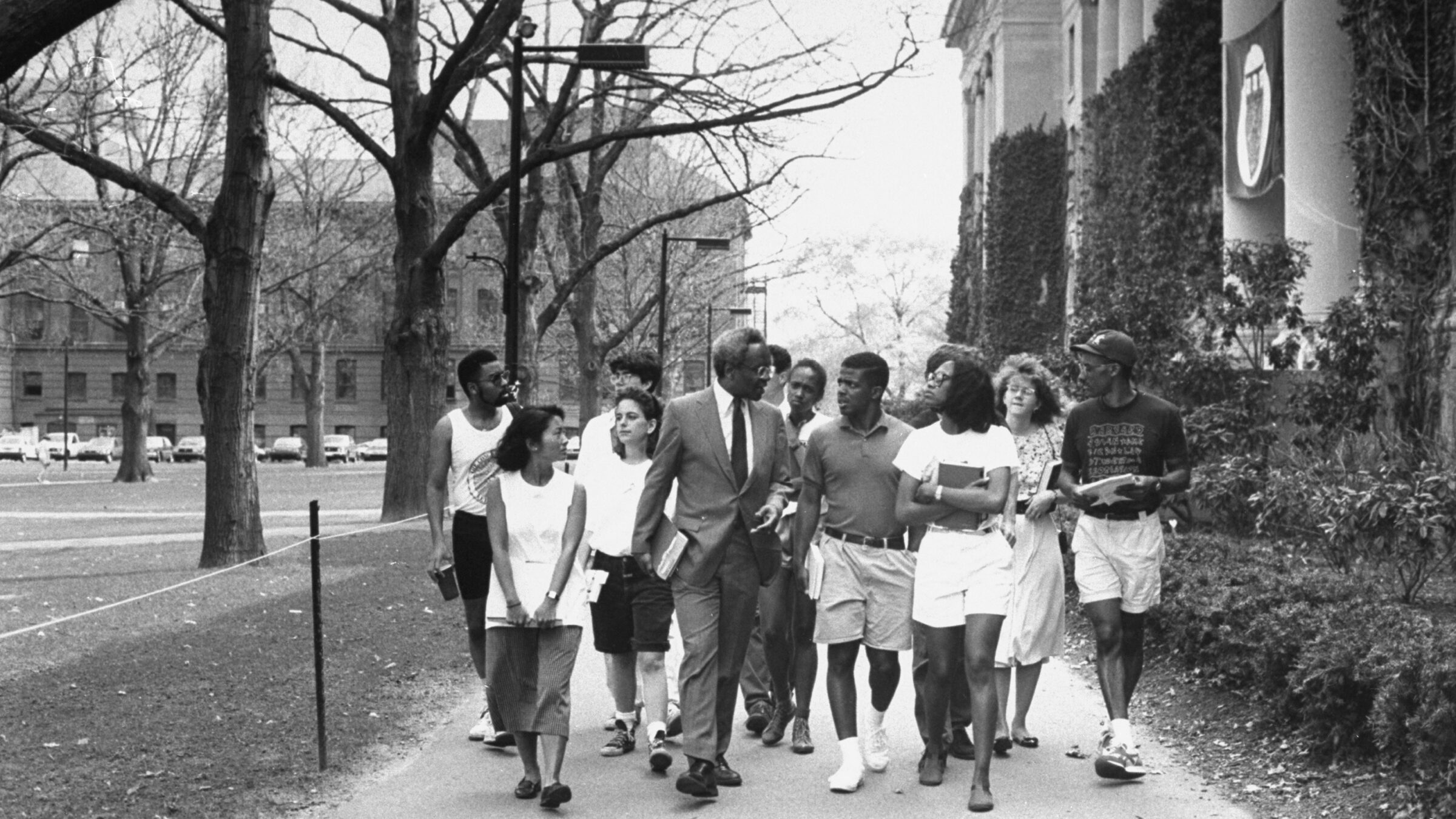
Bell walks with a group of law students after a taking leave of absence to protest the law school’s practice of not granting tenure to minority women professors (Photo by Steve Liss/Getty Images)
That hostility shares a common thread with more recent examples of pushback to minority representation or public discussion of systemic racism. Consider the right-wing hysteria that the 1619 Project elicited, merely by centering race in the story of American history, or how red states have rushed to prohibit discussions of race and gender in K-12 public education. Crenshaw’s description of Harvard Law’s opposition to inclusion of those topics, even in an elite law school, serve as a historic antecedent of more heated contemporary battles.
As to the supposed mediocrity of minority professors, that too finds an analogue in our current moment. The racist rhetoric often lobbed at Justice Ketanji Brown Jackson assumes that, as a Black woman, she must be intellectually incapable of serving on the highest court, and of course could only have secured confirmation as a “DEI hire.” Crenshaw’s experiences at Harvard forty years ago sound all too familiar for those of us who see how the legal system and culture more generally seek to stamp out inclusion or discussion of race and gender.
Backtalker’s description of the Clarence Thomas confirmation hearings 35 years after they took place has an equally resonant connection to our moment. To replace Thurgood Marshall, the retiring civil rights titan and first Black justice, President George H.W. Bush selected another Black judge—Thomas, a conservative former Reagan appointee who had served on the U.S. Court of Appeals for the District of Columbia Circuit for just a year. Crenshaw recalls the Bush administration’s pressure campaign upon civil rights organizations and Black leaders as using fear and arm-twisting tactics. Some of them did support Thomas, despite his dismal civil rights record, because of their hope of a “possibility of some life-altering change in perspective like the Biblical story of Paul on the road to Damascus,” in Crenshaw’s retelling.
The administration’s efforts seemed likely to succeed until NPR reported on allegations of sexual harassment by an unnamed woman against Thomas. That woman was later revealed to be Anita Hill, a law professor at the University of Oklahoma. Hill had worked with Thomas during the 1980s, while he served as a Reagan appointee in the U.S. Department of Education and the Equal Employment Opportunity Commission. During Thomas’s confirmation hearings, Hill testified that Thomas had repeatedly sexually harassed her: asking her out on dates, despite her protestations; discussing pornography and his own sexual prowess; and declaring at one point that “someone had put pubic hair on my Coke.”
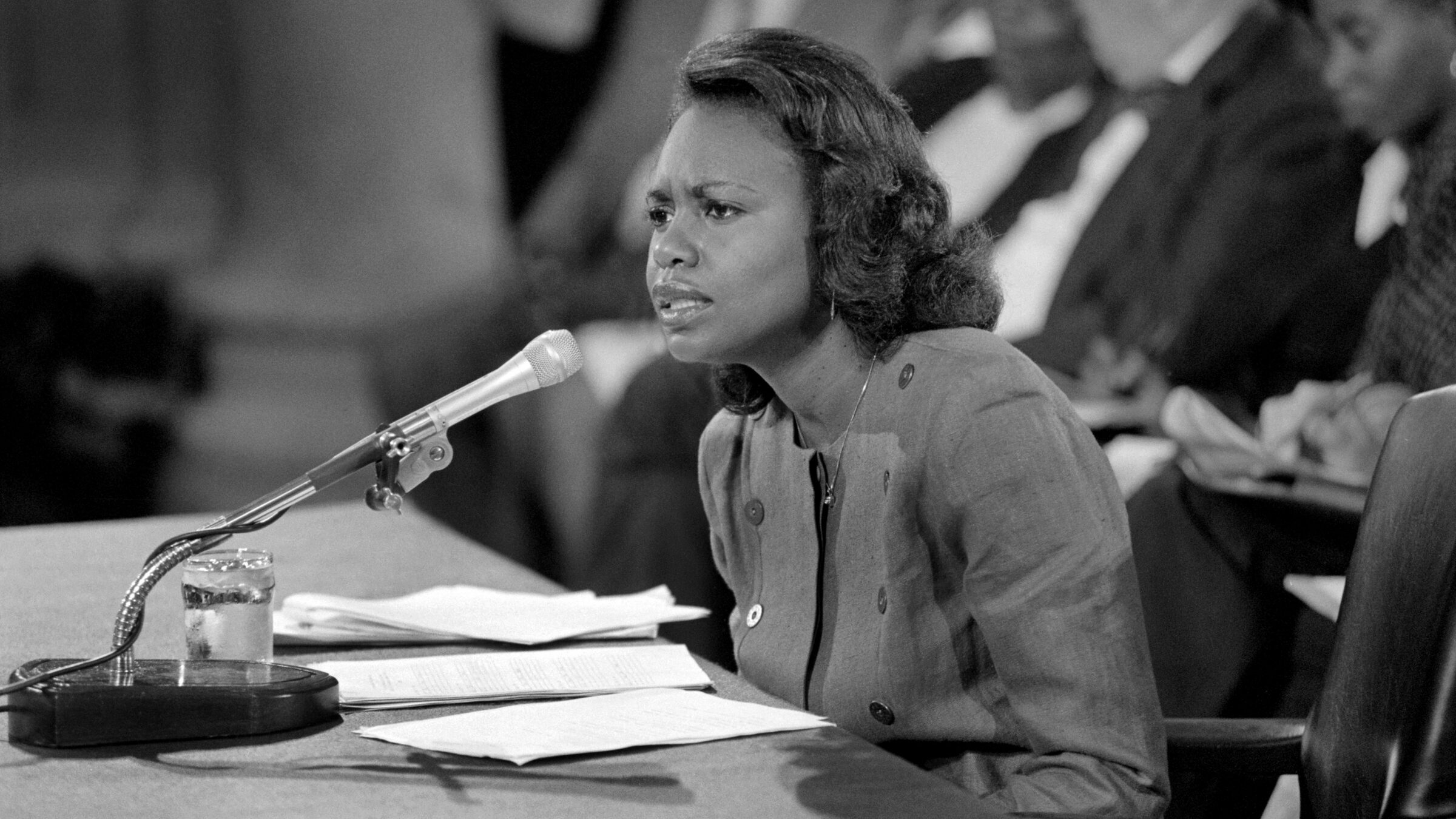
Hill testifying in 1991 (Photo by: Universal History Archive/Universal Images Group via Getty Images)
Other women had similar stories. Angela Wright, who also recounted that Thomas had repeatedly asked her out on dates and commented on her body. Sukari Hardnett, who said, “If you were young, black, female and reasonably attractive, you knew full well you were being inspected and auditioned as a female.” But then-Senator Joe Biden, the Democratic chair of the Senate Judiciary Committee, ironed out a deal in the face of Republican pressure to forestall further testimony from other women whose stories reflected similar experiences to Hill’s. Biden’s cowardice led directly to Thomas’ narrow confirmation to the Supreme Court. There, Thomas has consistently argued against federal laws and governmental policies that protect and promote civil rights, including a radical concurrence in Louisiana v. Callais in which Thomas argued against core protections of the Voting Right Act.
Crenshaw, who at the time had been at UCLA for about five years, recounts her experiences supporting Hill (whom she’d met a year earlier at a conference) with clarity and a keen eye for the consequences. As a founding critical race theorist, Crenshaw brings a skeptical eye to Thomas’s time in the Reagan administration, which she characterizes as promoting “his increasingly oppositional positions on civil rights,” including labeling his own sister as “an entitled welfare queen.”
But many Black leaders and organizations supported Thomas, out of a hope that as a Black man who had grown up in poverty he might later see the light and more fulsomely support civil rights—if the community would only magnanimously “embrace him,” in the words of Maya Angelou. As Crenshaw perceptively observed, “I had long considered myself a fierce defender of the ‘we,’ but now that notion of a ‘we’ that demanded solidarity in exchange for nothing seemed utterly pointless.”
Crenshaw rallied to Hill’s defense while presciently predicting what would unfold. She traveled to Washington, D.C. to support Hill as part of a larger legal team, which was faced with a double bind: If they did too little, Hill would never stand a chance against the Bush administration, Republican senators, and Black advocates who supported Thomas. But if Hill’s team worked to bolster her story alongside Democratic allies and civil rights groups who opposed Thomas, they would reinforce the narrative from Thomas’s supporters that his opponents recruited Hill to lie about what happened.

Republicans were still smarting from the defeat of Robert Bork’s nomination to the Supreme Court four years earlier. The Senate rejected Bork, a former Yale Law professor and, like Thomas, a judge on the D.C. Circuit, on a bipartisan basis after Democrats mobilized opposition to his extremely conservative views. His nomination’s failure incensed Republicans, likely leading to their willingness to go to the mat for Thomas, in order to not “cave” again to a perceived liberal smear campaign against their conservative nominee.
That strategic gamesmanship has continued through the failed nomination of Merrick Garland to replace Justice Antonin Scalia and the successful confirmation of Justice Brett Kavanaugh to the Supreme Court. Crenshaw reflects on how the narratives applied to Hill by conservatives—that she was “too aloof and uppity”—reify a practice that is “ill-informed and utterly irresponsible.” Focusing on Hill’s affect changed the focus from whether Thomas was qualified to serve on the Court to the character and claims of Hill herself. And while Crenshaw and other Hill supporters made calls, tried to persuade senators, and even got into arguments with cab drivers who supported Thomas, the attacks on Hill’s character subsumed any meaningful discussion of whether Thomas himself should serve on the Court.
That shift in focus has sadly continued both in the context of judicial temperament—recall the attacks on Dr. Christine Blasey Ford after she alleged that Kavanaugh sexually assaulted her during their high school years—and in society more generally. And if the rumors of an impending Supreme Court vacancy prove true, conservatives will go extremely far to ensure that Trump’s choice makes it onto the Court, just as they did with Thomas and Kavanaugh.
What Backtalker ultimately communicates is the necessity of continuing to resist the forces that desire a more racist, sexist, exploitative America. Even as Crenshaw’s experiences recur and rhyme throughout her life, she never demonstrates a weakening of her resolve. As she notes, being a backtalker is simply part of her life; she works “by talking back against agendas that [turn] on ignorance and forced compliance.” Backtalker teaches readers to try to be a little braver, and a little bolder, in advocating for change—not merely because the country has a long way to go in creating legal and democratic structures to protect all Americans, but because of the persistence of reactionary forces trying to turn back the clock.