For all the headlines the Supreme Court earns whenever it decides a landmark case—for example, last week, when the six conservative justices gutted what little remained of the Voting Rights Act—the Court’s decisions do not take effect instantly or automatically. Instead, under the rules of the Supreme Court, the clerk of the Court waits 32 days before sending a copy of the opinion and judgment to the lower court from which the case was appealed.
The purpose of this provision, which is known as Rule 45.3, gives losing parties time to ask the Court to reconsider its decisions. The justices rarely grant such requests, but given that the Supreme Court is the end of the road for litigants, Rule 45.3 safeguards the ability of losing parties to at least give it a shot.
For Republicans in Louisiana, though, those 32 days matter a lot. Shortly after the Court decided Louisiana v. Callais, lawmakers announced their intent to draw a new map that would all but guarantee Republicans a clean sweep of the state’s six-member House delegation. To that end, Governor Jeff Landry suspended the congressional primaries that were scheduled for May 16, even though some 42,000 Louisianans had already cast their absentee ballots. But even a rushed redistricting process takes time, and for as long as Callais remained within the Supreme Court’s jurisdiction, GOP lawmakers’ legal authority to gerrymander both Democrats and Black people out of electoral existence would remain uncertain at best.
Fortunately for Louisiana lawmakers, on Monday, the Supreme Court’s conservatives generously agreed to help them out. In an unsigned order, the Court directed the clerk to dispense with the customary 32-day period and to immediately return the case to Louisiana district court, allowing Landry and company to move forward at their preferred pace. Apparently, it was not enough for the conservative justices to consign the crown jewel of the Civil Rights Movement to the ashbin of history; they also wanted to ensure that their fellow Republicans would not have to wait one day longer to reap the benefits.

In a solo dissent, Justice Ketanji Brown Jackson criticized the Court for bending over backwards to “endorse” Republicans’ efforts to re-gerrymander the state in the middle of an ongoing election. She quoted Chief Justice John Roberts’s 2019 majority opinion in Rucho v. Common Cause, in which he warned of the putative dangers of any judicial interference in the messy process of redistricting. She also brought up the Purcell principle, which refers to a (very loosely enforced) rule that when deciding cases, federal courts—the Supreme Court and otherwise—should “ordinarily” strive not to “alter election rules on the eve of an election.”
In fact, Jackson noted, in December 2025, Justice Samuel Alito invoked Purcell while scolding a lower court that had invalidated as an unlawful racial gerrymander a map passed by Texas Republicans at the behest of President Donald Trump. Texas’s primary elections were scheduled for March 2026, which, Alito said, made it too late for the district court to intervene. By doing so anyway, he concluded in his opinion in Abbott v. League of United Latin American Citizens, the lower court had “improperly inserted itself into an active primary campaign, causing much confusion and upsetting the delicate federal-state balance in elections.”
Although Jackson did not spell it all the way out in her opinion, the implication is pretty clear: Then, Alito disapproved of judicial intervention when it would have harmed Republicans in Texas; now, he is greenlighting judicial intervention when it will harm Democrats in Louisiana. Then, Alito argued that under Purcell, a court should not interfere with a primary election scheduled to take place in three months; now, he is arguing that Purcell poses no obstacle to a court interfering with a primary election that is already in progress.
“The Court unshackles itself from both constraints today and dives into the fray,” Jackson concluded. “And just like that, those principles give way to power.”

Jackson’s dissent prompted Alito to write a concurring opinion that is more or less an angry blog post about how much Jackson had hurt his feelings. Joined by Justices Clarence Thomas and Neil Gorsuch, Alito gestures briefly at the fact that the 32-day waiting period is a “default” rule that the Court can set aside when circumstances warrant. But his real goal is to air out his grievances with Jackson, whose opinion, he says, “levels charges that cannot go unanswered.” At various points, Alito refers to the thrust of her dissent—the simple observation that the Republican justices are selectively applying rules and precedents in ways that help Republican politicians win elections—as lacking “restraint,” and as “groundless,” “utterly irresponsible,” and “baseless and insulting.”
It is of course not new for Supreme Court justices to get snippy with each other in dueling opinions. But what is notable about Alito’s rejoinder to Jackson—especially given his stated purpose of writing separately so as not to let her “charges” go “unanswered”—is how bereft it is of anything that even has the cadence of legal analysis. Perhaps the most telling passage comes in the second-to-last paragraph, when Alito asks, rhetorically, what “principle” Jackson believes the Court to have violated. Then, he offers two sarcastic possibilities: the “principle” that the Court should never shorten the 32-day period, and the “principle” that the Court “should never take any action that might unjustifiably be criticized as partisan.”
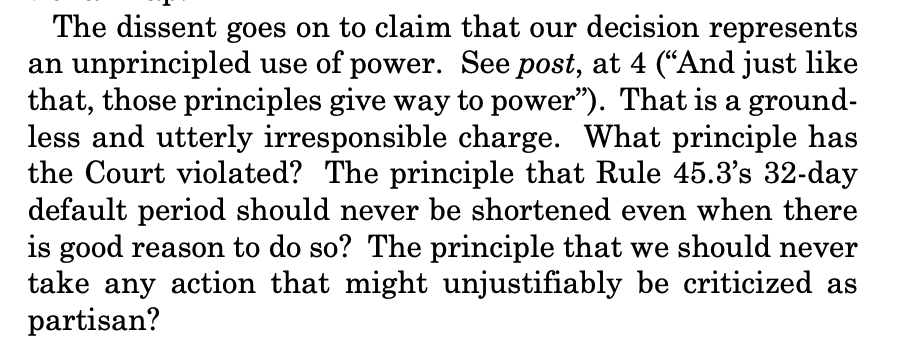
This is a weird question for him to frame as a gotcha, because, again, there is a real answer: In her opinion, Jackson details how the Court’s choice in this case conflicts with its choices in Rucho, Purcell, and Abbott. But Alito does not respond to Jackson’s point about Rucho, or assert that she is wrong about Purcell, or explain how his actions in Abbott and Callais can be reconciled. In fact, his opinion does not mention Purcell at all; he simply asserts that by having the temerity to disagree with him in public, Jackson is being very rude to him.
Over the past five years, the members of this six-justice conservative supermajority have been able to celebrate the sorts of policy victories that their predecessors could only dream about. But Alito and company remain vexed by the fact that they have yet to persuade the public, which increasingly views the Court as a partisan institution, that the Court’s decisions are the output of an apolitical legal process. Here, Alito’s response to Jackson reflects his frustration with his waning legitimacy, as well as the fact that the price of getting to implement his reactionary policy preferences is occasionally getting called out as a reactionary hack. To borrow an old saw from the legal profession, neither the facts nor the law are on his side. All he can do is pound the table and yell about it.