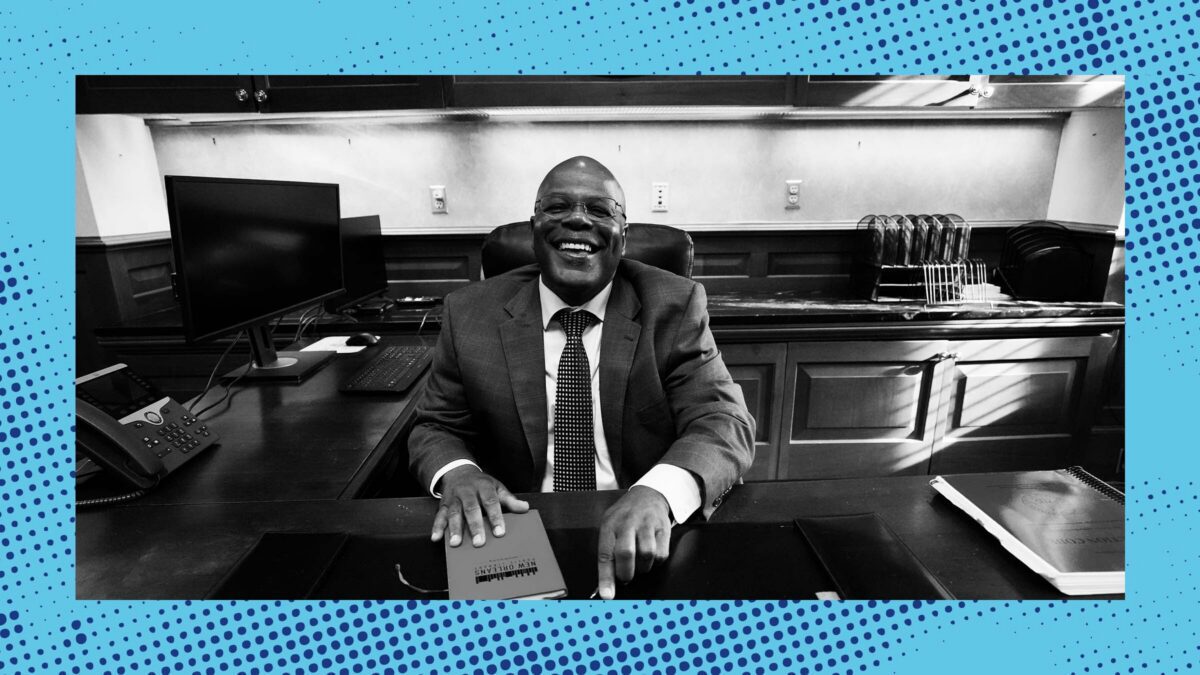
On Monday, May 4, Calvin Duncan officially began his term as Clerk of the Orleans Parish Criminal District Court. And for a fleeting moment, he told supporters that evening, he believed he would finally “live out a dream that’s been in the making for 40 years.” In 1985, an Orleans Parish jury sentenced him to life in prison for a murder he did not commit. As a result, he spent more than 25 years at the Louisiana State Penitentiary, a maximum security prison farm better known by its pre-Civil War name, Angola, where Black men like Duncan are still forced to harvest cotton, overseen by white men on horseback with guns.
Behind bars, Duncan taught himself law and became a sought-after expert, helping hundreds of incarcerated people and criminal defense attorneys challenge unlawful convictions and prison conditions. In the process, he learned that court clerks can act as gatekeepers for records containing evidence of innocence. But the Orleans Criminal Court Clerk’s Office repeatedly denied Duncan access to files that undermined his own conviction. In 2011, when Duncan was finally able to confront the government with those files, local prosecutors offered him a deal he now describes as a “Hobson’s Choice”: He could keep fighting to prove his innocence and remain in prison, or plead guilty to lesser offenses and be released from prison immediately on time served. He chose release.
Outside of prison, Duncan continued advocating for people ensnared by the criminal legal system. He was the driving force behind Ramos v. Louisiana, the Supreme Court’s 2020 ruling striking down a state law permitting non-unanimous jury convictions as an unconstitutional remnant of Jim Crow. A few months later, he enrolled in law school. And in 2021, Duncan was formally exonerated, pursuant to a new Louisiana law that allowed people to challenge their convictions if evidence of their factual innocence was never presented at trial. Finally, in 2025, Duncan ran for the clerk position that had stonewalled him years earlier, and pledged reforms to ensure that the injustice he experienced “never happens to anybody else.”
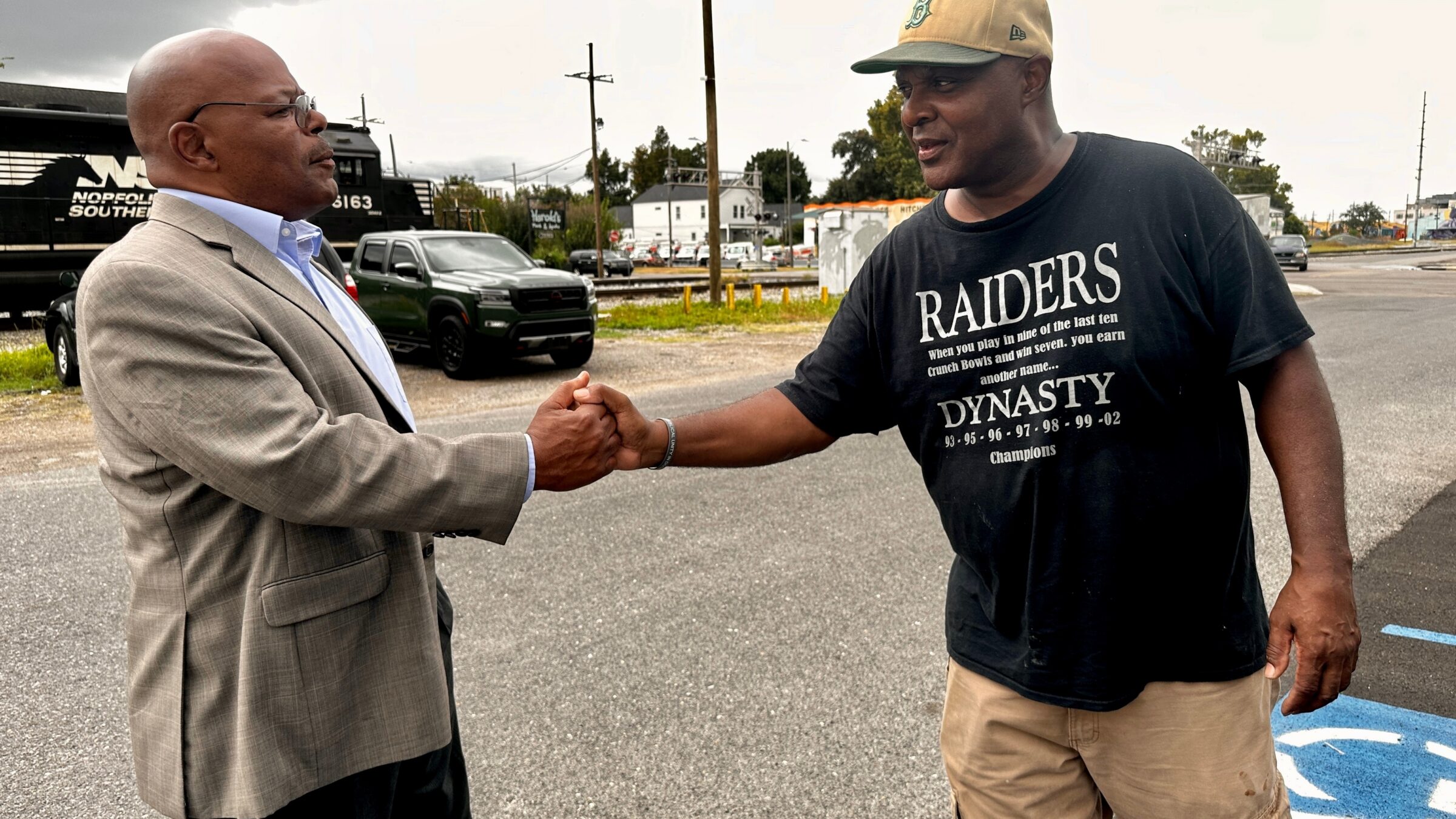
Duncan on the campaign trail, September 2025 (AP Photo/Stephen Smith)
Duncan won in a landslide, securing 68 percent of the vote. But days before he began his four-year term, Louisiana Republicans enacted a law abolishing his position and replacing it with a single clerk for the parish’s civil and criminal courts. The law says this combined clerk position is an elected office, but it also says the role will be filled on May 4 by the sitting clerk of the civil court. The current civil clerk, Chelsey Richard Napoleon, was elected in 2018 and has not appeared on a ballot since. Subsequent civil clerk elections were canceled after no one ran against her.
The basic fact pattern here—government actors preventing a duly-elected Black man from assuming office—has a long, ignominious history in Louisiana. In November 1868, newly enfranchised Black people in New Orleans delivered John Willis Menard 64 percent of the vote in Louisiana’s 2nd congressional district, making him the first Black man elected to the House of Representatives. But a few months later, white members of Congress refused to seat him: Ohio Congressman James Garfield, who would go on to be elected President of the United States, contended that “it was too early to admit a Negro to the U.S. Congress,” and argued that Menard’s seat should be “declared vacant” in order to save his $5,000 salary.
In 2026, Louisiana Governor Jeffrey Landry and state Senator Jay Morris are making the same arguments. Landry told reporters last week that the law abolishing Duncan’s position is “about recognizing that the city is out of balance,” and “cleaning up a system in Orleans Parish that has been plagued by dysfunction and corruption for years.” For Landry, it seems, it is too early for the majority-Black parish to govern itself. Morris, who has recently authored several bills targeting courts in New Orleans at Landry’s urging, has also offered up some financial motivations, arguing that it made little sense to “pay [Duncan] for four years in a job that’s going to be eliminated.”
Duncan, who has promised to “do whatever I have to do to vindicate the voters of New Orleans,” filed an emergency motion in federal court on Wednesday, April 29, challenging the new law as unconstitutional. And although Louisiana Republicans’ conduct harms the whole public, Duncan’s complaint also reveals how the new law was shaped by personal vendettas and bitterness. Landry and Attorney General Liz Murrill were the lawyers running the state attorney general’s office in 2020, when Duncan successfully fought against Louisiana’s nonunanimous jury law. And they’ve been bullying Duncan ever since. In 2023, for instance, Duncan filed a petition seeking $330,000 compensation for his wrongful imprisonment. Landry and Murrill threatened to charge him with perjury if he didn’t drop the claim. Afraid that he would lose his newly-acquired law license, he ended his lawsuit.
And in September 2025, in the leadup to the election, Murrill sent Duncan a letter demanding that he “cease representing to the public that you were ‘exonerated’ to avoid further action from this office.” Duncan’s opponent began similarly denying Duncan’s innocence, calling him a murderer and filing for his own temporary restraining order to prevent Duncan from referring to himself as exonerated. Lombard’s campaign withdrew the filing the following week.
In the complaint, Duncan said there is “no doubt” in his mind that the Louisiana government is retaliating against him for speaking out about racial injustice in the criminal legal system, and because he plans to defend his constituents from further abuses.
On Sunday, May 3, Duncan won a temporary restraining order that blocked the law from taking effect, allowing him to assume office on Monday morning. And the opinion, by federal district judge John W. deGravelles, called the disenfranchisement of Black New Orleans voters “fundamentally unfair and constitutionally impermissible.” But Louisiana Republicans filed their own emergency petition to the Fifth Circuit Court of Appeals, and by mid-morning on Monday, the Fifth Circuit granted an administrative stay, which temporarily lifts the lower court’s order and allows Louisiana to implement the law dissolving Duncan’s position. “I got a chance to be a clerk for like three hours,” Duncan said.
Louisiana’s fight against Calvin Duncan is part of a larger, longstanding war on the political power of the state’s Black residents, who just watched the U.S. Supreme Court take a wrecking ball to their right to vote last week. New Orleans is 54 percent Black, but Black people are 80 percent of those subject to arrest. At the same time, Orleans Parish has the highest exoneration rate per capita, among U.S. counties with populations of at least 300,000.
Duncan knows the impact of these statistics firsthand. That is why Black Louisianans voted him into office. And that is why Louisiana Republicans desperately want to abolish the office—a move that is not only offensive to Duncan and his constituents, but to the concept of multiracial democracy itself.